.jpg) |
| The Custer Fight Charles Marion Russell (PD) |

On July 5, 1876 the newspapers were filled with praises of the many patriotic events of the celebrations across the country on our 100th Fourth of July. But things suddenly turned into chaos, embarrassment, anger and sorrow.
On the evening of July 5, 1876 the New York Herald published an “Extra” with the first news received in the east about the June 25th Battle of the Little Big Horn” when “General” Custer and (reportedly) 314 other men of his 7th U.S. Cavalry were killed. The following morning all the newspapers across the country were printing stories about the massacre.¹
 |
| New York Times lede on July 6, 1876. (No copy of the July 5th New York Herald found.) Source |

This humiliating defeat by savages living on the desolate plains shook the nation’s confidence, especially since it had happened 10 days earlier. The U.S. Army at the time was a mere 25,000 men, down from the peak in 1865 of over a million men, and now thinly spread to cover coastal fortifications and the dozens of small frontier garrisons across the west. Additional troops were still tied down on Reconstruction duty in the southern states, stifling often crooked politicians vying for power. The destruction of Custer’s command was devastating.

Why the news of the defeat was delayed
While much of the nation had great communications via telegraph, and the transcontinental railroad now crossed the west, vast regions more than a few miles from major rail lines with their parallel telegraphs, remained primitive frontier territory, often days from any news. The telephone was patented earlier in 1876 but not yet in use anywhere. Radios would not be invented until two decades later.
The nearest telegraph to the shattered 7th Cavalry on the Little Big Horn was in Bismarck, about 450 miles as the present highways go, but in 1876 was about 700 miles by river.
 |
| Steamer Far West which carried the news, and wounded from the Big Horn to Bismarck, Dakota Territory. Source |

The paddle wheel steamer “Far West” was providing logistics support to the Army for the campaign. It was able to navigate many of the rivers being 190 feet long (about 3 ½ semi trailers) with a 33 foot beam and only drawing 30 inches of water when fully loaded, and 21 inches empty. [Source.]
By June 29th and 30th Far West was located at the mouth of the Little Big Horn River, some 15 miles from the battle site. There, 52 wounded were taken and placed aboard, and the river boat headed downstream to Bismarck and Fort Abraham Lincoln, with dispatches reporting the disaster.
The Captain was also given notebooks retrieved from the body or George Kellogg, a newspaper reporter “embedded” with the 7th Cavalry, to be delivered to Kellogg’s employer, the publisher of the Bismarck Herald.
The Far West reached Bismarck on July 5th and Kellogg’s notebooks and news of the battle reached Clement Lounsberry the publisher. Kellogg and Lounsberry were part of the Associated Press and the New York Herald could preempt a telegraph line for their use. Recognizing a major story, Lounsberry had the local telegraph office give him control of the line as soon as the Army’s report was sent. He then began dictating stories about the Custer defeat nearly continuously for 22 hours, interspersed with Bible verses for brief periods while composing additional material. Thus the New York Herald was able to “scoop” all the other eastern papers and break the news with an “extra” late on July 5th, although Lounsberry sent so much material that it was spread out over several following days.
Source: Much of the above comes from this source.

What appears in newspapers is not necessarily “history” but proof that “first reports are usually wrong.” The actual count for U.S. casualties at Little Big Horn was NOT 315 dead and 31 wounded, but a total of 268 including 16 officers, 242 enlisted men (including 5 wounded who later died of the wounds), 3 attached civilians, and 7 Indian scouts. Custer’s fighting lasted at most only a little over an hour before they were wiped out. Reno’s and Benteen’s elements of the 7th Cavalry which had attacked from other directions were located and pinned down for more than a day and finally relieved late on the 26th.

Historians have used all sorts of archival records as well as archaeological evidence to analyze the battle. One especially well done study was done by Dr. Douglas Scott, summarized in his excellent 44 minute presentation here:
He describes one item which especially evokes the personal tragedy of such events: “…the single most poignant artifact I have ever seen come out of the ground. That is an inexpensive brass, silver plated wedding ring, still around the finger of one of the soldiers.”
 |
Wedding ring of a 7th Cavalryman. Source: Screen cap at 31:00 of presentation above. |
The full 194 page book is available free for download at this source:
Historians have confirmed that much of the reporting of the deaths at the battle and post-mortem abuse of the dead soldiers was true. However, in the context of the cultures involved at the time it was not uncommon, or practiced exclusively by the “savages.” But, the losers in this battle made sure it was emphasized. Little was said about the Army’s tactics of attacking villages inhabited by warriors, women, children and the elderly, or killing off the buffalo herds which were their source of food. Those were different times, and atrocities were committed white on white, or red on red or any combination.
 |
| Source |
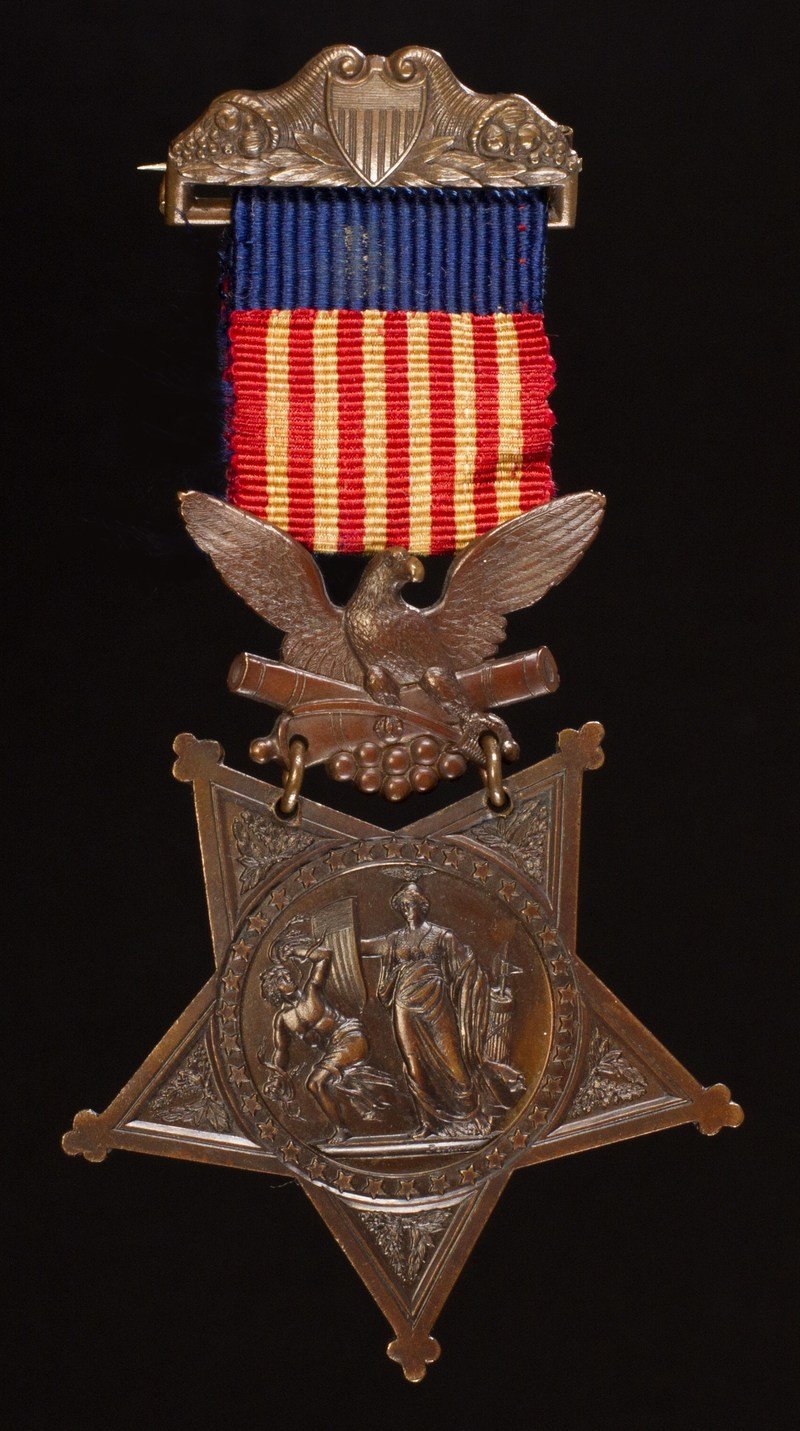
Medals of Honor, even in defeat
Posthumous awards of the MOH were not authorized at that time so none of the 268 dead 7th Cavalrymen were considered for awards, and there were no lesser awards (Silver Star, Bronze Star, etc.) at that time. Twenty four MOH were awarded for the Little Big Horn, mainly to men from Benteen’s or Renos’ commands who braved Indian fire to bring water from the river.
One MOH recipient was killed at Little Big Horn, Captain Thomas W. Custer (brother of General George A. Custer). He had received TWO Medals of Honor for separate acts during the Civil War, one of only 14 men [or 19 if you count the five guys who got both an Army and Navy MOH for the same action] to ever receive the MOH twice. (Marines Smedley Butler and Dan Daly are two others).
Three other Custer family members were also killed on June 25th. Boston Custer, the youngest brother, working as a forage master; 1st Lieutenant James Calhoun, a brother in law married to the only Custer sister; and Autie Reed, a nephew accompanying the expedition as a civilian.
To be continued ...
¹ George A. Custer was actually a Lieutenant Colonel in 1876, but had been a Brevet Major General of Volunteers at the end of the Civil War, so the honorific title of General was used thereafter. It was not uncommon for a post Civil War regiment to have several officers who had been Brevet Colonels or Generals, now serving as a Captain, Major, Lt. Col. or Colonel.
Interesting to read how the news of the battle trickled out. And there's more reading at the link, thanks JB and Sarge.
ReplyDeleteJB,
ReplyDeleteVERY interesting post. I did not know many of those details, including the losses in the Custer family. When I was very young ( no we did not live in caves back then), my Dad was stationed at a BMEWS ( Ballistic Missile Early Warning Site) near Little Big Horn. I have a vague memory of him taking us to the battlefield. Even as young as I was and as long ago as that was, I have memories of battlefield. Mostly graves and very sobering. Thanks for adding details. Well done!
juvat
To echo Nylon12, the history of how the news got out is very interesting (and new to me as well). Thanks JB!
ReplyDeleteThe battlefield today is really worth a visit if you are out that way. Being there and seeing it quite helps understand the descriptions.
The concluding installment will have several videos of the battlefield so we can all appreciate the terrain- and the victors.
DeleteJust getting there underscores the vast distances involved in the frontier Indian wars, and the logistical challenges. That 405 mile trip from LBH to Bismarck takes abut 5 hours now (highways have about 80 mph speed limits out there), but by steamboat under normal conditions it would take about 3-4 days downstream, or maybe 4-5 days fighting the current going upstream.
The LBH Visitor Center has been torn down and a new one is under construction, which is expected to be much improved.
JB
JB, a new visitors center would be a great reason to go back.
DeleteI visited the battlefield once, bad vibes.
ReplyDeleteHe left the Gatling guns back at the fort. He did not them holding him back with extra gear.
ReplyDeleteThanks for this commentary. It sobers us up after a heady week-end of celebration. Back to the blood and tears - it's a good a good thing.
ReplyDeleteFuzz D4
Custer did make grave error in violating fundamental rules of warfare - unity of command (Reno and Benteen have been split off , and have been for the most part out of communication with Custer) and concentration of force (same decision, when facing potentially overwhelming numbers of enemy).
ReplyDeleteNo wonder he came last in his West Point class...
Note that same dividing tactics doomed British at Isandhlawana.
Also, Natives have been better armed than most people realize, it is assumed that up to 30 percent of Coalition warriors were armed with various modern repeater rifles traded or captured from Whites. Those were superior in fire rate to US standard issue one-shot Springfields.
ReplyDeleteExcellent insights from our friend in Poland. Thanks!
ReplyDeleteJB
(Don McCollor) A perspective from the Far West's viewpoint is given in "The Conquest of the Missouri" by Joseph Mills Hanson (A biography of Captain Marsh, 1916, first published 1906 - available on Archive.org). That run down the treacherous Missouri to Bismarck with wounded soldiers and Comanche aboard was epic. They averaged 13 1/2 knots steaming by night as well as day. No navigational aids and no lights. Only the pilots' skill, memory, and their ability to "read" the river.
ReplyDelete