OK, I've been thinking about things in my USAF career that brought thought to my brain. (Easy folks, my feelings could be easily hurt with comments about that.) In any case, one of my first assignments was to F-4 training at Luke AFB, AZ. I had a lot on my mind at the time having just graduated from pilot training and now about to start learning how to fly a real Fighter! I was very excited and somewhat nervous. But...I got through, scared my IP's a couple of times, but I got through.
But, one of the things that I didn't think about at the time was "Why was Luke AFB named that way?" Well, I will rectify that right now. Hang on to your hats.
 |
| Source |
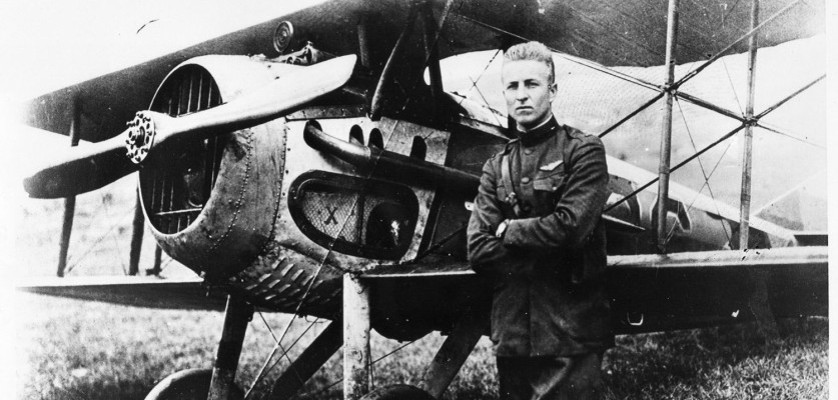
The above picture is of Lt Frank Luke one of, if not "the", first aces in the USAF History Books. There is some confusion of when victories by Luke and Rickenbacher occurred. Hence "First" is in doubt.
My wikipedia source stated "Because of his arrogance and occasional tendencies to fly alone and disobey orders, Luke was disliked by some of his peers and superiors. But the 27th was under standing orders to destroy German observation balloons. Because of this, Luke, along with his close friend Lieutenant Joseph Frank Wehner, continually volunteered to attack these important targets although they were heavily defended by anti-aircraft guns on the ground. The two pilots began a string of victories together, with Luke attacking the balloons and Wehner flying protective cover. Wehner was killed in action on September 18, 1918, by Georg von Hantelmann in a dogfight with Fokker D.VIIs, which were attacking Luke. Luke then shot down two of these D.VIIs, two balloons, and a Halberstadt; the last "credit" enabled Luke to achieve his 13th official kill—a Halberstadt C-type observation plane of Flieger Abteilung 36."
 |
Luke with his 13th Kill |
Between September 12 and 29, Luke was credited with shooting down 14 German balloons and four airplanes. Luke achieved these 18 victories during just 10 sorties in eight days, a feat unsurpassed by any pilot in World War I. To be honest, Captain Rickenbacker had 26 victories but it took him longer and he survived the war.
Luke didn't. One might think shooting down a stationary balloon might be easy. Not so fast there! The balloons were anchored to the ground and surrounded by a lot, and I do mean an Awful Lot, of AAA as well as German fighters to protect them. So, not as easy to do as it might seem.
 |
| Source |
And....Unfortunately, luck didn't hold true for Luke. He was shot down and surrounded by German Soldiers who ordered him to surrender. He pulled out his pistol and...That was That.
Rest in Peace, Hero!
Citation for the Award of the Medal of Honor to Frank Luke
After having previously destroyed a number of enemy aircraft within 17 days he voluntarily started on a patrol after German observation balloons. Though pursued by 8 German planes which were protecting the enemy balloon line, he unhesitatingly attacked and shot down in flames 3 German balloons, being himself under heavy fire from ground batteries and the hostile planes. Severely wounded, he descended to within 50 meters of the ground and flying at this low altitude near the town of Murvaux opened fire upon enemy troops, killing 6 and wounding as many more. Forced to make a landing and surrounded on all sides by the enemy, who called upon him to surrender, he drew his automatic pistol and defended himself gallantly until he fell dead from a wound in the chest.
Never give up, Never surrender!
Luke AFB was named for him and was the primary fighter training base at the time. His story was a fine example for a budding fighter pilot.
Rest in Peace, Warrior!
Sources
https://en.wikipedia.org/wiki/Frank_Luke
https://www.nationalmuseum.af.mil/Visit/Museum-Exhibits/Fact-Sheets/Display/Article/196836/lt-frank-luke-jr/
https://www.aerotechnews.com/lukeafb/2022/03/22/remembering-luke-afbs-namesake-2nd-lt-frank-luke-jr/
Reading Wiki that Luke participated in bare-knuckle boxing was foretelling his aggressive nature in the air perhaps juvat. That drive and determination to come to grips with the enemy was pretty overriding in Luke.
ReplyDeleteNylon,
DeleteAgreed regardless of the costs. More's the pity.
juvat
There was a SPAD that had a 37mm gun firing through the propeller, the SXII. I see what appears to be a hole in the center of the propeller. Did Luke fly an SXII?
ReplyDeleteAccording to the font of all knowledge (AKA wikipedia) it was indeed a Spad X!!!.
DeleteWell Done, StB!
juvat
I can see where a 37mm shell would be hard on a balloon.
DeleteSurrounded by enemy soldiers. Ordered to surrender. Decides to attack anyway. After being shot down.
ReplyDeleteJust thanks, Juvat. Good to remember such men existed.
THBB,
DeleteThe very meaning of "Never Give Up, Never Surrender". Don't know if I could've done it if presented with the situation. Vietnam or Japan (WWII) maybe as they probably wouldn't have hesitated to kill shot down aircrews and frequently didn't. Fortunately, I never had to answer that question. Thank you, Lord!
juvat
From my youthful model making days, I thought that was a SPAD in the photo, which the source link confirmed.
ReplyDeleteInteresting that the SPAD was a mechanical marvel in its day, but sort of puny by today's standards. The 210 HP engine (in the later models) gave about 131-135 MPH top speed with flight duration of about 2 to 2.5 hours. Takeoff speed was about 65 MPH. (Juvat would not even think about urging his Eagle off the ground until at least 130 mph, but preferably more...)
In WW2, the mission of nearly every fighter in American service was to haul some Browning .50 caliber machine guns to a fight and then use them to clear the air of bad guys, and maybe irritate some guys on the ground on the way home. For the SPAD, they started with the clunky .303 VIckers guns, but switched to the Browning designed .30-06 Marlins, which were basically his original M1895 "Potato digger" with a slightly revised gas system.
8,472 SPADs were built during WW1, and orders for 10,000 more were canceled with the Armistice. That's a LOT of airplanes!!
But, the aeroplanes only win battles and wars when guys like Luke kick the tires, hop in and lift off.
John Blackshoe
JB,
DeleteA very well said synopsis. Thank you. BTW that was a LOT of Spads and 10 grand more would have been unbelievable. Thanks for the numbers.
juvat
The balloonists were also armed. And the cables attached to the balloons were hooked to powered winches and could be reeled in rather quickly. One of the tactics of the balloonists and their groundcrews was to do 'dangle' the balloon and pull it down when enemy aircraft came around, sucking the attacking planes into the AAA envelop.
ReplyDeleteBetween all that and trying to strike a target that's basically 'still' while in a moving plane, balloon busting was a dangerous and difficult business.
Especially since balloons are somewhat very resilient to bullets. To effectively kill a balloon, you had to either punch a lot of holes, a lot of lot of lot of holes, in the balloon or get the balloonists in the basket.
Beans,
DeleteI'm gonna mildly disagree with one of your points. It is quite easy to shoot and hit a stationary target from an airplane. It's even fairly easy to hit a moving target in the air. Did it quite a few times in the F-4 and F-15 against the towed target called a dart. Now, I also agree that the bad guys had a lot of tricks up their sleeves and a lot of AAA on the ground to distract your aim. I think I'd have gone for the guys in the basket. One pass and haul, well you know what.
juvat
(Don McCollor) Keep in mind that the balloons were filled with hydrogen and the allied planes were probably firing tracer bullets.
DeleteYou had to punch enough holes in the balloon to allow air in to reach the magic mixture that allows the hydrogen to burn. Magic ratios with early generation tracers or incendiary.
Delete