I wrote this and a few other postings while I was on the airliner to and fro to London for our cruise. So this is a week or so old. Sorry.
This Medal of Honor series has been an enjoyable research episode. I've learned quite a bit about the Medal of Honor's history. (Yes, Beans, I still have a few more USAF Recipients to report upon.) Just thought I'd do some background. So...
 |
| SOURCE |
This is what I thought capturing the flag involved. I wasn't wrong and the flag for both sides was generally the communication and organization method used by the commanding general to control their troops in battle up to and including the Civil War. After the Civil War, military units started stopping carrying the colors and were replaced with the invention of the radio.
However, up to that point, in American battles, capturing the enemy's flag or protecting yours was a common reason to award the Medal of Honor. In the Civil War, There were 1523 Medal of Honor Recipients, many, if not most, were capturing or protecting the flag.
 |
| Source |
JACOB PARRISH
Jacob Parrish was the First Recipient of the Medal of Honor. His Award reads First US MOH Recipient.
:
One of the 19 of 22 men (including 2 civilians) who, by direction of Gen. Mitchell (or Buell) penetrated nearly 200 miles south into enemy territory and captured a railroad train at Big Shanty, Ga., in an attempt to destroy the bridges and tracks between Chattanooga and Atlanta.
That didn't happen very often and still doesn't.
First MOH Recipient
Jacob Parrish was the First Recipient of the Medal of Honor. His Citation reads:
"One of the 19 of 22 men (including 2 civilians) who, by direction of Gen. Mitchell (or Buell) penetrated nearly 200 miles south into enemy territory and captured a railroad train at Big Shanty, Ga., in an attempt to destroy the bridges and tracks between Chattanooga and Atlanta."
 |
| SOURCE |
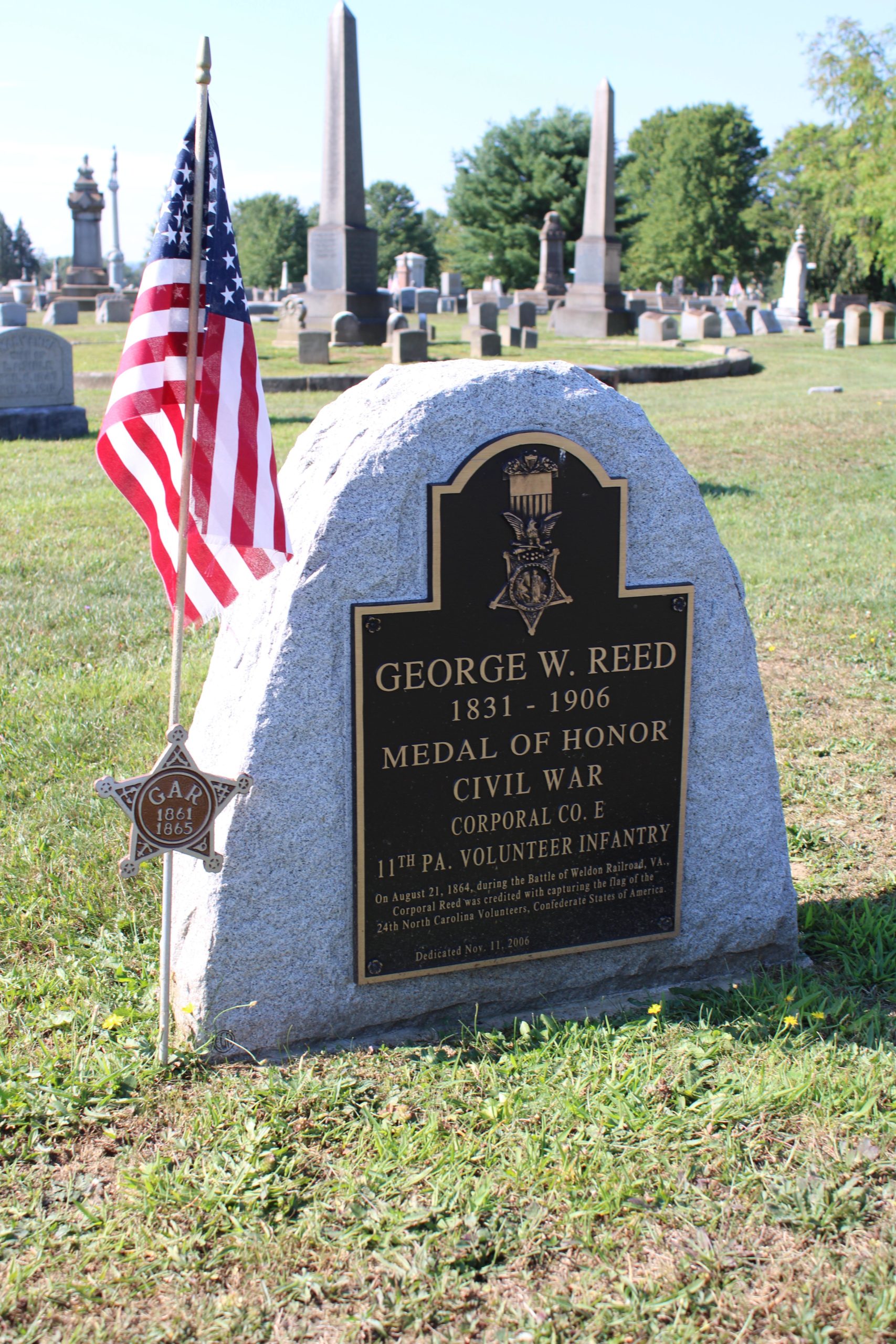
The picture above links to a story of the Medal of Honor to George W. Reed, the hero mentioned in the picture above. A very interesting story and the Honoree survived the event and the Civil War, passing in 1906.
OK, Juvat why was capturing the enemy's flag such a big deal? A good question that finding the answer was rewarding.
Good question, I didn't know, but a little internet research......
"Capturing an enemy’s battle flag during the Civil War was considered one of the most dangerous and significant acts of valor because the flag was the regiment’s most important battlefield reference point.
Military importance of the flag
In the pre‑radio era, regimental colors were carried by a color bearer and guarded by a small “color guard.” They served as the primary visual guide for troop movements in the smoke and chaos of battle, directing soldiers forward or back, and often acting as rallying points Congressional Medal of Honor Society+1. Losing the flag meant confusion, disarray, and the risk of friendly fire. Both Union and Confederate soldiers knew that killing or capturing the color bearer was a major tactical blow Congressional Medal of Honor Society.
High risk of capture
Because of their strategic value, enemy flags were heavily defended. Penetrating the color guard’s defenses and returning with the flag required bravery in the face of heavy fire. Many attempts failed, and those who succeeded often did so at great personal cost theedgeofmemory.com.
Symbolic and morale impact
Capturing a flag was not just a tactical win — it was a morale boost for the capturing side and a blow to the enemy’s cohesion. It could demoralize troops, disrupt command, and signal to the enemy that their unit was vulnerable National Cemetery Administration. In some cases, like Thomas Custer’s double-flag capture, the act honored two enemy regiments at once National Cemetery Administration.
Examples of Medal of Honor captures
Several Medal of Honor recipients were honored for flag captures, including:
- Corporal George W. Reed (1864) capturing the 24th North Carolina Infantry’s flag during the Weldon Railroad campaign Congressional Medal of Honor Society.
- Corporal Harrison Collins (1864) killing a Confederate major and routing his men to secure a flag theedgeofmemory.com.
- Major William B. Hincks (1863) capturing a Confederate 14th Tennessee Infantry flag during Pickett’s Charge at Gettysburg www.war.gov.
- Captain Thomas Custer (1865) capturing two Confederate flags at Namozine Church and Sailor’s Creek National Cemetery Administration.
In summary: Capturing the flag earned a Medal of Honor because it was a rare, high‑risk feat that disrupted enemy command, boosted friendly morale, and demonstrated exceptional courage under fire — all of which aligned with the criteria for the nation’s highest military honor"
A lot, if not most, of the Civil War Recipients received the Medal because of this action. Who am I to judge?
Taken verbatim from here Bing.Com (The link is embedded.)
I found this whole subject very interesting and time consuming, but...when you're on two flights totaling 34 hours of your time going to and fro, what else do you have to do!
Enjoy!
Trying to destroy railroad tracks/bridges, captured, beaten and exchanged, 1st Lt. Parrish's citation is sparse juvat.The First Minnesota took a Confederate flag at Gettysburg IIRC and officials here haven't given it up yet.
ReplyDeleteNylon,
DeleteWell, since there is no Confederate States of America, who would they give it up to? It's a museum piece, why SHOULD they gie it up. The Stars and Stripes is the Nation's flag.
juvat
Flags were returned to the States. At the time of the War of 1861 most people, north or south, more closely identified with their State than with the nation. Pennsylvanians, Ohioans, Virginians, Texans.
DeleteThe usual phrasing when referring to the nation was "The United States ARE..." not "The United States IS..."
Grover Cleveland signed an executive order that captured battle flags be returned to the States as a gesture if reconciliation. Not met well by anyone. Northern states said "We took 'em fair and square!" Southern states saw it as condescending.
Joe,
DeleteInteresting. But still it's the Flag of the United States with 50 State flags.
juvat
That war was about States Rights. The Union won and the States lost.
DeleteRob,
DeleteAgreed
juvat
After action reports frequently included things like, "Captured 9 flags, 36 cannon, and 243 stands of muskets" (numbers grabbed out of thin air) showing the importance placed on flags and artillery.
ReplyDeleteJoe,
DeleteYeah, I can see that. No real good communication systems back then. Commands would almost have to be visual in nature as I suspect it gets pretty loud on the battlefield. (Still does). Artillery also had a big role. Still does. Just to add a bit of modernization, Close Air Support and Battlefield Interdiction sorties have assumed a large role also. Just sayin' ;-)
juvat
The capture of symbols -be they flags, standards, or aquilae -has a very long and established history. Rome, for example, went to great lengths to recover lost aquilae ("eagles") of the legions.
ReplyDeleteI can see that! Recovery means you've ivercome the enemy in the end, also known as winning.
Deletejuvat
About 30 years ago my father found out that his great uncle (my great-great uncle) was a recipient of the MoH during the Civil War. His grandfather after whom I am named never passed that on to his daughter, my grandmother. My great-great uncle was Michael A. Dillon. He was a member of the 2nd New Hampshire Volunteers as was his older brother and my great grandfather. Here is the citation:
ReplyDeleteBravery in repulsing the enemy’s charge on a battery, at Williamsburg, Va. At Oak Grove, Va., crawled outside the lines and brought in important information.
BillB, Very interesting. Have you done any research on the story? That's a pretty concise description of the reason(s) for the Medal. But repulsing the enemy and crawling outside the lines to reconnoiter the enemy's position are pretty important and dangerous missions. So, well deserved, IMHO.
Deletejuvat
I think they've tightened up the requirements for the MOH since that time, with a bit more danger and daring necessary. We've also added a few more awards since that time. - Tuna
ReplyDeleteTuna,
DeleteBoth true and the right things to have done.
juvat
I fully agree
DeleteMe too!
DeleteJuvat- Thank you for the diligent work on this series. Very informative and inspiring.
ReplyDeleteJohn Blackshoe
JB,
DeleteI've actually enjoyed it. Some of these men I knew about, but a lot of them I'd never heard of. Which is a bit of a shame. All of them performed "above and beyond the call of duty". I'm just glad I know them better. I think I've got about 10 left to write about. Don't know what I'll do next.
juvat
(Don McCollor) No MOHs awarded for the service as far as I know, but a small group of the 8th Wisconsin had the rare elite duty of serving as the "Eagle Bearer". The regiment had a live bald eagle "Old Abe" as a mascot. The soldier's duty was to care for him and to carry Old Abe into battle on a pole topped with a perch. Old Abe participated in more than 30 battles.
ReplyDeleteWow, I had no idea! Something to look into, thanks
Deletejuvat