Ok, folks another Medal of Honor Hero to discuss. Today's story is about Tech Sergeant Forrest L. Vosler. Sgt Vosler was a radio operator and gunner on B-17s.

Staff Sergeant Vosler deployed to the European theater in October of 1943. Remember that Air Superiority was not attained by the Allies until mid-1944. So, missions over Germany were dangerous and very costly in casualties. On Dec 20th 1944, his crew and he took off on a mission to attack Bremen Germany with a target time of noon.
One thing the Germans had at the time to counter the airstrikes, was AAA (anti-aircraft artillery for those not in the know). They had a lot of that, an awful, awful lot of that. In fact most of the Allied air losses were due to AAA. But on this mission, the AAA was augmented by 125 German Fighters.
27 Bombers were lost (10 crewmembers per plane) and the bomber Sergeant Vosler was aboard was shot up and ditched in the English Channel. Obviously given that this was December, the water was extremely cold. The tailgunner had been severely injured by the German Fighters. Sgt Vosler made his way to the back of the aircraft and pulled him out of it. The crew was getting the life raft out and set up. Sgt Vosler was injured and could not see out of one eye. He noticed that the tail gunner was sliding off the wing into the channel. Sgt Vosler grabbed him and pulled him back onto the wing and held on to him and an aircraft antenna so as to not slide back in the sea.
He was awarded the Medal of Honor for going beyond his duty to save members of his crew. Because of his injuries which caused blindness in the one eye and poor eyesight in the other, he was medically discharged from the Army Air Force.
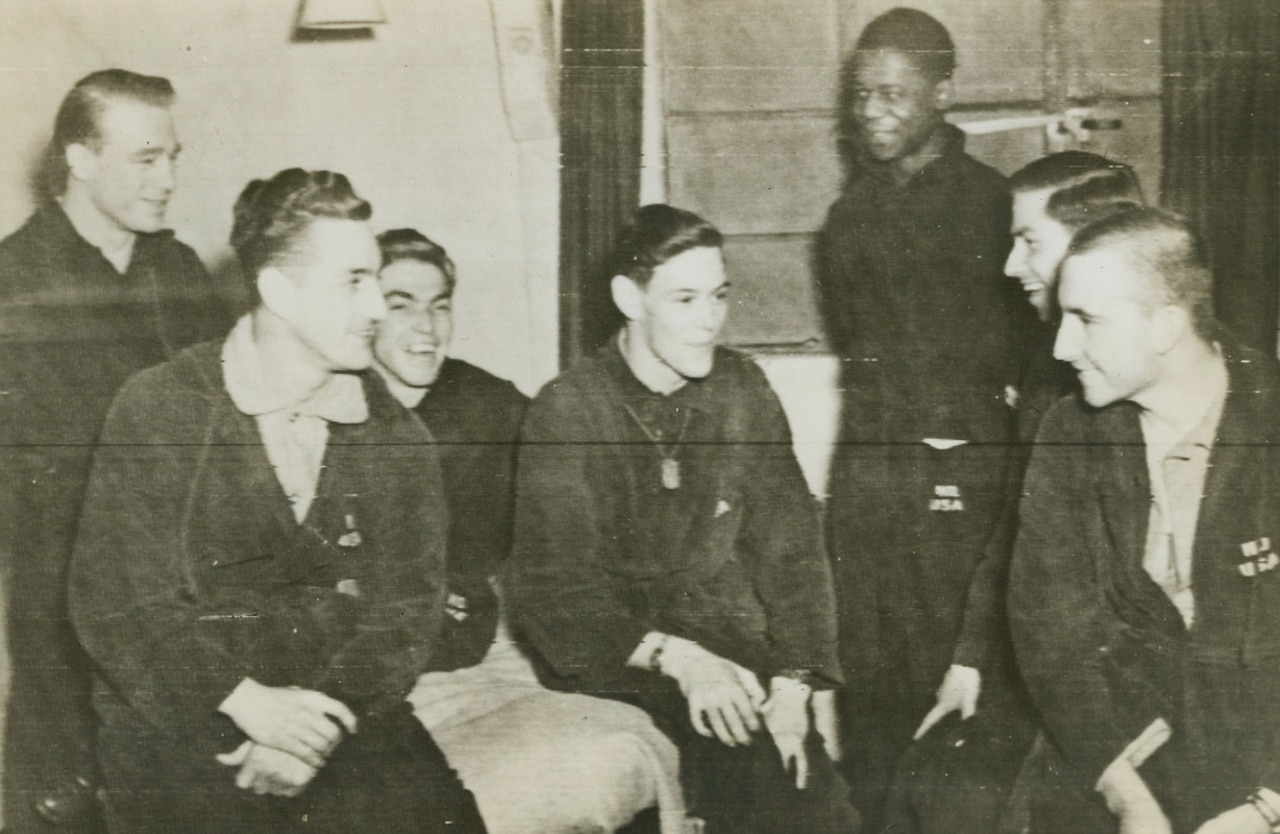
On September 6, 1944, President Roosevelt presented him with the Medal of Honor.
 |
| Source |
He died of heart attack on February 17, 1992 at Titusville, Florida, at the age of 68. He is buried at Arlington National Cemetery.
Medal of Honor Citation
For conspicuous gallantry in action against the enemy above and beyond the call of duty while serving as a radio operator-air gunner on a heavy bombardment aircraft in a mission over Bremen, Germany, on 20 December 1943. After bombing the target, the aircraft in which T/Sgt. Vosler was serving was severely damaged by antiaircraft fire, forced out of formation, and immediately subjected to repeated vicious attacks by enemy fighters. Early in the engagement a 20-mm. cannon shell exploded in the radio compartment, painfully wounding T/Sgt. Vosler in the legs and thighs. At about the same time a direct hit on the tail of the ship seriously wounded the tail gunner and rendered the tail guns inoperative. Realizing the great need for firepower in protecting the vulnerable tail of the ship, T/Sgt. Vosler, with grim determination, kept up a steady stream of deadly fire. Shortly thereafter another 20-mm. enemy shell exploded, wounding T/Sgt. Vosler in the chest and about the face. Pieces of metal lodged in both eyes, impairing his vision to such an extent that he could only distinguish blurred shapes. Displaying remarkable tenacity and courage, he kept firing his guns and declined to take first-aid treatment. The radio equipment had been rendered inoperative during the battle, and when the pilot announced that he would have to ditch, although unable to see and working entirely by touch, T/Sgt. Vosler finally got the set operating and sent out distress signals despite several lapses into unconsciousness. When the ship ditched, T/Sgt. Vosler managed to get out on the wing by himself and hold the wounded tail gunner from slipping off until the other crewmembers could help them into the dinghy. T/Sgt. Vosler's actions on this occasion were an inspiration to all serving with him. The extraordinary courage, coolness, and skill he displayed in the face of great odds, when handicapped by injuries that would have incapacitated the average crewmember, were outstanding.
Sources
https://en.wikipedia.org/wiki/Forrest_L._Vosler
https://www.war.gov/News/Feature-Stories/story/Article/2874805/medal-of-honor-monday-army-tech-sgt-forrest-l-vosler/
https://www.thisdayinaviation.com/20-december-1943/
Geeez....the word tenacious comes to mind reading this MOH citation, wounded twice by 20mm cannon fire and passing out more than once, vision gone, what guts juvat.
ReplyDeleteNylon,
DeleteAnd SURVIVED! Gotta be tough to make it through also.
juvat
What i find interesting about so many people who have received the MoH is how they look like absolute Walter Mitty milquetoasts. Until you really look at the eyes.
ReplyDeleteJoe, yep just regular guys, until they were presented with a problem, then they clanked as they went and solved it even if they knew the likely cost.
Deletejuvat
Thanks Gor this, Juvat! One I hadn't known previously.
ReplyDeleteBoat Guy
Nor I. Still got quite a few names I’m not familiar with, which I am slowly rectifying.
Deletejuvat
This leapt out at me: "Pieces of metal lodged in both eyes, impairing his vision to such an extent that he could only distinguish blurred shapes. Displaying remarkable tenacity and courage, he kept firing his guns and declined to take first-aid treatment. The radio equipment had been rendered inoperative during the battle, and when the pilot announced that he would have to ditch, although unable to see and working entirely by touch, T/Sgt. Vosler finally got the set operating and sent out distress signals despite several lapses into unconsciousness. "
ReplyDeleteAnd that was all before he got out on the plane.
This is a worthy endeavor, Juvat.
THBB, thanks
Delete,
juvat
That right there is a fellow who has no quit in him. Well done!
ReplyDeleteYeah, there certainly were a lot of opportunities to just “get it over with”. Titanium testicals.
Deletejuvat