Thursday, July 31, 2025

Lighthouse Cruise

The reason for the trip, one of the Narragansett Bay lighthouses.
OAFS Photo
With family in town from both California and Maryland, you may have noticed that I haven't posted since Sunday last. Been busy I have.

Had an unexpected trip down to Maryland last week as Tuttle was traveling and The Nuke had a series of muy importante meetings which could, conceivably, run later than would allow her time to drive back from DC to pick up the lads at their summer camp/day care. (Roberto was doing the camp thing, Finnegan does the day care thing). As Grandma had certain commitments in Little Rhody which she couldn't get out of, that left it up to me.

So Your Humble Scribe pulled pitch last Sunday and drove down to the Old Line State. (In all fairness, I do need to confess that The Nuke flew up Saturday in order to travel with me, in case I needed to be spelled at the wheel. Nice of her, innit? And no, I drove the whole way.)

Of course what goes up (south in this case, down to me) must go down again (north in this case, up to me) so on Sunday last, the entire Maryland clan piled into two vehicles and headed to Little Rhody. Where the temperature has been that of the sun's surface for the past cuppla. (Worth noting - The Nuke and her daughters flew in from California on Sunday morning.)

Activities were planned, one of which was the famous lighthouse cruise out of Quonset Point. We'd done it before and rather liked it. So we did it again. Though it was scorching hot outside, the wind over the bow (and the air conditioned cabin) made things pleasant.

The grandkids loved it. Roberto says he wants to join the Navy when he grows up, just like Mom and Dad, the trip out on Narragansett Bay seemed to cement that desire.

And a good time was had by all.

Some of my crew enjoying the wind and the sun.
OAFS Photo
From my station on the bow, it was out of the sun and I made myself useful opening the door (to my right) for those who had trouble with it (with a 30 knot wind coming over the bow at times, the door did not want to open easily!)
OAFS Photo

One of the beautiful places which line the shores in these parts.
OAFS Photo


Finnegan approves, cousin Belle seems less than impressed
OAFS Photo

Roberto Approves
OAFS Photo
Roberto says, "'Tis a sailor's life for me!"

If I had to do it over again? I'd tend to agree with my grandson.

Summer rocks in Little Rhody
OAFS Photo


Wednesday, July 30, 2025

John Blackshoe Sends: Serendipity History – Elephants? A book report and some brief history...

Big, beautiful beasts, they are. But, I knew almost nothing about them, even though my earliest childhood memory is when a circus came to town, via rail car, and an elephant waved his trunk at ME! I think I waved back, and then hid.

Source
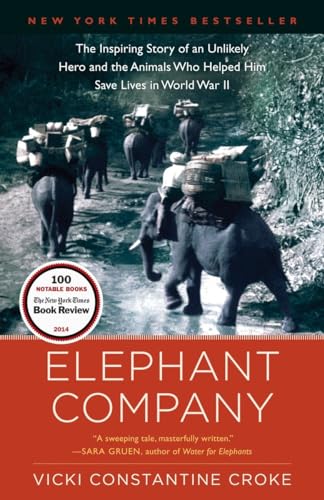
We picked up the audio book version of Elephant Company by Vicki Constantine Croke for a recent trip. It turned out to be really interesting and full of unexpected tidbits.

It is a mixture of the intertwined stories of a magnificent elephant, Bandoola, and how he was raised, used (sometimes abused), and served first in the teak logging industry in Burma, and then in the British SOE during WW2. He is really the main character of the book.

Bandoola was inextricably linked with one James Howard Williams (eventually known as “Elephant Bill”), an iconoclast Brit of some privilege who served in the Middle East during WW1 with the Camel Corps and mules, where he read a book on “The Diseases of the Camel and the Elephant,” which I hope none of us will ever see or read. However, post WW1 he aspired to learn more about elephants, and signed on with the Bombay and Burma Teak Company as a “Forest Assistant.” A job, usually the only Englishman within many miles, responsible for getting teak trees cut and then hauled to the closest river where the logs would be flushed downstream by monsoon rains for processing and shipment to the UK for ship building. Of course, this involved being properly attired, accoutered and provided with suitable tentage, gin, etc as befits the dignity of an English gentleman in a colonial outpost, supervising hordes of locals and the dozens of elephants needed to do the heavy lifting. The company held them responsible for the care, feeding and training of the very expensive investments in 2,000 pachyderms in ten camps. To get to work, he took a steamer to Rangoon, partied a few days in civilization, then took a small steamer (one step above “African Queen” size) a couple of days up the Irrawaddy river to the base of the mountains where the camps were.

To understand “Elephant Bill” Williams, or Bandoola, the author injects a steady stream of information about elephants, their extreme intelligence, social habits, even a bit on mating habits. They are the largest land mammals, with the male Asian elephants running about nine feet high weighing about four tons. They are very social, with a matriarchal leadership. A lot of coverage is given to training elephants, both the traditional “beat them until they obey” approach, and a kinder, gentler rewards and praise approach William learned from the old guy who trained Bandoola. This lead to the Company setting up “elephant school” to train calves on proper behavior and work skills, which seemed to be very effective.

All of this is in the confusing cultural context of the time and place where the Burmese were near revolt against their colonial masters, but dependent on them for trade and maintaining order. Throw in a healthy dose of ethnic or clan differences between Burmese, Indian, Thai, British and eventually Japanese players, and just a bit of failure to communicate keeps it unpredictable.


With the outbreak of WW2, and Japanese overrunning vast areas of Asia, they eventually got to Burma, coming up the rivers, ending the teak trade. British and Indian forces operated in Burma to link with the Chinese to fight the Japs, and building roads was a top priority. “Elephant Bill” volunteered his services and his 1,600 elephants becoming a Lieutenant Colonel. First as part of the Indian Army as mere transport animals, then as part of the General Slim’s 14th Army as a Special Operations Executive unit for bridge building.

As the Japs pushed further inland, unprepared Brits and loyal Burmese and Ghurka families fled further into the interior, suffering horrible losses. Eventually they were in extremely rough terrain, and just barely escaped after using the elephants to help carve out a dangerous trail to get over the last geographic obstacles to reach the Indian border.


This book left a profound appreciation for the elephant species, and their ability to work with man. Also, immense appreciation of Bandoola and Elephant Bill, who were both about the same age. Plus a better understanding of the geography of Burma, and the cultures of its people, and the history of WW2 in that remote corner of the war.

If you like hard copy books, this is available on AbeBooks.com and other places for under $10.00. Since driving prevents me from reading for many hours at a time, I really enjoy audio books. Audio versions may be free at your library or available from digital sources to download to your phone or some such tech wizardry.


This made me dig a little deeper and discover that Elephants have been important military assets for many centuries. Not in our European military annals, but certainly in Asian and some African regions. Their sheer size, and invulnerability to primitive cut and thrust weapons made them nearly invincible on the battlefield. Their bulk and ability to follow commands made them resistant to cavalry attacks, and deadly against Infantry, along with handy at hauling all the stuff an army needed. 

Source
Remember, Hannibal had elephants with him in 218 BC when he crossed the Alps, although more at the start than at the end, elephant chow is scarce in snowy mountains. There are lots more examples if you dig into “War Elephants.”


One British publisher, Helion, (sort of a more scholarly version of Osprey) has a whole book on War Elephants, or at least the period from 1380 to 1700. The publisher’s note shows there is much one can learn on the subject, if interested.

“Elephants and Gunpowder presents for the first time a chronological, detailed and richly illustrated account of the development of warfare in mainland Southeast Asia during the Early Modern Period. It begins by describing the region’s medieval military inheritance that was dominated by the use of war elephants. Firearms began to appear during the late fourteenth century and would be used alongside elephants and cavalry in a long series of wars between Burma (Myanmar) and Siam (Thailand). Exciting sieges and dramatic naval combat are also discussed along with much fascinating material about beliefs in omens and divination and the impact of foreign mercenaries. While cannons fire around them elephants act as mounts for noble hand-to-hand combat, as living battering rams to use against city gates and, in the form of the precious and much coveted white elephant, as both an excuse and a pretext for war itself. The text is complemented by a large number of carefully selected photographs, maps and specially commissioned artwork that present the arms and armaments of the Southeast Asian warrior and his elephants in a way never seen before.”

Source
Elephants are also used for sporting purposes, such as hunting tigers in India. Westley Richards, made “Howdah pistols,” massive double barrel affairs carried as a last resort if the tiger begins to attack the wicker Howdah basket in which the hunter is carried on their elephant. The Illustrated London News of April 1, 1876 had a lengthy illustrated article on HM The Prince of Wales (an old respected one, not the domesticated Ginger spare) including this image:

So, there is a lot to learn about elephants.


Tuesday, July 29, 2025

John Blackshoe Sends: Serendipity History – Welcome Home to those who were Soldiers Once… And Young

Source
“Some had families waiting, for others their only family would be the men they bled beside, there were no bands, flags no honor guards to welcome them home, they went to war because their country ordered them to, but in the end they fought not for country or their flag, they fought for each other.
 
We who have seen war will never stop seeing it, in the silence of the night we will always hear the screams. So this is our story... For we were soldiers once and young.”
Source: Lt. Gen. Harold G. Moore and Joseph L. Galloway, We Were Soldiers Once...and Young: Ia Drang - The Battle That Changed the War in Vietnam


We’ve enjoyed Sarge’s well spun yarn about bold lads who rallied to the colors of whatever nation or principality appealed to them in 1815, and suffered the hardships, glory, boredom and dangers of adventuresome military life. 

The Napoleonic wars ended in 1815 and Europe returned to its customary low intensity conflicts over now forgotten trivia. The brave veterans returned home to family or friends with or without celebrations by entire nations. 

Life went on, and the vast majority shed the uniform and the security of shillings, franks, marks or rubles earned by a soldier. They resumed former occupations or trades, mostly unskilled, to eke out subsistence, inevitably advancing from youthfulness to middle aged, to elderly, then decrepit, and eventually dust unto dust.

British veteran Henry Maidment (ca. 1795-1868) and wife circa 1866 about 50 years after his military service. (Colorized)
(More on them below, based on same source as photo.¹)
Source
We are talking of thousands, hundreds of thousands or millions of soldiers who survived serving their nation, and returned home.

But, what of them after they returned home? Some probably were welcomed by loving families, or discovered family members had perished from disease or accidents. Some might have returned to discover an unfaithful spouse had decamped with Jody’s ancestor, leaving them alone, for better or worse. 

Returning to civilian life was not always a return to normalcy, for once they had “seen the elephant” many were changed for life, physically maimed, debilitated by disease, or cursed by mental health issues common to those who have seen what should never be seen. But, they did the best they could, finding work of some sort, shelter somewhere and perhaps solace with family or friends, or in a bottle.

The shabbily dressed pensioner above is Napoleonic War veteran Henry Maidment (ca. 1795-1868). He proudly wears his Military General Service Medal on his lapel. He fought in the Battles of Talavera, Salamanca, Vittoria, Pyrenees, Nivelle and Toulouse. For this, he earned the Military General Service Medal with clasps. His battalion had even accompanied Napoleon Bonaparte into exile on the island of St Helena in 1815. Each of his major battles was represented by a clasp on the ribbon. Such a medal was valued in 2006 to be worth £3,700 to collectors, but back then it would not buy him a pint at the pub.

Henry was an agricultural labourer who lived in the North Dorset village of Pimperne. 

In 1866, Henry was one of the few surviving British Army veterans who had fought Napoleon Bonaparte’s French Army in the Spanish Peninsular War.

At this stage in life, he could not work and had hit hard times. He was surviving on a parish handout of just two shillings and sixpence (12.5p) per week and a single loaf of bread. The octogenarian pauper had, in reality, a distinguished military record but no military pension. 

Details of Henry Maidment’s medal. 
With a commanding stare like that I bet he was a Sergeant.
Henry died a couple of years after the photo was taken, and buried on 26 March 1868 in the graveyard of St. Peter’s Church, Pimperne. He had lived in an era when an agricultural labourer rarely left his home village. However, as a soldier he experienced Ireland, Portugal, Spain and France and would have visited cities such as Cork, Porto, Toulouse and Bordeaux. (Source)


Veterans of our own Civil War (1861-1865) aged as well. Half a century after the horrific bloodshed at Gettysburg, veterans from both sides returned to Gettysburg to commemorate that event, and mourn their lost comrades. Handshakes between former enemies were exchanged, with wounds of that lost cause slowly healing and our nation reuniting. Sadly, 110 years later haters would engage in a Stalinesque eradication of memorials to half those Americans in that war. History includes the whole truth, not just propaganda beloved by a few in power.

Union and Confederate veterans shaking hands at reunion to commemorate the 50th anniversary of the battle of Gettysburg. (PD)
On 29 March 1975 the last American combat troops left Vietnam. Thus ending that game of dominoes which lasted nearly 20 years, and starting a string of second place finishes driven by “higher” despite the heroic efforts of those who actually fought. Vietnam era vets are rapidly rejoining their former comrades in arms on Fiddlers Green or Valhalla, or wherever their theological beliefs might take them.

Unidentified Vietnam Vet from the VA website (cropped)
Source
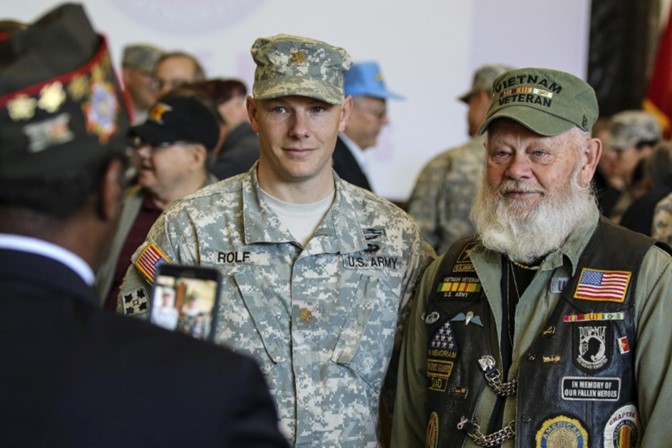
Some New England Vietnam vets: Vietnam War veterans (from l to r) Howie Thomas, Paul Anderson, Kevin Sullivan and Bill Benson pose together in from of West Haven City Hall in front of the Vietnam Veterans Day banner in West Haven, Conn., on Tuesday April 22, 2025. Christian Abraham/Hearst Connecticut Media
Source 

St. Landry Parish, LA, veterans listen to presentations during 2023 commemoration event at the parish Veteran’s Memorial.
Vets have a special bond, and have experiences others may not understand. They can share among themselves the good times and bad, and perhaps forget some of the bad.

Thank you to all veterans!


¹ This image is available from several sources, but this is colorized and really brings out the fact we are talking about real people. Various sources lack, or have conflicting, biographical information on Maidment. A quick check of genealogical sources confirm the gist of this account of his life.

Monday, July 28, 2025

Monday Update


Well, Campers, it's that day of the week. So maybe a little Jimmy to get us started.

 Monday! You know....The one you dread because you're still in the "work=pay" grind.  Now, according to Sarge, that's no longer the problem for he and I. So he says.

But, there is a little bit of a hiccup there, see...I'm married and no longer working (for pay).  Back in the day, if there was something that she thought needed to be done, I could say, I'll take care of it over the weekend.  

That worked occasionally, not often, but...sometimes.

Now, however, no excuse.  

In all seriousness, retirement has been pretty nice.  I do get a lot of things done around the place.  I get to spend quite a bit of time in my workshop.  My Chef skills are also improving. 

And, I am down about 10 LBs (Mrs J says she thinks it's more.  I like her way of thinking!).  So...I got that going for me.

As to this weeks posting.  My last post talked about the flood just south of our property.  At that time, the count was 125 dead and more than a hundred missing.    The rescue effort got a lot of help from volunteers from pretty much all over the country.  The team we put up in our guest house came from Michigan, Florida, Illinois and Louisiana.  Virtually everybody involved in the effort came by private vehicle, with cadaver dogs and/or their own equipment.  No pay, no expenses.

Those are Heroes in my book.


Their Search Dogs have Business Cards! 😆😆😆


The cadaver dogs had a very hard job, wading around in the horribly poluted water with raw sewage. logs and yes, bodies all around.  I've got a lot of respect for their owners also.  Not an easy job and hard on the nerves.  Quite a few little girls lost their lives among the others.  Finding them had to have a lose/lose impact on the searchers and their dogs. As to the bodies, may they all rest in peace in the Lord's arms. 

In any case, the searching is significantly reduced but still going on. Many of the searchers are back at their homes. The "final" count is 135 dead.  The number of missing has dropped significantly from more than 100 to 3.  So a bit of "not quite as bad" news. 

Thank You, Lord!  

I'll switch topics to a bit of, hopefully, good news this week.  We got a call from our real estate agent asking if he could bring someone by the next day to look at the house.

Well, Duh!

So, the next several hours were spent mowing, vacuuming, scrubbing, putting extraneous "stuff" in the attic, mucking the horse barn, et cetera, et cetera, et cetera.

Well, turns out the folks interested live in Colorado, are about our age and also retired.  Their retired interest is caring for orphaned kids.  So, they were looking for a fairly large property.  They had engaged a real estate agent in town to look for that and do a film walk through of it.

Yes, Beans, ~20" rain will turn the grass green even in a Texas Summer!


Our property has 10 bedrooms total in the 4 dwellings.  All the bedrooms can handle at least 2 kids each (one can handle 8 comfortably). So, should meet the buyer hopeful's needs.

So we've got the house inspection by their real estate agent ready in the nick of time, we loaded up the 4 dogs and 1 cat into two cars and drove to the Sonic Drive In in town until given the all clear.  Yes, Beans, the look on the attendant's face when she brought up the burgers  and Atticus was sitting in the driver's seat made my day!

In any case, the Colorado folks told their agent they were very interested in the property and are making plans to fly over here and take a look in person in the next couple of weeks.

The Catholic upbringing in me caused me to leave no prayer unturned (to mix metaphors). 

Yes, the statue is buried in our back yard.  We'll be bringing it with us when we sell.

We'll see what we will see!  Fingers Crossed!

Peace out, y'all! 

Sunday, July 27, 2025

Aftermath ...

Source
With some difficulty Christian was carried back to Mont St. Jean farm which was overwhelmed with wounded. The surgeons were very busy, but due to Christian being an officer, one of them had a quick look.

"You're a lucky man, Major. A glancing brush, no more."

"I don't understand." Christian was in a great deal of pain.

"You had a brush with a round shot, might have a couple of broken ribs, but you'll live. You're also going to have a massive bruise by morning. Had that shot been another inch over, you'd have been smashed to a pulp, Sir. Now," he looked at the men who had brought him there, "if these lads can bind you up, I've got real wounded to take care of."

"Look here ..." one of the men objected.

"He's not going to die, nasty scratch on your belly I see. Bayonet?" The surgeon was taking an academic interest in Christian's wounds, he also needed the break from sawing off limbs and probing for projectiles.

"I believe so."

"Just clean it out, bind it with clean linen. As to the ribs, they'll heal. Some recommend just leaving them be, others say binding them up is just the thing. I'd go with binding, reminds you that you're banged up, don't you know. Now, I must be off."

The surgeon bustled off and Christian looked at the men. "I'll guess I'll be alright. But if you lads don't mind, can you find someplace else for me to rest. This place is a charnel house."

One of the men took off abruptly, as Christian started to protest, another of the men said, "Hans is just off to find something to patch you up, Herr Major. He'll be back."

And he was, within minutes. One of the men cleaned up the bayonet wound with water from his canteen, apologizing for that, noting that it was the cleanest water within reach at the moment. They bound the wound with linen, then wrapped Christian's chest with cloth.

"Where'd you get this cloth?"

"Dead fellow outside, he warn't usin' it, Sir."

"Ah, very well."


Kurt was giving serious thought to killing himself, the pain in his groin was nearly overwhelming. His leg was a black mess and smelled horribly. Gangrene, Kurt thought, I've seen it kill others.

"Why wait, why wait to be overwhelmed by pain?" Kurt groaned aloud as he muttered those words. He reached for the pistol he kept with his cloak.

Someone had stolen it.

"No ..."


"We should wait for dawn, Ma'am." Thomas protested, but Elsbeth was adamant about proceeding immediately.

"Sunrise might well be too late. We should ..."

At that moment the door slammed open, "Help me with this stuff, won't ye Tom?"

It was William.

"Where in hell have you been, lad?"

"Got stuck on the high road, bloody German cavalry stole most of what was in the wagon, then they took the spare horse and the mules. Bastards, I'm lucky to have not been cut down myself. But some English dragoons come along, most of 'em wounded, and chased the Germans away."

Elsbeth sniffed, "I'm German, you do know that, right William?"

"As am I, milady, but this lot weren't Hanoverians, sounded like damned Rhinelanders."

"What news of the battle, William?" Thomas was hoping the distraction would keep Elsbeth preoccupied and not think about heading south.

"Boney's off, his whole army came apart at the seams. Old Blücher hit him at Plancenoit, nearly in Boney's rear. Old Nosey¹ held Boney by the nose, while the Prussians kicked his arse!"

Elsbeth sighed, "Well, at least that's done. Surely it's safe to head south now?"

William scoffed, "Are ye daft, lass? The Allies are holding here and the Prussians are pursuing Boney. They're a rough lot. They'll be sabering and bayoneting Frenchmen from here to Paris. You do not want to be on that road on this night. As sure as anything, you won't see tomorrow. But I reckon we can head on down to Mont St. Jean, the Duke's lads have the area secured."

"What's at Mont St. Jean?" Elsbeth snapped. She was almost ready to give up. She was tired, she had no idea of the fate of her husband, and she had been awake for nearly two days. Her patience was exhausted.

"Hospital, ma'am. Your husband might be there. It's not far from the battlefield."

"My husband was wounded at Quatre Bras, why would he be at Mont St. Jean?"

Thomas nodded, "Good point, ma'am. But it's closer to Quatre Bras, innit?"


They arrived at Mont St. Jean early on the 19th. Traffic on the Brussels chaussée had settled down, the wounded who could be moved had already been sent on. Those that remained were in various stages of dying. Southbound traffic now consisted of people visiting the battlefield.

"F**king ghouls. Pardon my French, Madam." Thomas had muttered, seeing the silk-stocking clad dandies with perfumed handkerchiefs clasped to their nose and mouth. For indeed, the smell was awful, even some distance from the field.

"Hey Tom, lookee there, ain't that the Major's son?"

Thomas looked in the direction William was pointing. There, outside of a small roadside tavern, sat Wolfgang von Kaltenweide on his horse. Thomas, knowing the lad, started calling his name and waving his arms.

Lieutenant von Kaltenweide looked over and thought he recognized his father's man, Thomas. Wasn't that also one-armed William with him? He walked his horse through the carriages proceeding south.

"Thomas! William! Have you seen my father?"

Thomas answered, "Not since before the battle, young Sir."

"Ah ha! Then you're in luck, he is within that very tavern."

It was only then that he noticed Elsbeth. He was suspicious of her friendship with his father, probably due to how devoted he was to his mother. He scarcely nodded at her before turning his attention back to Thomas and William.

"Father is pretty banged up, Frenchie bayonet scored his belly and a round shot broke some ribs. He's sore but should heal nicely, given time. Mother is with him now."

"Frau von Kaltenweide is here?"

"Yes, she came over on the 14th, she's been in Ostend the entire time. The provost would not let any of the civilians there travel to Brussels. Until yesterday when the outcome of the battle became known. Mother and I rode all night to get here."

Elsbeth interrupted, "I heard you were on the Prince of Orange's staff, is that true?"

Wolfgang paused, he seemed annoyed at Elsbeth's interrupting him.

"Yes Madam, as is your husband I believe."

"Yes, yes, has there been any word of him?"

"Yes Madam, he lies wounded at Quatre Bras, unless the French took him along on their flight to their homeland. I doubt they paused long enough to worry about that. Now, if you will excuse me, I must report to the Duke,"

Wolfgang rode off, nodding at the men but completely ignoring the woman.


Christian had been pleasantly surprised when his wife had arrived. She had fussed over him, let him know that he was "an old fool" but had seen to his needs. She had even managed to feed him, something that hadn't happened since the night of the 17th.

William had come by to inform him that his son had let them know where he was and that all was well, though unfortunately he had lost all the horses, mules, and the wagon and its contents.

"You are alive, that is all that matters. Where is Thomas?"

William looked around, Carolijn von Kaltenweide was in another room but he still leaned in close to whisper to the Major.

"He's escorting Frau von Weiding to Quatre Bras. They say her husband lies wounded there."

"It's all right William, I know all about Elsbeth and my husband's silly infatuation with her." Frau von Kaltenweide chided William as she came into the room.

Carolijn smiled as she said, "You really are an old fool, Christian, my love."

"Yes, I suppose I am. I really am old enough to know better."

"Yet you persist in thinking you're 18 years old."

He smiled at his wife before turning to William, "You must stop them, William. Major von Weiding is dead, we received word this morning."

"Dead? She will be distraught."

Carolijn looked at William, "Bring them both here. I suppose we shall have to help her now. I mean it's the Christian thing to do, isn't it?"

Christian knew her comment had been phrased exactly like that both to reprimand him and to remind him of their duty to a fellow Hanoverian. After all, Major von Weiding hadn't been a bad sort, even if his wife was a bit too friendly with Carolijn's husband. He was also of the King's German Legion, they needed to watch out for each other.

"I suppose she is family, after all." Carolijn added.

"Yes, she is."


Four days after the great battle, Elsbeth and Thomas arrived at the crossroads of Quatre Bras, the local peasants were still burning dead men and horses, looting them as well. The smell of burning flesh had caused her to stop and vomit more than once. Thomas wondered how she could have anything left to bring up.

"We should leave this place, ma'am."

"My husband, where is he? Do you think they burned him?"

"No, ma'am, not the Allied soldiers. They were all buried in a common grave near Gemioncourt. It's only the French they are burning, with the horses of course."

In truth, Thomas had talked to the local priest, Major von Weiding had taken his own life due to the great pain of his infected wound. As such he could not be buried on hallowed ground, he had been thrown onto the pyre with the dead Frenchmen. A number of villagers had protested, but the priest had overridden their objections. The man was both a heretic and a suicide the priest had proclaimed. But Thomas didn't tell Elsbeth that.

"What do I do now, Thomas? I am alone in this world."

"Don't you have family in Hannover? A father and mother, and a sister I believe?"

"I don't know, I haven't heard from them in over a year. Perhaps they are all dead, I don't know, I'm alone, it feels as if I am completely alone."

"Major von Kaltenweide will take care of you, I know he will. Let us return to Mont St. Jean."

Somehow she knew that there was nothing for her there as well, but what else could she do?

As the sun set on the 22nd of June, 1815, two figures walked slowly north on the road to Brussels. One alone and desperate, the other wondering if he was too old for this beautiful woman.

Both were alone in the world.

As were so many in the aftermath of the great battle of Waterloo ...

One man's ambition had cost so many so much, for some, it had cost everything.


¹ One of the Duke's nicknames.
Saturday, July 26, 2025

La Haye Sainte, Late Afternoon and Evening

The Attack on La Haye Sainte
William Barnes Wollen
Source
Christian had lost count of how many times the French cavalry had advanced up the hill. Whoever was controlling the fight on the other side of the valley seemed to have lost his mind. Doing the same thing over and over again, with the same result. Lots of dead cavalrymen and horses, the occasional dead, or wounded, infantryman. But when the cavalry fell back ...

"Sir! We can't take more of this!"

"Stand to, Lieutenant. We must take more, we will take more."

Christian had tried to sound confident, but yet another cannon shot tore through the square killing and maiming everyone in its way. Everywhere he looked were wounded men, dead men, and they were his men.

"Battalion will lie down!" he bellowed.

The men did as ordered, but as soon as they did so, a squadron of lancers dashed at them out of the smoke.

Source
Christian screamed in rage and horror, "UP LADS! UP!"

But it was too late, the horsemen were among them, those with lances (fortunately only the first rank) were killing and wounding men left and right. The horsemen used the lance with ease, manipulating the nine foot long weapon as easily as a saber.

Christian stood defiantly, about a dozen men stood with him, in the confusion they almost went unnoticed. Then Christian saw half a dozen of the green-clad Frenchmen coming towards them. All Christian could think to do was yell out ...

"FIRE AT WILL!"

The muskets fired, enveloping them in smoke, but it remained clear enough for Christian to see at least three horses go down, then another crash of musketry rang out, to the cavalry's flank.

With that, the French turned and fled down the hill, leaving more than two dozen Legionnaires dead or wounded, but leaving a number of their own on the ground as well. Christian watched in horror as one man bayoneted a cavalryman on the ground who was pleading for his life.

All of the French survivors were dispatched without a qualm.

"STAND TO LADS, FORM LINE!"

Christian realized that there were so few of them left that they wouldn't form much of a square at all, at least in line they weren't so enticing to artillery. He also had a feeling that the French cavalry were done for, the remnants of multiple units lay heaped on the field. Dead horses and men so thick you could walk upon them from his position to La Haye Sainte.


Kurt von Weiding could barely stand the pain anymore. The minor wound had turned his leg into a swollen, black and red mess. A local veterinarian had come to look at his leg, the man had shaken his head.

"Perhaps yesterday we could have saved the leg, perhaps this morning we could have amputated the leg and you might have survived. I'm afraid mon ami, that the infection has spread into your groin. There is nothing even a qualified surgeon can do for you now."

"There is nothing you can do, Monsieur?"

The man shook his head, "Rien, how do you say, nothing. If you were a horse ..."

"Yes, yes, you would shoot me. Might I get some paper and a pen?"

"Certainly Monsieur, if you address the letter, I presume it is a letter, I can make sure it goes into the post."

That had been two hours ago. Now Kurt sat and looked at what he had written. First of all, he told his son to look to his mother, though she and Kurt and separated when Karl was quite young, the woman still loved her son. Kurt knew that Elsbeth loved the boy as well, as if he were her own, but still, blood was blood.

To Elsbeth he said, "... do not mourn me for long, you are still young, find another. And have a heart for Karl, I know you care for the lad, but he will need his mother. With your support he will prosper, I'm sure. Know that I loved you with all my heart. I know that there is another man often in your thoughts these days, I do not mind. If it's who I think it is, let us just say that I count him as a friend, I know he would not betray me, nor would you. But he is a good companion and a good man. If your inclinations lie that way, then do it. Be happy, it's all I ask."

He thought about writing to his friend Christian but did not. Christian would never leave his wife, no matter how he might feel about another. He suspected him and Elsbeth of nothing more than friendship, unusual in these days, but clear to all who saw them together. To mention Elsbeth to Christian would be in poor taste and Christian might take offence. Better to just let nature have its way. However, that might turn out.

The veterinarian came by once more, shortly after sunset.

"There has been a great battle to the north."

"I have heard the guns all day." Kurt managed to say, his strength was fading fast.

"They say that the French Emperor will sleep in Brussels this very night."

"No doubt as a prisoner of the Duke of Wellington." Kurt said, his voice getting softer by the moment.

The veterinarian smiled at his human patient, "Rest now, mon ami, save your strength. I shall come by in the morning."


"Kaltenweide!"

Christian looked up to see his brigade commander, the Baron von Ompteda.

"Take what's left of your men and reinforce Baring. I fear he is on his last legs. Do you have rifle ammunition?"

"No Sir, it is gone. My riflemen have re-equipped themselves with muskets. Even they are low on ammunition."

Ompteda sighed and looked across the valley. "I fear that scoundrel isn't done yet. If it commits his Guard we shall be hard-pressed."

"Any word of the Prussians?" Christian asked.

"No, though the scouts say they are not far off. We need them and soon, or Boney will dictate the peace from Brussels."

"Ah, but we shall be dead by then, nicht wahr?¹"

Ompteda nodded, "Now get your men into the farm, hear those drums? The bastards are coming on again!"

As Ompteda galloped off, Christian and his surviving officers and men led the men over to La Haye Sainte. They made it through the opening to the barn just in time.

"Spread the men throughout, fight with the men of the 2nd and whoever else is here. We stand or fall on this ground, this very day. Now go!"


The sun was setting, ammunition was running low and the house and barn were both on fire. Christian thought it a scene from Dante's Inferno. His sword was broken off near the tip, what was left of the blade was encrusted with blood. His left cheek was laid open where a French bayonet had pricked him while helping to hold the opening to the barn. The French corpses were piled three deep there. Though in truth, there were a number of dead Germans with them.

"Sir! They're breaking through the main gate, by the road, we have no ball, no ammunition!"

"Then we'll meet them with cold steel!"

Christian saw a rifle upon the cobbled courtyard, the sword bayonet still affixed. He threw his sword away and picked it up.

"Come on, Sergeant! Let's kill some Frenchmen!"

Source
The French managed to collapse the gate onto the men trying to hold it closed. Christian looked over, he saw his Shakespeare quoting Sergeant collapse as a big French pioneer split the man's head with his axe.

Sobbing with exhaustion, Christian tried to get to the man, but was shoved backwards in the frenzied melee by the gate. The last he saw of the Sergeant was him on his back, being bayoneted multiple times by angered French infantry.

Christian got to his feet, then went back down, it felt as if he'd been punched in the stomach. When he sat down hard, he reached for his midriff, his hand came away bloody.

He felt someone lifting him from behind, "Let's go, Sir. Baring has ordered a retreat to the ridge. Can you walk?"

He took a step, it hurt but he could walk, he assumed that he had a flesh wound, no more.

He and the captain, it was Knorr, how the man had survived thus far was something of a miracle, staggered into the farmhouse. He could hear the screams of the men behind him. One man, a corporal rushed back to the courtyard, screaming ...

"They're bayoneting the wounded!"

Knorr called after him, "No! Corporal, this way, we have orders."

Christian shook his head, "Let's go, he won't be back."


Fortunately night was close, when he and Knorr, and perhaps fifty men of his own battalion, reached the ridge, he was distraught to learn that Baron Ompteda had been killed leading one of the Line battalions down to lend support to La Haye Sainte. French cuirassiers had come out of the smoke and cut the battalion to red ruin. Ompteda had been shot in the throat while trying to rally the battalion. He had died instantly.

They could hear firing to the east, a passing officer had informed them, "The Prussians! The Prussians are here and are driving the French before them!"

Off in the gathering gloom, they heard shouts, and drums. Another passing officer yelled out that the French Guard were attacking the ridge.

Christian was beginning to think he might be alive to celebrate the victory.

Then he was hit again, this time in the chest. A far more serious wound.


"I don't care what you say, Thomas. I'm going and you cannot stop me. Come with me, or be quiet. My husband may be dead or dying, my friend, your friend, may be as well. Are you content to just sit there and hope?"

Thomas realized that she was going to have her way, no matter what he did. "Very well, ma'am. But at least assume some form of disguise. Perhaps dress as a peasant man, no one will think twice about that. But a beautiful woman on the road? There are desperate men out there, they would think nothing of taking you against your will."

"Very well, but let us be quick."

"As you say, ma'am."

As they left Waterloo, the streams of wounded on the road were thicker, they also noticed quite a few French prisoners of war. Thomas saw a man he knew.

"How goes the war, Alfred?"

"The Duke has done for old Boney, his army is running back to Paris even as we speak. The Guard came up and our lads kicked them in the teeth. First time Boney's Guard has ever run away. 'Twas a sight to see. Now, I need to get these tame Froggies up to Brussels. Fare thee well, Thomas."

"And you, Alfred."

Bonaparte is defeated?" Elsbeth asked, her voice betraying her surprise.

"Seems so, Madam, seems so."


¹ Isn't that right?