Sunday, June 7, 2026

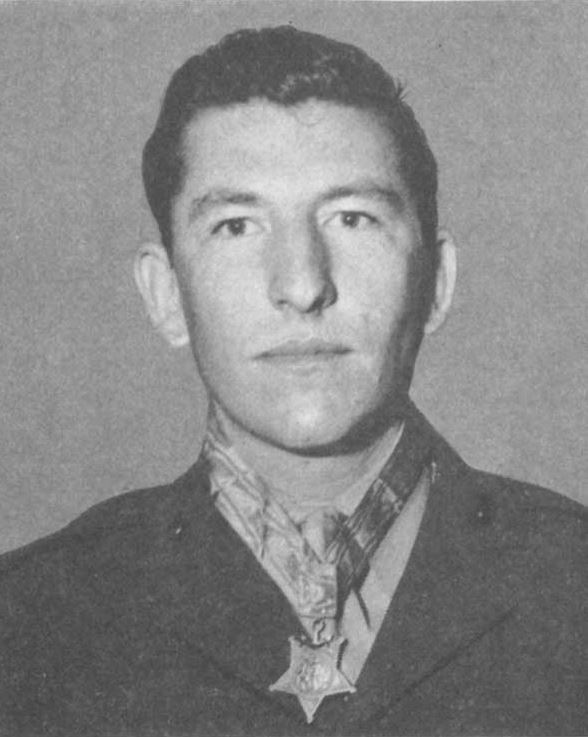
Lt Jack W. Mathis MOH


 Ok, folks this handsome young lad, if you hadn't noticed is Texas born and raised.  San Angelo to be precise, about 80 miles south of Big Spring, my domicile for about 10 years of my youth.  Big Spring is a next door neighbor to San Angelo and except for one reason which I'll tell you about, he and I could've been friends.

Source


He was a bombardier in the B-17 in England. He and his brother had both volunteered to be bombardiers and had gone to that school together.  He had completed 14 missions (of 25 needed to return to the US). On his 15th mission. he was tasked to be the lead bombardier on a mission.

The bombing procedure at the time was the lead bombardier would find the target aim point and when the time came to drop, he would trigger off his bombs.  EVERY other bombardier in the formation would do the same thing, at the same time, when they saw him drop.  

I'm not sure exactly why this was the methodology other than possibly with a hundred or so aircraft in tight formation and a hundred or so bombardiers trying (and literally flying) to get the aircraft in the right position to hit the target.  Mid-airs might be a reason.  

Besides a large flight of B-17's, sometimes several hundred on a mission and up to 8000lbs of bombs each, the tactic of dropping all at once could be very effective, especially if the target was large.

To say the least.

In any case, he was the bombardier in the lead airplane, as the formation approached the target, AAA became very dense and the lead plane was hit. Lt Mathis was severely injured.  His right arm was shattered and badly wounded in his right side and abdomen.  Realizing that the attack would fail if he didn't release the bombs properly, he dragged himself back to his position, found the target and released the bombs.  The rest of the formation followed suit.

Unfortunately, the wounds to Lt Mathis were fatal and he passed away shortly thereafter.

Lt Jack Mathis's brother Mark was also in his squadron albeit assigned to a different crew.  He requested to be transferred to his brother's crew which was granted.

He was killed in action a couple of months later.

Rest in Peace, Warriors! 


Source


Citation:

For conspicuous gallantry and intrepidity above and beyond the call of duty in action with the enemy over Vegesack, Germany, on March 18, 1943. 1st Lt. Mathis, as leading bombardier of his squadron, flying through intense and accurate antiaircraft fire, was just starting his bomb run, upon which the entire squadron depended for accurate bombing, when he was hit by the enemy antiaircraft fire. His right arm was shattered above the elbow, a large wound was torn in his side and abdomen, and he was knocked from his bomb sight to the rear of the bombardier's compartment. Realizing that the success of the mission depended upon him, 1st Lt. Mathis, by sheer determination and willpower, though mortally wounded, dragged himself back to his sights, released his bombs, then died at his post of duty. As the result of this action the airplanes of his bombardment squadron placed their bombs directly upon the assigned target for a perfect attack against the enemy. 1st Lt. Mathis' undaunted bravery has been a great inspiration to the officers and men of his unit.[1]'


Saturday, June 6, 2026

Sarge, Where the Hell Have You Been?!?!

OAFS Family Photo
That's my Dad in the photo and my oldest kid brother, The Olde Vermonter, running around the trail of the artillery piece. Said artillery piece being a howitzer, which in those days were measured by the size of the bore and not the weight of the shot. What I refer to as a cannon (or gun, the terminology differs from country to country but I'll let the real gunners weigh in on that), was measured by the weight of the shot, anywhere from the little 3-pounders up to the big boys used for sieges firing shot weighing 24-pounds (and up, I believe).

That photo is from around 1958-60 (or so) at Fort Ticonderoga in Upstate New York (which New Yorkers tell me means anything north of NYC). If you look closely you'll see a pair of legs to the right of the howitzer (ahem, behind it in the photo). That would be Your Humble Scribe, even then knowing to stay out from behind a field piece about to be fired.

Though Dad (today is his birthday, he would have been 98 today) was in the Army, he was in the Signal Corps. His knowledge of the feeding and care of black powder artillery was lacking. One does not straddle the carriage of a cannon (or howitzer, or gun, take your pick) as when fired, that piece is going to roll backwards a few feet (the actual distance depends on the size of the piece).

But you will note that Dad has a handkerchief wrapped around his head. Gunners did do this but the cloth should cover one's ears as those cannon (or howitzer, or gun, take your pick) were noisy sumbitches when fired. So Dad at least did pay attention to paintings of artillery being fired.

I'm guessing the date, The Olde Vermonter, probably knows the exact date as it is no doubt stamped on the back of the photo. Now The Olde Vermonter looks to be four or five years old, maybe as young as three (which would make it 1958) but no more than five (1960). You can't see me (duh) so I would be anywhere from five to seven years old.

We visited Fort Ti (as we called it BITD) a number of times when I was nobbut a lad. A place I truly enjoyed. Haven't been there since 1982 (I think) when we returned from Korea and I learned that a bagpipe competition was taking place there. As was (and perhaps still is) my wont, I packed The Missus Herself and The Naviguesser into the trusty old VW Beetle and off we went to the fort. About 80 miles and an hour and forty minutes by Volkswagen.

It was that day that I learned that one does not travel without providing for provisions and beverages for the crew. That was my thing, hare off into the wild and buy whatever I needed when I arrived at wherever I was going. I don't think The Missus Herself has cured me of that habit completely, though she has tried very hard to do so over the years.

Sigh ...

OAFS Photo
So yeah, where have I been? Well, right here at Chez Sarge is the simple answer. Manning that beast in the previous photo twice a week since we returned from Maryland a cuppla weeks ago. Springtime is no time to let the grass grow as it will, DAMHIK.

But the lawn is once again under control, until the next time I need to cut it.

Lawn mowing aside, I haven't felt like writing as of late. I've been busy reading, playing games on my computer, and hanging out with friends to have any time (or desire) to sit down and write. Today, obviously, being an exception.

Now juvat has gone hog wild posting about Medal of Honor winners, mostly Air Force recipients, but I note that there are a few Army guys sprinkled in there as well. Prior to 1947 the Air Force was, of course, part of the Army. This post series seems to have taken on a life of its own, which is good, those folks need to be remembered. But I daresay juvat's not going to write about all of them. There are over thirty five hundred MoH recipients. I mean sure, that would give me a nice long break from blogging, but ...

Yeah, I don't need that long a break.

OAFS Photo
Another tradition at Chez Sarge is to quaff a brew when the cutting of the grass is done. Found the beverage above in the refrigerator and as it was the only one in the fridge, I drank it. Okay, there was a Guinness, but I won't drink Guinness out of a can unless I absolutely have to, I'm not a barbarian. Okay, I am, but not that big of one. I was too lazy to find my Guinness glass, so Brigadeiro it was.

The brew was most delicious, when I went looking for where I could get more, seems that they don't make it anymore, at least not locally. I do believe The Musician, my youngest kid brother, might have gifted me that brew for Christmas. So woe is me, I may not have that one ever again.

Welp, there are plenty of other beverages I like, so be it.

So yeah, not writing (it was starting to feel like work, something I had to do, and that grated on me) and relaxing to the full extent allowed by law (I guess that means I have to wear clothes). I'll get back to it sometime, probably sooner rather than later, but please, don't hold your breath.

I'm fickle like that.

Be seeing you.


John A Chapman, MOH


Source

As you may have realized with Sarge on Vacation (hint, hint), that when I get writer's block I refer to the USAF list of Medal of Honor recipients for their story. I think those stories are important for Americans to know.  Freedom isn't free.


Well, folks, that's the post for today.  The recipient this time has two different reasons for this posting.  One, he is the most recent recipient of the Medal of Honor and two, as you may recognize from his picture, he's enlisted.  OK, three, one more reason.  


His story is one of the most courageous descriptions of ground combat that I've read.  (Suffice it to say, I read a lot of stories like that.). Given that, I'll shut up and post the data.
 

The President of the United States of America, authorized by Title 10, Section 8742, U.S.C., awards the Air Force Cross to TSgt John Chapman for extraordinary heroism in military operation against an armed enemy of the United States as a 24th Special Tactics Squadron, combat controller in the vicinity of Gardez, in the eastern highlands of Afghanistan, on March 4, 2002. On this date, during his helicopter insertion for a reconnaissance and time sensitive targeting close air support mission, Sergeant Chapman's aircraft came under heavy machine gun fire and received a direct hit from a rocket propelled grenade which caused a United States Navy sea-air-land team member to fall from the aircraft. Though heavily damaged, the aircraft egressed the area and made an emergency landing seven kilometers away. Once on the ground Sergeant Chapman established communication with an AC-130 gunship to ensure the area was secure while providing close air support coverage for the entire team. He then directed the gunship to begin the search for the missing team member. He requested, coordinated, and controlled the helicopter that extracted the stranded team and aircrew members. These actions limited the exposure of the aircrew and team to hostile fire. Without regard for his own life Sergeant Chapman volunteered to rescue his missing team member from an enemy stronghold. Shortly after insertion, the team made contact with the enemy. Sergeant Chapman engaged and killed two enemy personnel. He continued to advance reaching the enemy position then engaged a second enemy position, a dug-in machine gun nest. At this time, the rescue team came under effective enemy fire from three directions. From close range he exchanged fire with the enemy from minimum personal cover until he succumbed to multiple wounds. His engagement and destruction of the first enemy position and advancement on the second position enabled his team to move to cover and break enemy contact. In his own words, his Navy sea-air-land team leader credits Sergeant Chapman unequivocally with saving the lives of the entire rescue team. Through his extraordinary heroism, superb airmanship, aggressiveness in the face of the enemy, and the dedication to the service of his country, Sergeant Chapman reflects the highest credit upon himself and the United States Air Force.

Holy Crap!  Talk about LARGE Gonads!   Advancing by himself and destroying a manned machine gun position then turning and doing the same to a second position while severely, and ultimately mortally, wounded. 

AND...this was the citation for the Air Force Cross.  I'd HIGHLY recommend reading the story here.  It took until 2018 for the Air Force Cross to be upgraded to the Medal of Honor.  Suffice it to say, the politics and quid pro quo involved is a bit sickening. 

 I've read a lot of MOH stories.  This one takes the cake.

Source


Greater love has no one than this: to lay down one’s life for one’s friends.”

‭‭John‬ ‭15‬:‭13‬ ‭NIV‬‬

Boy, no kidding.

"Lord, I don't feel a need to be presented with a situation like that, but if you say so, PLEASE don't let me screw it up!"

I've said a prayer along those lines a time or two under some troubling instances in my day. Fortunately, it was never needed.

Peace out Y'all! 


Friday, June 5, 2026

And so it has begun!


February 27, 2026

Ok, Campers, the “fun” has begun! The construction was supposed to start on May 27th but "Things came up". Now it's this week, but...the weather forecast is for rain every day this week. The horse barn construction will begin “as soon as the weather cooperates”. A couple of reasons for the horses first plan. First, the horse area is located on the farthest end of the property from the gate and road. Better to keep them from getting out of the pasture and going partying on the road. Second, they’ve been boarded until now. You’d have thought they’d been staying in the Four Seasons Hotel George V in Paris based on the boarding fee. But, it wasn't quite that good.

Ok, not even close. 

Yes, Beans, boarding horses is expensive. But they will be free to roam in a much larger area than where they've been cooped up in since we moved here in December.  So...we (and they) have that going for us.

Now that our builder got back from his vacation, the pouring of the slab ceremony will soon be celebrated and construction of our home begun .(Well, when the rain stops. The forecast is for rain the next 6 days. Bummer, Dude!)  Completion date is still "maybe December", but completion is easier to estimate once building has begun. As they get organized with the building teams and their schedules, my Brother's cottage will also be started.  It'll be about 900 sq ft which is bigger than the cottage he was living in on our property in Fredericksburg, so...onward and upward.

At some point, they'll put in my wood shop and Mrs J's sewing cabin and that will be that.  Until we think of something else we "Need!".  

Just to give y'all a feel for the property.  Enjoy!  


So that's life around here these days. Speaking thereof, tomorrow I'll begin traveling my 72nd turn around the sun.  I have no plans to call it quits. That's up to the guy upstairs.

Thank You, Lord!

Peace out, y'all! 


Thursday, June 4, 2026

Air to air combat!


I've been posting Air Force Medal of Honor recipient stories for a week or so.  (Sarge needed a break, I find them interesting, especially the ones I'm unfamiliar with. So, you'll be seeing a few more soon.). 

However, I decided I'd resuscitate a posting from one of the first posts I put up 13 years ago or so.  Through the years, we've discussed one of my heroes a few times.  Here's one of my favorite stories about him.  Unfortunately....

Source

 So...Off we go!

Air to air combat is fun and exciting in practice. I suspect that when it’s for real, the “fun” part drops off. Tell me if I’m wrong.

Ed Rasimus and I were both assigned to the 435TFTS at Holloman AFB NM. Suffice it to say that even though I was qualified as an "experienced" fighter pilot flying time wise, I learned a lot more from Ras during flight briefings and debriefings, and in the air than I thought possible.  Some of the most important things I learned from him were taught in the Squadron Bar. After he PCS’d to Fort Carson for his last assignment in the Air Force as an ALO, I lost touch with him and didn’t reconnect with him until I saw his book “When Thunder Rolled” on Amazon.  Bought it immediately, and started reading.  It was like being in the Bar again; I’d heard most of those stories. A few years ago, I managed to track him down and restablish our friendship.  Unfortunately, he's no longer with us.  Heaven to me would be flying fighters against and with both He and Vegas. Yes, that would be heaven.

But rereading that post really triggered a memory of one flight he and I had together while at Holloman.

Basic Fighter Maneuvers (BFM) are  exactly what the name implies, at the most basic level, how do you maneuver a fighter so as to kill another fighter and/or avoid being killed yourself.  It’s not just "pull on the pole as hard as you can".  It’s using your energy wisely, regaining it when you can, using gravity to enhance the effect.  Most of the Lead In Fighter Training program consisted of BFM rides, and throughout the flying portion of my career, a sizeable portion of my rides were BFM also, whether I was in an Air to Air Squadron or an Air to Ground Squadron.  BFM skills are critical and very perishable. 

BFM rides involved two aircraft, a 1 v 1, and typically there were two types of setups.  In the first setup, one jet takes a position 30 to 45 degrees off the tail of the other and 6000-9000’ away.  In a real world fight, this is a very dangerous position for the person in front to be in.  Once participants are ready, the fight is started with a “Fight’s on” call and maneuvering commences.  The fight typically continues until a kill shot is taken by one or the other fighter, a fighter manages to disengage successfully, the desired learning point has been achieved, or a safety factor is encountered.  (Over G, going through minimum altitude, min fuel etc).

The second type of setup is a neutral setup, typically called a “Butterfly”.  The two jets start in tactical formation about 6-9K’ apart and the flight lead calls for a turn away from each other of 45 degrees.  At some point the flight lead calls for the turn in and both aircraft turn back towards each other for a head on pass.  The flight lead will call fight’s on at some point,  typically immediately prior to the pass so that maneuvering can begin.

This now leads to a decision on the part of both fighter pilots.  Do I want a two circle fight or a one circle fight?  There’s an excellent discussion of this here , but basically, if your turn radius is better than the other jet's, try for a one circle.
 
Back in the day, I used to be able to draw a fight diagram much better.  My apologies.


  If your turn rate is not better than the other, try for a two circle fight because you’ve got more turning room to use.


I say “try”, because the other guy also gets a vote in the fight. He has to turn in the direction you expect him to otherwise ....  I was about to learn how to make that happen.

So,  There I was………….*  Ras and I were scheduled for an IP currency 1 v 1 BFM ride in Beak Charlie, the closest air to air area to Holloman.  Basically, we would be fighting air to air against each other for currency.  Cloudcroft NM was the Western Boundary  Roswell the Eastern and  Ruidoso the Northern.  That proximity meant we’d have maximum gas for fighting.  Typically, when these rides went on the schedule, they were immediately filled by students riding in the back seats, however, this time it was just Ras and I.  (He had told the Duty Officer not to allow any students, you’ll understand why shortly).

Briefing was short and sweet, here’s the frequencies, joker and bingo* fuel levels and a discussion of which BFM setup we were going to use (Butterfly).  We had flown together enough as IPs that not much else was needed.  We step to the jets, crank up, formation takeoff and we’re in the area.  A couple of G awareness turns . (The AT-38B was getting old and we needed to “tune” our bodies to what the mandated G limit was, so that we didn’t overstress the aircraft and reduce its lifespan.  Must have worked, this story occurred about 30 years ago, and the airplanes are still flying.)

Everything’s ready to go, a quick fuel check from Ras and he calls for the turn away.  I check 45 away and rollout, snap my head around so as to keep sight of Ras.  Got him, we continue on heading for a bit and he calls turn in.  I’m pulling right on the g-limit, get pointed at him and unload the aircraft to get some speed back.  We’re about a mile out now and I’m planning for a two circle fight, since I’m a little above him, I plan to slice down to the left leading the turn as much as I can.  At that point, Ras calls fight’s on and pulls up and takes a head on gun shot. 

At the time, the safety rules prohibited any gun shots within 45 degrees either side of head on, so I’d never seen a head on shot.  Also, since the guns on most fighters are boresighted with the aircraft, where the gun is pointed is where the aircraft is pointed. If Ras has taken a gunshot, the gun is pointed at me and so is his aircraft.  Ras passes close aboard.  This has left me somewhat startled and there’s a pause before I start to maneuver.  I roll left and start the pull, expecting Ras to have done the same which should put him somewhere above my tail pointed away.  I can’t see him and call blind (another safety thing, if he calls blind also, we knock it off and get altitude separation).  He calls “continue”.  I’m in big trouble, he sees me!  I’m still frantically searching for him looking over my left (down) shoulder, when something catches the corner of my eye.  I crank around to the right, just in time to see Ras swooping down on the back side of his vertical circle. He's gone for a one circle fight, using the vertical and by virtue of being below me and pulling up for the shot, he's lead turned me.  When he got to the top of his loop, he was slow and inverted, so gravity helped him turn much faster.

Fortunately, he’s not in guns range yet, but he’s closing fast.  I break back right and up, trying to force his nose into lag  (pointed behind me), but I’m running out of airspeed and he’s not.  I see his nose slide out in front of me and I start to make out the intakes on the side of his jet (with my eyesight at the time, that was my indication that he was about 2500’ away, AKA guns range.  With my eyesight now, I think he'd be in my back seat before I saw intakes).  I roll the aircraft until the canopy is about 45 degrees below the horizon and plant the stick in my lap.  I’m jinking…Hard.  Roll the aircraft again,  push the stick forward.  Again,  and Again and Again, but Ras is still back !there, he hasn’t called any shots, but I ain’t getting away either.  I’m expecting a knock it off for lesson learned, but no.  I’m jinking for about a month and a half until we get to bingo.  Knock it off and head home.

Back in the debrief,  Ras walks in with a couple of beers, hands one to me and says “Juvat, there are no safety ROE (Rules of Engagement) in combat, and there’s no knock it off”.  Then he took a couple of sips of beer as he let me ponder that.  He then followed with “Best Jinking I’ve ever seen, I never got a shot.  Let’s talk about how you did that, I want to learn how.”

I miss him.
 
If you'd like to read more of his stories (and I highly recommend you do), he published three books before he passed, One in conjunction with Robin Olds, the other two autobiographies about his assignments (yes, Beans, more than one) in South East Asia.  Excellent stories.
 

 Rest in peace, Warrior! Ed, you deserve it!

Peace out, y'all!

* Joker fuel means "keep an eye on your gas, this is the last engagement".  Bingo fuel means "Knock it off!  Rejoin on me and we're headed home".  Enough gas to get home and land with a safe amount of fuel in case something bad happens at the base.
  • What’s the difference between a fairy tale and a war story?  A fairy tale starts with “Once upon a time” and a war story starts with “So there I was”.  

Wednesday, June 3, 2026

Erwin R. Bleckley MOH


Earlier this week I wrote a post about a Medal of Honor recipient from WWI, 1st Lt. Harold E. Goettler. Unfortunately, my research left out one important piece of information, his back seater (at the time the title was Observer) was also awarded the medal.  So, to rectify this,  here we go. 

Source


Erwin R. Beckley entered service as a member of the Kansas National Guard, was commissioned as an artillery officer, then volunteered for aviation training and duty. Essentially, a weapons systems officer in modern terminology.  They arrived in theater on 24 September 1918 and flew their first combat mission on the 26th.  

DeHaviland DH-4


On the 6th of October they were assigned to drop ammunition and supplies to the "Lost Battalion" which was surrounded by German troops.  Their first mission went ok, although they had taken some bullet holes and their engine was running rough.  Volunteering to go back and drop more supplies they borrowed another aircraft.  With the heavy AAA they had seen in the morning mission, they elected to go in much lower. *

Unfortunately, as they made their approach, the gunfire from the ground hit the airplane and Lt Goettler, his pilot, was killed.  The airplane crashed severely injuring Lt Beckley who later succumbed to his injuries.

Rest in peace, Heroes! 

*IMHO this is a mistake,  AAA can still shoot at you low and every enemy soldier with a rifle can also.  But the Air Service was new and still trying to develop tactics.

Interestingly, in researching this and his pilot's story, I learned that there were only 4 flying Medal of Honor recipients in WWI.  I suspect that since they were in the Army, there might have been a bit of problem understanding their mission and its dangers by the officers who decided MOH awards. Just sayin'.


Tuesday, June 2, 2026

Harold Goettler MOH

Lt Harold Goettler 

Frankly, I think he looks like a badass!


 Ok, Folks, I'm back with another recipient of Medal of Honor in the US Army Air Service what would go through a few name changes and eventually become the USAF.  He would be one of the first to receive the Medal although posthumously. I've gotta confess, I had never heard of this recipient until I started this series of posts.  He is Harold Goetler and his story was worth the research.


DeHaviland DH-4

  Source


Upon arrival in Europe, he was assigned to the 50th Aero Squadron flying the DeHaviland DH-4.


According to the National Museum of the USAF:

"Goettler's first mission was on Sept. 12, 1918, the first day of the Allied St. Mihiel Offensive. His observer was Lt. Erwin R. Bleckley. On Oct. 6, Goettler and Bleckley were ordered to search for the so-called "Lost Battalion" of American units surrounded by German forces in the Argonne Forest. Several aircraft could not find them because the ground troops' commander feared signaling the fliers would reveal his units' position to the enemy. Goettler and Bleckley saw them, however, and dropped supplies despite heavy ground fire. On their second supply trip, as Goettler flew the airplane very low to drop supplies more accurately, he was killed by German rifle and machine gun fire. The plane crashed in Allied territory and observer Bleckley died shortly afterward. "

 Wow, 24 days.  War is certainly hell! I think this is an excellent example of that saying.

His citation for the Medal of Honor reads as follows:

First Lt. Harold E. Goettler, with his observer, 2d Lt. Erwin R. Bleckley, 130th Field Artillery, left the airdrome late in the afternoon on their second trip to drop supplies to a battalion of the 77th Division which had been cut off by the enemy in the Argonne Forest. Having been subjected on the first trip to violent fire from the enemy, they attempted on the second trip to come still lower in order to get the packages even more precisely on the designated spot. In the course of his mission the plane was brought down by enemy rifle and machine-gun fire from the ground, resulting in the instant death of 1st Lt. Goettler. In attempting and performing this mission 1st Lt. Goettler showed the highest possible contempt of personal danger, devotion to duty, courage, and valor. 

Rest in Peace, Heroes!

Peace out, y'all! 

Monday, June 1, 2026

First Jets


One of the things I've learned while contributing to Sarge's blog is the importance of carefully proof reading your story.  I've also learned that it's a lot more difficult than it sounds.  Your brain tends to read what your brain told you to type.  Which is not always what is actually written.  I had a case of this with my "Juvats" posting recently.  My intention for the subject was the progression of aircraft that the 80th TFS had flown since WWII.  I mistakenly posted a picture of a P80 and captioned it as the first jet fighter.  Which should have said first jet fighter for the Juvats as both the British and Germans had jet fighters before that.  Thanks for pointing that out, Mea Culpa!.  But... On the upside of that mistake, it produced a subject I found interesting for this posting.

So…Here we go with first jet fighters.

ME-262  Schwalbe/Sturmvogel*


According to the Military Aviation Museum (where I got the photo above) the first operational jet fighter was the ME-262 built by Messerschmidt. Much like any new technology it had its good points and its not so good points.  First, it was much (much, much) faster than any of the Allied propeller driven fighters.  Thus, the ME-262 could attack the Bomber fleet and run away before the Allied escort could bring sights to bear.  However, as in any war, tactics are developed to maximize your strengths and minimize the enemy's.  The Allies started positioning P-52 Mustangs over the ME-262 airfields as bombing attacks were being conducted in the vicinity.  If a ME-262 took off, they would attack it while it was still accelerating.  Since the engine’s spool up in the jet took a bit of time, the P-51 diving from altitude had a significant airspeed advantage.  Since there weren't a lot of ME-262's in operation, loss of any was a big victory for the Allies.  But, for purposes of this posting, they were the first operational jet fighter.

 Gloster Meteor


 The Gloster Meteor was the first Allied jet fighter and the only Allied jet to see combat.  It was faster than the Messerschmidt, but a bit less maneuverable.  Not a good characteristic for a Fighter.  Interestingly, it was still flying, albeit as a test bed, in 2023.

P-59 AiraComet

Bell P-59B Airacomet > National Museum of the US Air Force™ > Display 

The P-59 Airacomet was the first US built jet fighter . Planning for the jet began in 1941 and flights began in July 1943.  Unfortunately, it's capabilities did not match the capabilities of the P-51, P47, or P-38, so it never reached production.

 Which brings me to my oops. The P-80 on first commissioning later renamed as the F-80 . This site explains a lot about the P-80 as a jet fighter.  As most of you know the king of the air in Korea was the F-86 which took over the air to air role there.  277 P/F-80s were lost there.  1 loss is bad, 277 is terrible.  They were soon remodeled and turned in to the T-33 which were still flying missions when I came on active duty and pilot training.

No, Beans, I never flew one, they were just for flying stuff and people around at the time. The T-37 and T-38 were in service by then.

 MIG-9 Fargo

Source


The first Russian jet was the  Mikoyan-Gurevich MiG-9, NATO code named "Fargo".  Production started in 1946 and ended in 1948.  Obviously, it did not fly in WWII.  610 were built.  As I read this article I came to realize that the Soviets were not able to produce this "jet" before the war ended.  Lots (Lots and Lots) of problems.

The Nakajima Kikka (橘花 for those of you who read  Japanese)


As one can see, it bears quite a similar look as the ME-262.  I don't know, but it wouldn't surprise me if there wasn't a bit of cooperation going on.  It had zero influence on the war as it flew only once, and that was in August 1945. 

 And Finally! 

Caproni Campini N.1

Source

The aircraft pictured above was Italy's entry into the "first" jet fighter competition.  Design and testing was started in 1940 and flown in 1941.  2 models were built and flown.  One was either destroyed by Allied bombing or by the Italians to avoid it's capture.  The one above was discovered by the Allies after they defeated the Italian Army.

So.  There are the first jet fighters and fighter prototypes from WWII. 

And, even though I like all of them, this is my favorite Fighter.


Source

 No surprise there!

Thanks for the idea Dearieme!  Peace out y'all.  


*Schwalbe/Sturmvogel. Schwalbe if it was air to air, Sturmvogel if it was Air to Ground 


Sunday, May 31, 2026

“What is courage without risk... It wouldn’t really be courage, would it?” *


This post is an update of a post from 2016. That post describes the heroism of a Forward Air Controller (FAC) during the Vietnam war.  Back when this was originally posted, I had had the opportunity to visit Lackland AFB and walk the parade field, the edge of which has a representation of many USAF airplanes.  It also has a monument listing all Air Force Medal of Honor Recipients.  


As I studied the list, I realized that, while I knew the stories of several and recognized the names of a few more, there were many of whom I had no knowledge.  These men had received our Nation's Highest Award for Valor, for "acts of Valor above and beyond the call of Duty." and I didn't know them?  Unacceptable.  I resolved to rectify that situation.

Today's post will describe the actions of Captain Hilliard Almond Wilbanks.  Capt. Wilbanks was born in Cornelia GA.  He  enlisted in the USAF in 1950 serving 4 years as an Air Policeman in SAC before being accepted into the Aviation Cadet program.  I suspect 4 years guarding Bombers in the Northern Tier would be strenuous for a Southern Gentleman.  Anyhow, in June of 1955 (a personally excellent month), he received his wings and was commissioned.


His first assignment was as an IP (First Assignment Instructor Pilot (FAIP) to be precise).  Completing that assignment, he flew F-86s before being assigned to Vietnam as a Forward Air Controller.  Assigned to the 21st Tactical Air Support Squadron, he flew the O-1A Bird Dog.  From April 1966 to Feb 1967, he flew 488 combat mission earning the Air Medal 19 times (technically 1 Air Medal and 18 Oak Leaf Clusters) as well as a Distinguished Flying Cross.

Ok,  He's flying a single engine Cessna with a takeoff speed of about 90K, a cruise speed of 90K and a landing speed of 90K.  It is not armored, nor strengthened from the civilian variant.  It is armed, sort of, with 4 White Phosphorus Rockets.  Yes, they will hurt you if they hit you, but they're primarily used for marking targets. 


Capt. Wilbanks flew this aircraft in combat 488 times.  He clanked when he walked.


In February a few weeks before he was scheduled to DEROS (Date estimated to return from overseas AKA get to come home), Capt. Wilbanks' primary AOR is moved further north into the highlands.  On 22 February, an NVA Battalion captures a tea plantation in Capt Wilbanks old AOR and sets up an ambush.  The next morning a South Vietnamese company walks into the ambush and is entirely killed or captured.  No report is made as the radio operator threw the radio into a well to prevent its capture.  The next day a South Vietnamese Ranger battalion is sent to figure out what happened.  

Capt. Wilbanks replacement flies 3 missions but is unable to find the destroyed unit or recognize the ambush site.  Capt. Wilbanks is diverted from his current area to return and help with the search.  Based on his extensive experience, he is able to detect the ambush site.  As he radios a warning to the Rangers, the NVA recognize that they have been detected and spring the ambush, even though the Rangers are not fully in the ambush crossfire.


Capt. Wilbanks begins doing the FAC thing directing the fire of three helicopter gunships while evading 50 caliber machine gun rounds and extensive small arms fire.  Two flights of F-4s are diverted toward the area. 

As the helicopters make a pass, one takes a 50 cal hit in the hydraulic system.  He radios Capt Wilbanks that he will "probably' make it back to base.  Capt Wilbanks clears the other helicopters off to escort him back to base.

On seeing the helicopters leave, the NVA launch a new attack on the Rangers.  Capt Wilbanks checks the F-4s ETA, but they won't arrive in time.  Capt Wilbanks rolls in and launches a rocket at the attacking force which stops them momentarily and diverts their fire towards him.  

He is now out of rockets, but has an M-16 on board as a personal survival weapon in the event of a crash landing.  He sets up for a pass, dropping the side window and holding the M-16 in the slipstream. 

He makes several passes, causing the NVA to stop their attack each time, but he's taking hits from small arms and machine gun fire.  Finally, he takes an incapacitating hit and crashes near enough to the Rangers that they pull him from the wreckage.  He's alive, but perishes shortly thereafter.  

About this time the Phantoms arrive, and the attack is defeated.

As I read this, I wondered why a Battalion (easily several hundred men) would stop an attack based on the fire from a single M-16.   This gave me an insight.  Evidently the only way a North Vietnamese soldier could get leave to go home was to shoot down an aircraft.  It didn't matter how well he did on the ground, he was stuck for the duration.  If he shot down an airplane though, he would get transported back to North Vietnam for some leave.  I don't know whether Capt. Wilbanks knew that or if it would have mattered. 

This site has more details of the battle for those interested.  One caveat, the site's author has, shall we say, some baggage. The section on Capt. Wilbanks is well done though.  Do a Ctrl+F and search on Wilbanks and you'll save yourself a lot of stress.  

Capt. Wilbanks Medal of Honor Citation.
"For conspicuous gallantry and intrepidity in action at the risk of his life above and beyond the call of duty. As a forward air controller Capt. Wilbanks was pilot of an unarmed, light aircraft flying visual reconnaissance ahead of a South Vietnam Army Ranger Battalion. His intensive search revealed a well-concealed and numerically superior hostile force poised to ambush the advancing rangers. The Viet Cong, realizing that Capt. Wilbanks' discovery had compromised their position and ability to launch a surprise attack, immediately fired on the small aircraft with all available firepower. The enemy then began advancing against the exposed forward elements of the ranger force which were pinned down by devastating fire. Capt. Wilbanks recognized that close support aircraft could not arrive in time to enable the rangers to withstand the advancing enemy, onslaught. With full knowledge of the limitations of his unarmed, unarmored, light reconnaissance aircraft, and the great danger imposed by the enemy's vast firepower, he unhesitatingly assumed a covering, close support role. Flying through a hail of withering fire at treetop level, Capt. Wilbanks passed directly over the advancing enemy and inflicted many casualties by firing his rifle out of the side window of his aircraft. Despite increasingly intense antiaircraft fire, Capt. Wilbanks continued to completely disregard his own safety and made repeated low passes over the enemy to divert their fire away from the rangers. His daring tactics successfully interrupted the enemy advance, allowing the rangers to withdraw to safety from their perilous position. During his final courageous attack to protect the withdrawing forces, Capt. Wilbanks was mortally wounded and his bullet-riddled aircraft crashed between the opposing forces. Capt. Wilbanks' magnificent action saved numerous friendly personnel from certain injury or death. His unparalleled concern for his fellow man and his extraordinary heroism were in the highest traditions of the military service, and have reflected great credit upon himself and the U.S. Air Force."

Warrior!
I thought it interesting to do a little research on how many members of USAF and its predecessor organizations had received the Medal of Honor.  My intent is to read the story of each of them.  Many I recognize the name, I'll start with the ones I don't.
Here’s the list: (I haven't checked , but it looks like it's in order of either action or awarding.)

1st Lt. Edward   V. Rickenbacker
2nd Lt. Frank Luke Jr.
1st Lt. Harold E. Goettler
2nd Lt. Erwin R. Bleckley
Brig. Gen. James H. Doolittle
Capt. Harl Pease Jr.
Lt. Col. Pierpont M. Hamilton
Col. Demas T. Craw
Brig. Gen. Kenneth N. Walker
1st Lt. Jack W. Mathis
Sgt. Maynard H. Smith
2nd Lt. Joseph R. Sarnoski
Maj. Jay Zeamer Jr.
2nd Lt. John C. Morgan
2nd Lt. Lloyd H. Hughes
Lt. Col. Addison E. Baker
Maj. John L. Jerstad
Col. Leon W. Johnson
Col. John R. Kane
Maj. Ralph Cheli
Col. Neel E. Kearby
Maj. Raymond H. Wilkins
Tech. Sgt. Forrest L. Vosler
Lt. Col. James H. Howard
Sgt. Archibald Mathies
2nd Lt. Walter E. Truemper
1st Lt. William R. Lawley Jr.
1st Lt. Edward S. Michael
Lt. Col. Leon R. Vance Jr.
2nd Lt. David R. Kingsley
1st Lt. Donald D. Pucket
Capt. Darrell R. Lindsey
Maj. Richard I. Bong
Maj. Horace S. Carswell Jr.
2nd Lt. Robert E. Femoyer
1st Lt. Donald J. Gott
2nd Lt. William E. Metzger Jr.
Brig. Gen. Frederick W. Castle
Maj. Thomas B. McGuire
Maj. William A. Shomo
Staff Sgt. Henry E. Erwin
1st Lt. Raymond L. Knight
Maj. Louis J. Sebille
Capt. John S. Walmsley Jr.
Maj. George A. Davis Jr.
Maj. Charles J. Loring Jr.
Maj. Bernard F. Fisher
Capt. Hilliard A. Wilbanks
Maj. Merlyn H. Dethlefsen
Lt. Col. Leo K. Thorsness
Capt. Gerald O. Young
Lt. Col. Joe M. Jackson
Lt. Col. William A. Jones III
Capt. James P. Fleming
Sgt. John L. Levitow
Capt. Steven L. Bennett
Col. George E. Day
Capt. Lance P. Sijan
Airman 1st Class William H. Pitsenbarger
Chief Master Sgt. Richard Etchberger
Tech. Sgt. John A. Chapman

*Jocelyn Murray, Corfe Castle