Showing posts with label Guest Post. Show all posts

Wednesday, July 8, 2026

John Blackshoe Sends: Serendipity History – “History is written by the winner” Part 3

Source
The victors’ celebrations which continue 150 years after Custer’s defeat

Remember, the Plains Indians were composed of many different tribes, with their own languages, almost none of it written, and dependent on mostly oral history traditions passed down from each generation. They do have some pictographic documentation of various events often on buffalo hide, paper or fabric, and are sometimes called “Ledger art” for the ledger books used for the drawings. When carefully studied they seem to be very accurate representations of the depicted events. Several pictographs exist of the Custer battle, done by participants. 

One Bull was the adopted son of Chief Sitting Bull, and a participant in the battle. He painted the pictograph discussed in the video in the source above (6:06 long). I urge you to view this one which ties together so much information about the Custer battle. There are many short videos below showing today’s Indians celebrating these events.
 
Today, a lot of documentation is taking place on social media instead of buffalo hides, so to see the full story, we need to look at several social media postings such as those below.  It is worth the time to view them and try to understand their culture, even today.

To appreciate the battle you need to understand the terrain.  It is a maze of jumbled hills, ridges, and depressions. The Little Big Horn River is pretty much the only water, and trees grew along it, but hardly anywhere else. The river at the battle site is only 25-50 feet wide, and ankle to knee deep. Here are two short videos.

VIDEO 1 (42 seconds) - Little Big Horn battlefield from a distance, showing last stand hill (green area on the hilltop with visitor center) and Indian village location in the trees along the river. VIDEO

VIDEO 2 (42 seconds) - Views from the battlefield, along the path of Custer’s retreat, taking casualties up to Last Stand Hill. VIDEO

The mission of the 7th Cavalry was to destroy the Indian camp which was unexpectedly large, estimated at maybe 1,500 to 4,000 warriors and total of 10,000 people from many tribes ready to start the annual buffalo hunt. Here are two short videos showing a much smaller camp at this year’s celebration which was held on privately owned land adjacent to the Custer battlefield. 
 
VIDEO 3 (42 seconds) – Indian camp on eve of victory celebration. (Beautiful!). VIDEO

Video 4 (42 seconds) – Indians gathering in camp (Northern Cheyenne and Crows) and celebrations. VIDEO

The plains Indians were dependent on horses to hunt game, and haul their teepee camps to new locations. Horses had been reintroduced to North America by Cortez expedition in 1519, but spread rapidly in the wild. Obtaining (capturing or stealing) horses was a necessity for their way of life. Great horses make great warriors. Here is a two minute video of some Lakota Sioux in their camp showing off some of their horses.

VIDEO 5 (2:00 minutes) –Lakota Sioux camp with their horses prior to the reenactment of the battle. VIDEO

The highlight of the Victory Day celebration is the reenactment of the Indian repulse of the cavalry and their pursuit and destruction away from the camp to “last stand hill.” The following short videos are a good representation of the battle, although with far smaller numbers than in 1876. But, for the 268 men of Custer’s command, this is a good approximation of the battle. The first is a 1:57 minute view of the Indian charge from camp up the hill surrounding the site of Custer’s troops. Then a 22 second video taken in the midst of the attacking Indians. Finally, two videos (under a minute each) where the warriors charge from the hilltop to the spectator line – pretty much what Custer saw coming at them.

VIDEO 6 (1:57 minutes) “Victory Day” Warrior charge up the hill. VIDEO

VIDEO 7 (22 Seconds) – Indian View from inside the warrior attack. VIDEO

VIDEO 8 (45 seconds) - Final charge towards the spectators. VIDEO

VIDEO 9 (59 seconds) Another video captions this part of the celebration: 

150th Little Big Horn Victory- The Final Charge. 

From the top of the hill to the base of our seats, riders arrived in less than ten seconds, a sight from the front row that sends chills down your spine.

But this ground holds something deeper. Warriors from the Oceti Sakowin, Cheyenne, and Arapaho once stood on lands like these, defending everything they held sacred, their families, their freedom, and their right to live upon the ancestral lands of their people.
 
Let this be a reminder of the tenacity and courage that still runs through our blood. VIDEO

The final video of the reenactment is 40 seconds of a ceremonial dance by the spectators honoring their ancestors.

VIDEO 10 - (40 seconds) - “And we danced for our ancestors! Much respect for our ancestors.” VIDEO

There are other pictographic accounts of the battle, in addition to the oral histories known to the participants in the reenactment above. Follow the links below for more on the pictographs and what they tell us.

Chief Red Horse’s depiction of the battle (detail of one of several) done circa 1881.
Source
The artist, Chief Red Horse:

For further reading on pictograph sources check out the following:

Part 1 of 2 part series on Red Horse’s work:
https://www.notesfromthefrontier.com/post/the-amazing-little-bighorn-drawings-of-red-horse

Part 1 of 2 part series on Red Horse’s work:
https://www.notesfromthefrontier.com/post/red-horse-at-the-battle-of-the-little-bighorn-an-eyewitness-account

Crow “White Swan” work circa 1890 in Denver Art Museum
https://www.denverartmuseum.org/en/object/1968.336

Some say there were no survivors from the Battle of the Little Big Horn.

They are wrong, the survivors are called “Indians.”


Tuesday, July 7, 2026

John Blackshoe Sends: Serendipity History – “History is written by the winner” Part 2

The Custer Fight
Charles Marion Russell (PD)
Part 2 of 3 - Our horrendous defeat which spoiled the 1876 Centennial celebration- Shocking News from the Greasy Grass, July 5, 1876.


On July 5, 1876 the newspapers were filled with praises of the many patriotic events of the celebrations across the country on our 100th Fourth of July.  But things suddenly turned into chaos, embarrassment, anger and sorrow.    

On the evening of July 5, 1876 the New York Herald published an “Extra” with the first news received in the east about the June 25th Battle of the Little Big Horn” when “General” Custer and (reportedly) 314 other men of his 7th U.S. Cavalry were killed. The following morning all the newspapers across the country were printing stories about the massacre.¹

New York Times lede on July 6, 1876.
(No copy of the July 5th New York Herald found.)
Source
General Phil Sheridan, commanding the Army in the West from a post in Chicago (Now Fort Sheridan) was in Philadelphia for the ceremonies, and the official Army report of the defeat had been telegraphed to his desk in Chicago.  He did not believe the newspaper headlines when he saw them, but a copy of the official report finally reached him later in the day. Nor had General W.T. Sherman, Commanding General of the Army who was also in Philadelphia and had not yet received any report forwarded from Chicago.

This humiliating defeat by savages living on the desolate plains shook the nation’s confidence, especially since it had happened 10 days earlier.  The U.S. Army at the time was a mere 25,000 men, down from the peak in 1865 of over a million men, and now thinly spread to cover coastal fortifications and the dozens of small frontier garrisons across the west.  Additional troops were still tied down on Reconstruction duty in the southern states, stifling often crooked politicians vying for power.  The destruction of Custer’s command was devastating.


Why the news of the defeat was delayed

While much of the nation had great communications via telegraph, and the transcontinental railroad now crossed the west, vast regions more than a few miles from major rail lines with their parallel telegraphs, remained primitive frontier territory, often days from any news.   The telephone was patented earlier in 1876 but not yet in use anywhere.   Radios would not be invented until two decades later.   

The nearest telegraph to the shattered 7th Cavalry on the Little Big Horn was in Bismarck, about 450 miles as the present highways go, but in 1876 was about 700 miles by river. 

Steamer Far West which carried the news, and wounded from the Big Horn to Bismarck, Dakota Territory.
Source
The paddle wheel steamer “Far West” was providing logistics support to the Army for the campaign.  It was able to navigate many of the rivers being 190 feet long (about 3 ½ semi trailers) with a 33 foot beam and only drawing 30 inches of water when fully loaded, and 21 inches empty.  [Source.]

By June 29th and 30th Far West was located at the mouth of the Little Big Horn River, some 15 miles from the battle site.  There, 52 wounded were taken and placed aboard, and the river boat headed downstream to Bismarck and Fort Abraham Lincoln, with dispatches reporting the disaster.   

The Captain was also given notebooks retrieved from the body or George Kellogg, a newspaper reporter “embedded” with the 7th Cavalry, to be delivered to Kellogg’s employer, the publisher of the Bismarck Herald.

The Far West reached Bismarck on July 5th and Kellogg’s notebooks and news of the battle reached Clement Lounsberry the publisher.  Kellogg and Lounsberry were part of the Associated Press and the New York Herald could preempt a telegraph line for their use. Recognizing a major story, Lounsberry had the local telegraph office give him control of the line as soon as the Army’s report was sent.  He then began dictating stories about the Custer defeat nearly continuously for 22 hours, interspersed with Bible verses for brief periods while composing additional material. Thus the New York Herald was able to “scoop” all the other eastern papers and break the news with an “extra” late on July 5th, although Lounsberry sent so much material that it was spread out over several following days.
Source:  Much of the above comes from this source


What appears in newspapers is not necessarily “history” but proof that “first reports are usually wrong.”   The actual count for U.S. casualties at Little Big Horn was NOT 315 dead and 31 wounded, but a total of 268 including 16 officers, 242 enlisted men (including 5 wounded who later died of the wounds), 3 attached civilians, and 7 Indian scouts.   Custer’s fighting lasted at most only a little over an hour before they were wiped out.  Reno’s and Benteen’s elements of the 7th Cavalry which had attacked from other directions were located and pinned down for more than a day and finally relieved late on the 26th.


Historians have used all sorts of archival records as well as archaeological evidence to analyze the battle. One especially well done study was done by Dr. Douglas Scott, summarized in his excellent 44 minute presentation here:  
 
He describes one item which especially evokes the personal tragedy of such events: “…the single most poignant artifact I have ever seen come out of the ground.  That is an inexpensive brass, silver plated wedding ring, still around the finger of one of the soldiers.”

Wedding ring of a 7th Cavalryman.
Source: Screen cap at 31:00 of presentation above.
The full 194 page book is available free for download at this source:

Historians have confirmed that much of the reporting of the deaths at the battle and post-mortem abuse of the dead soldiers was true.   However, in the context of the cultures involved at the time it was not uncommon, or practiced exclusively by the “savages.”  But, the losers in this battle made sure it was emphasized.   Little was said about the Army’s tactics of attacking villages inhabited by warriors, women, children and the elderly, or killing off the buffalo herds which were their source of food.  Those were different times, and atrocities were committed white on white, or red on red or any combination.  

Source

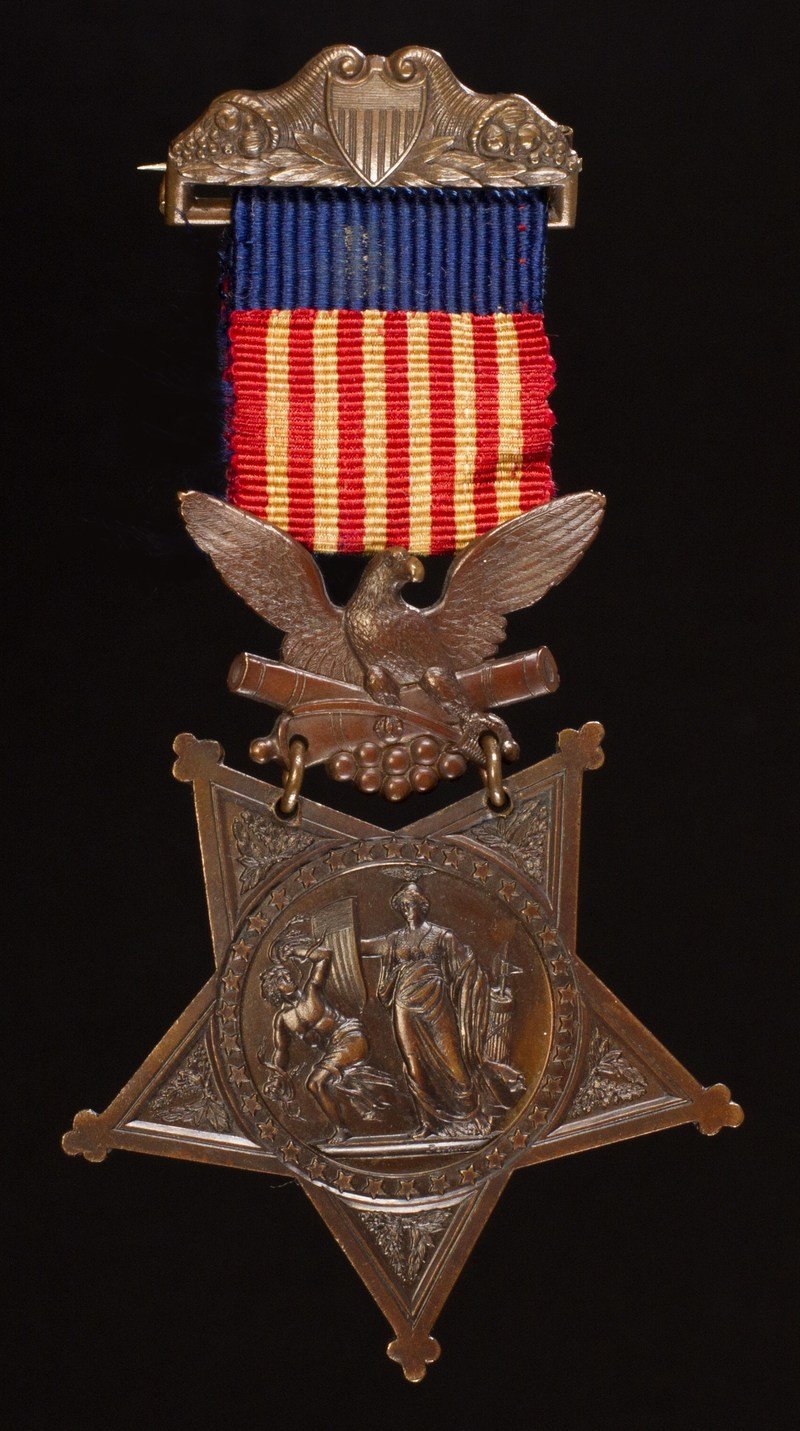
Medals of Honor, even in defeat
 
Posthumous awards of the MOH were not authorized at that time so none of the 268 dead 7th Cavalrymen were considered for awards, and there were no lesser awards (Silver Star, Bronze Star, etc.) at that time.  Twenty four MOH were awarded for the Little Big Horn, mainly to men from Benteen’s or Renos’ commands who braved Indian fire to bring water from the river.

One MOH recipient was killed at Little Big Horn, Captain Thomas W. Custer (brother of General George A. Custer).   He had received TWO Medals of Honor for separate acts during the Civil War, one of only 14 men [or 19 if you count the five guys who got both an Army and Navy MOH for the same action] to ever receive the MOH twice.  (Marines Smedley Butler and Dan Daly are two others).

Three other Custer family members were also killed on June 25th.  Boston Custer, the youngest brother, working as a forage master; 1st Lieutenant James Calhoun, a brother in law married to the only Custer sister; and Autie Reed, a nephew accompanying the expedition as a civilian.  

To be continued ...


¹ George A. Custer was actually a Lieutenant Colonel in 1876, but had been a Brevet Major General of Volunteers at the end of the Civil War, so the honorific title of General was used thereafter.  It was not uncommon for a post Civil War regiment to have several officers who had been Brevet Colonels or Generals, now serving as a Captain, Major, Lt. Col. or Colonel.

Sunday, July 5, 2026

John Blackshoe Sends: Serendipity History – “History is written by the winner”* Part 1

The Nation Makers
Howard Pyle
Author’s photo, Brandywine Museum of Art, Chadds Ford, PA. 2025.
Our 1876 Centennial Celebration; our horrendous defeat which spoiled that celebration; and the victors’ celebrations which continue 150 years later.

*Attributed variously to Napoleon or Winston Churchill, but a recurring thought over many centuries, so they may have said it, but likely were not the first to do so. Churchill noted he would be well regarded by history, for he intended to write it… and did so.

Part 1 of 3 - Our 1876 Centennial Celebration

Celebrating our Victory!

Our Revolution’s first shots were fired April 19, 1775. The war ended with the Peace of Paris signed September 3, 1783 confirming our victorious liberation from British colonial status after a long and arduous struggle. That was nearly a year after the surrender of the British army at Yorktown, VA on October 19, 1782 where Lord Cornwallis claimed to be indisposed and skipped the surrender ceremony. The United States of America had truly won over the most powerful country in the world at that time, and proudly recorded that in our historical records

Since we had declared our Independence on July 4, 1776, we chose that date to celebrate as our official “Independence Day."


0ne hundred years later, now 150 years ago, our great nation prepared to celebrate the Centennial of our Independence Day. Just like today, with parades, fireworks, and public festivities. The Philadelphia “Centennial Exhibition” had opened on May 10th hosting nearly a million visitors by the end of June.

1876 Centennial Exhibition- opening day, attended by 160,000 people!
Source
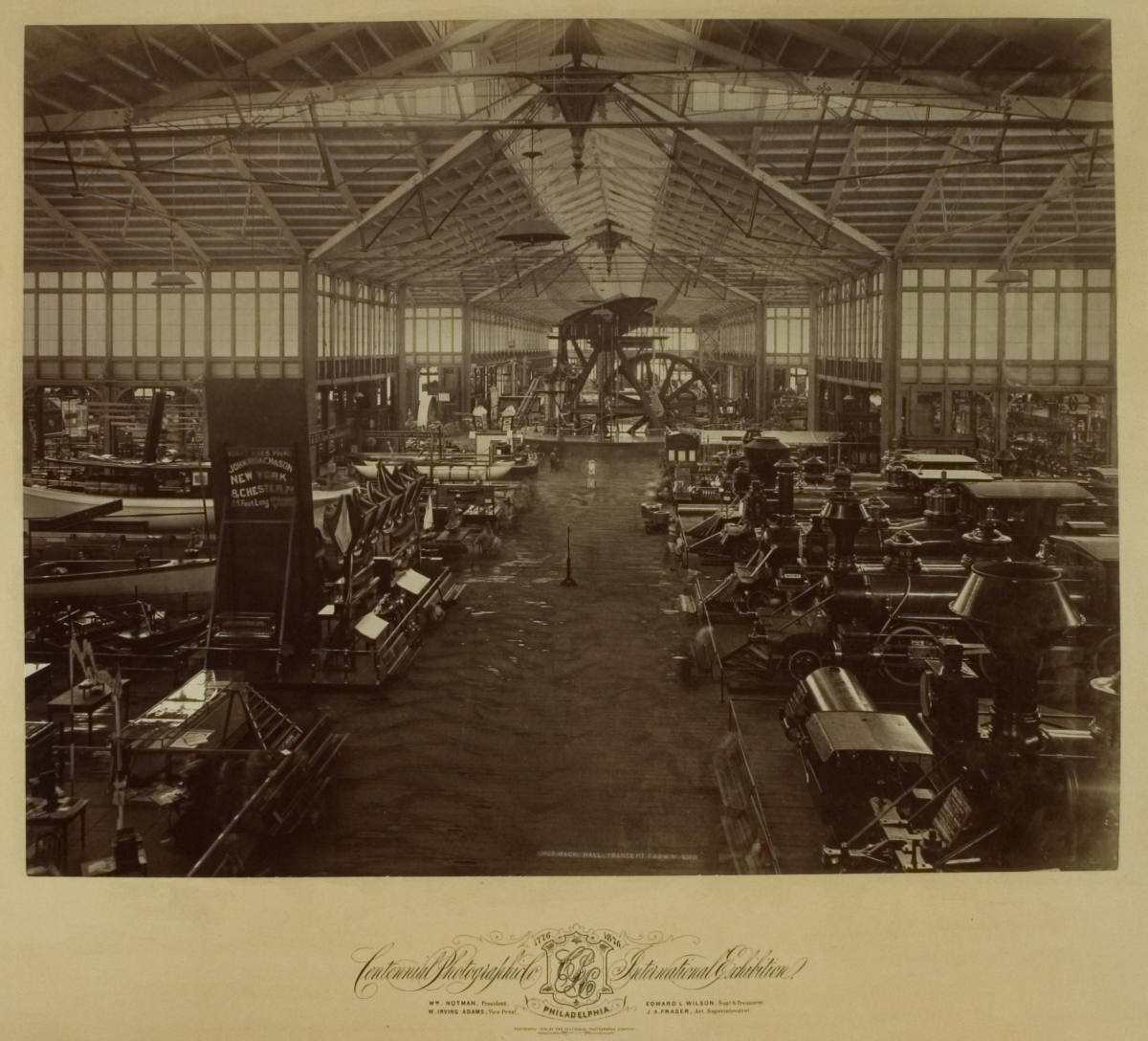
One of the most impressive parts of the Exhibition was the 14 acre “Machinery Hall” highlighting our industrial accomplishments. A 1,400 horsepower two cylinder Corliss steam engine with a 56 ton flywheel provided line shaft and steam power to 800 exhibits in the building. Agriculture, historical items, domestic goods and all sorts of other interests were featured in the 60,000 exhibits under a total of 75 acres of enclosed space. We were truly a leading world power. “The late unpleasantness” which had ended April 9, 1865 had faded, and the nation was reunified, and the Centennial was celebrated North and South.

Portion of the Machinery Hall, with the Corliss engine in the back, and new locomotives right foreground, steam launches front left.
Source
Military technology was also on display, and the Army Ordnance Department had an exhibit where workers made dummy .45-70 cartridges with a special headstamp, passed out as souvenirs.

A “draw set” showing detailed steps in making a cartridge in 1876.
Source
A “draw set” showing detailed steps in making a cartridge in 1876. For nerdy details on the centennial cartridge sets, and a view of the production line set up to make them, chase that Source above.

These were made with soft copper cases which later experienced extraction problems, possibly aggravated by verdigris build up from carrying in leather belts. The soft copper cases were later partially blamed for extraction problems in a famous battle.

To be continued ...


Sunday, August 31, 2025

John Blackshoe Sends: Serendipity History - West Point and Shrapnel (Part 2 of 2)

Part 1 covered a WW1 era artillery shell marked “WEST POINT, KY/ 1918” which lead to looking at connections with West Point, etc. Okay, that was enough about geography and names. Let’s get to the stuff that goes “BOOM!” The shell that initiated this quest is a “Shrapnel shell,” invented by Henry Shrapnel.

Shrapnel shell fired in flight at left, and bursting at right 
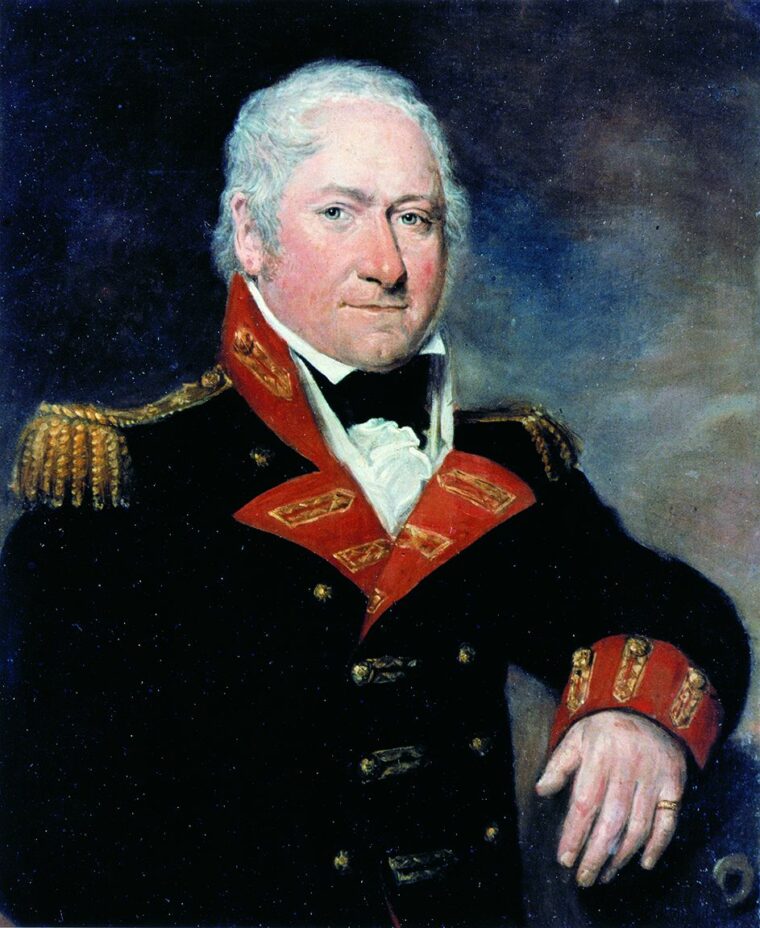
The legacy of two famous artillerists intersect in this artifact from West Point, KY. Both achieved the rank of Major General, both were named Henry, and they really do look somewhat alike. I bet they would have engaged in some fascinating, if arcane, discussions on artillery matters had they ever met.

Major General Henry Shrapnel, Royal Artillery (1761-1842) 
Major General Henry Knox, U.S. Army (1750-1806) 
At any range a single round, solid cannon ball (or “shot”) was deadly, but unlikely to strike more than one or a few people. A hollow explosive “shell” fuzed to burst some distance from the cannon would break into maybe 5-10 pieces which increased potential casualties.

At very short ranges, cannons could fire grape shot (bunches of medium size iron balls) or canister (basically a large can filled with lead or iron balls or scrap metal chunks) effectively becoming a huge shotgun. But, ballistics limited the effective range of grape of canister to maybe 200 yards. There was a need for something more effective against groups of troops at ranges of many hundreds of yards.

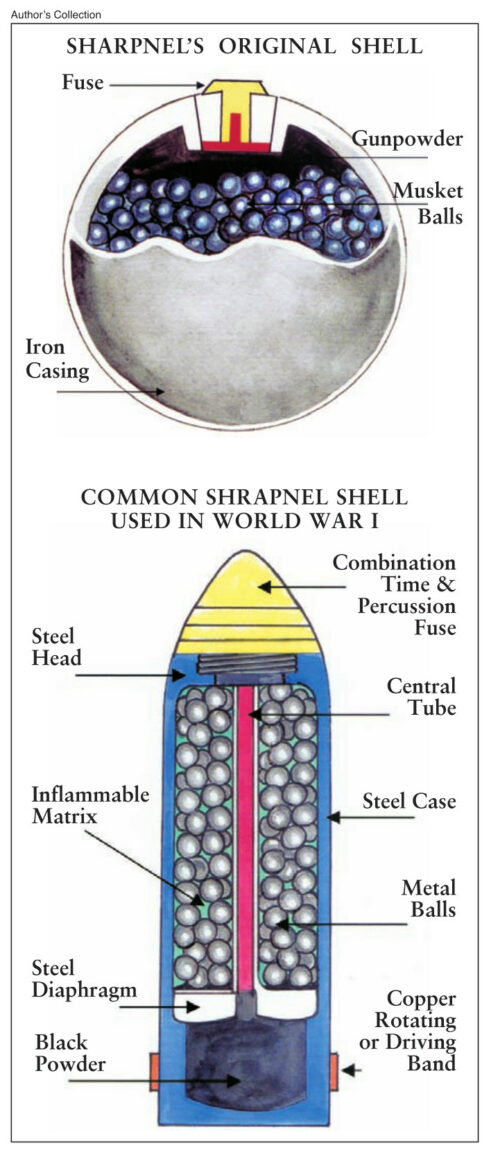
Around 1804 British ordnance officer Henry Shrapnel designed what was later called “spherical case shot” where a 12 pounder (4.62” diameter) shell would include 78 lead or iron balls (about .50 caliber or ½ inch diameter) mixed with the explosive filling so that there would be dozens of fragments and balls churning up the an area many hundreds of yards from the gun when the shell was exploded by the fuze. But, Shrapnel’s newfangled idea was only reluctantly and slowly adopted for use.

It was a still a relatively new concept during the Napoleonic Wars. At Waterloo, one source (which Sarge may or may not agree with²) claims:

Indeed, there are many military students who are of the opinion that Shrapnel’s murderous creation went a long way to being one of the decisive factors at Waterloo. General Sir George Wood, Wellington’s artillery commander, went so far as to state, “Without Shrapnel’s shells, the recovery of the farmhouse at La Haye Sainte, a key position in the battle, would not have been possible.”¹
 
Spherical Case Shell and Shrapnel Shell
When breech loading artillery came along, and increased use of elongated (bullet shaped) projectiles, Shrapnel’s concept evolved to what we see in the lower example above. Instead of a spherical burst in all directions. The elongated shells used a small charge behind a pusher plate at the back to blow all the balls out the front, pretty much like a shotgun being fired in the area of the target, with the shell body acting as the barrel, several hundred yards from the gun position. The nose fuze is blown off in the process, and a 4.7 inch shrapnel shell expels 711 balls, each the weight of a .45 auto bullet, to rake an area about a quarter of a football field.

U.S. 4.7 inch “Common” Explosive shell, Shrapnel Shell and 120 x 425mm rimmed cartridge case showing shell in place as a fixed round.
Ignorance and time have morphed the very specific term “Shrapnel” into a generic name for any fragment from an explosive round, such as splinters, shards or fragments created by explosive shells, while Shrapnel should be reserved for the now rare shells which expel large numbers of spherical shrapnel balls.


The 4.7 inch guns, Model of 1906 were pretty modern (for the time), and could be horse drawn, or pulled by a small bulldozer type tractor. Typical of the single trail designs of the period, elevation was restricted to about -5 to +15 degrees, and only about 8 degrees left to right. Max range was about 8,700 yards with the 45 pound projectile. Only about 209 were completed before the end of WW1, and only about 64 were actually shipped to serve in France. 

So, this souvenir from Camp Zachary Taylor’s artillery range at West Point, KY, is a relatively uncommon artifact from WW1. Part of the fun of collecting or studying historical artifacts is the opportunity (or necessity) of learning their serendipitous history.


¹ Shrapnel use at Waterloo.
² OAFS: Yes, I'm throwing the challenge flag on that. The Prussian arrival and the repulse of the Imperial Guard had more to do with the recapture of La Haye Sainte than the Shrapnel round, as its French captors were forced to retreat with the rest of their army. Nice story but not really.

Saturday, August 30, 2025

John Blackshoe Sends: Serendipity History - Familiar Names, Strange Places … West Point, Fort Knox? (Part 1 of 2)

“WEST POINT, KY / 1918 / 4 Point 7” marked on a fired 4.7 inch Shrapnel shell.
Author’s photo.
On May 12, 1962, General of the Army Douglas MacArthur left the Waldorf Astoria Hotel in New York City, his home from 1952 until his death in 1964. He was on his way to address the U.S. Military Academy Corp of Cadets, which would be his inspirational farewell speech on “Duty, Honor, Country.” He opened by remarking:

As I was leaving the hotel this morning, a doorman asked me, "Where are you bound for, General?" and when I replied, "West Point," he remarked, "Beautiful place, have you ever been there before?"¹

MacArthur had indeed been to West Point, NY, previously, graduating at the top of his class in 1903 after four years as a cadet, and as Superintendent from 1919 to 1922. Most Americans are familiar with the USMA at West Point, New York, and instantly think of that when they hear “West Point.”


Others have heard of the West Point Foundry, located across the Hudson River from the Military Academy, slightly upstream. Established in 1817 to cast iron cannon for the Army, it was a leader in that industry under management of Robert P. Parrott (USMA 1824), producing 2,000 cannon during the Civil War and over a million shells for them. The maker mark WPF and inspector mark RPP are on the black painted Parrot guns on most Civil War battlefields. The Foundry eventually closed when steel replaced cast iron for most military and industrial applications and new foundries grew in Pittsburgh to be closer to steel suppliers. For many the West Point Foundry is a second guess when they hear “West Point.”

Civil War historians may recall West Point on the Pamunkey River in Virginia, the origin of the York River. Created by the confluence of the Mattaponi and Pamunkey rivers, named after local Indian tribes. Jamestown’s founder Captain James Smith Pocahantas, girlfriend of, (not a Senator from Massachusetts) was a member of the Pamunkey tribe.) This “West Point” name is not related to geography, but comes from the settler who built a plantation there, Colonel John West. “West’s Point” evolved to merely West Point. It was a base of operations for the Union Army while they destroyed Confederate supplies east of Richmond in May 1863, before being withdrawn when Lee moved north for the Gettysburg campaign.

Actually, at least 24 places in 20 states are named “West Point.”


But, I was recently surprised to find “West Point, KY” painted on the WW1 Artillery shell shown above, which was “none of the above” locations.

My first guess was that maybe USMA cadets had some adventures in Kentucky in 1918 and created this as a souvenir. Further research revealed a much more interesting story about military bases and how they grew.

When the U.S. entered WW1, our Army was expanded far beyond any previous notions, requiring massive numbers of men, uniforms and equipment, small arms, artillery, and bases to house and train them, and ranges to make them proficient with their new weapons.

Artillery ranges were especially difficult to create due to the large danger areas surrounding the firing points. Most field artillery used 75mm or nearly identical 3 inch guns firing shells weighing about 12-16 pounds. We also had a modest number of Model 1906 4.7 inch guns (120mm) firing 45 to 60 pounds shells, and by the end of the war had adopted French 155mm (6 inch) with 95 pound shells as well. Bigger guns required bigger shooting ranges.


Camp Zachary Taylor was one of 16 new posts built in the summer of 1917 to handle the expansion of the Army. It was located on the southern fringe of Louisville, Kentucky. In less than 90 days the camp began to receive 44,000 troops in newly constructed barracks and eventually over 1700 structures were built on the 4,400 acre camp. One of the camp’s functions was to train artillerymen for the newly formed 84th division. But, the area was too built up for safe artillery firing exercises.

Bayonet fencing practice at Camp Zachary Taylor. They are using heavy wooden dummy rifles the same length as a M1903 Springfield with bayonet fixed. This was NOT due to a lack of real rifles, but to keep their real rifles from getting really beat up. The USMC uses “Mokuju” wooden rifles for bayonet practice in their “Combatives” training for the same reason.

In December 1917, land was leased at West Point, Kentucky about 22 miles southwest of Camp Zachary Taylor for a new firing range, easily accessible by road, railroad or the Ohio River. Land there had previously been used for military maneuvers involving several thousand troops. This was mainly farmland along the Ohio River at the confluence with the Salt River, site of one of Kentucky’s oldest settlements founded in 1776, and at that time the western most point of “English” settlement. It had taken over 150 years for the edge of the American frontier to move the 600 miles over the Appalachian Mountains from West Point on the Pamunkey to West Point, Kentucky, on the Ohio.

4.7 Inch Field Gun Model of 1906
The West Point ranges were only used for a few months, amid growing concerns about frequent flooding of the low lying lands along the river. So, in April 1918 the Army elected to move to higher ground to escape potential flooding problems, and set up a much larger artillery operation in the nearby hamlet of Stithton, KY, forcing the residents to move elsewhere. This new facility was designed as a Field Artillery Brigade Firing Center Cantonment for six brigades, about 45,000 men.²

Major General William Snow was head of the Army Field Artillery (“and those caissons go rolling along…”) and needed this Stithton, Kentucky, training site and another new one in North Carolina in addition to existing artillery posts in South Carolina and Oklahoma.

Of course, every new Army post needed a name, so:

[Snow] … told his deputy to give both camps their names. His one stipulation: they have to be short.

"I'm growing tired of writing Camp Zachary Taylor. I want the names short. They've got to be five letters or less and named after a distinguished artillery officer,'" … So [the deputy] came up with Bragg after Civil War General Braxton Bragg, and Knox after Revolutionary War General and Secretary of War Henry Knox.³


Thus began Camp Knox, later Fort Knox, famous as the home of U.S. Armor and the George S. Patton Museum. (His ivory handled Colt Single Action revolver is in the museum along with several other guns from his personal collection.) But, times change, and artillery is long gone from Fort Knox, and all the armor moved in 2011 to Fort Benning, GA. Meanwhile, the Army built an 883,000 square foot three story, six winged palace for the “Army Human Resources Center of Excellence.” This is the largest office building in the state of Kentucky. This consolidated several far flung paper-shuffling and body snatcher commands into a single location. Thus Fort Knox, named for an artilleryman, famous for armor is now home to personnel management staffies. Perhaps a fitting new name would be Fort Peter Principle.

There is a nice video from Kentucky PBS TV on the history of Camp Zachary Taylor, including a number of motion picture clips of artillery which are undoubtedly from the West Point range. A 4.7 inch gun is shown firing at about 7:19 in the 7:59 minute video.


Entrance to Fort Knox and the Armor Center some years ago.
Source
In 1936 Fort Knox was reduced by 42 acres transferred to the Treasury Department where they built the United States Bullion Depository, called “Fort Knox” by everyone but the Army and Treasury Department.

But, wait, there’s more!

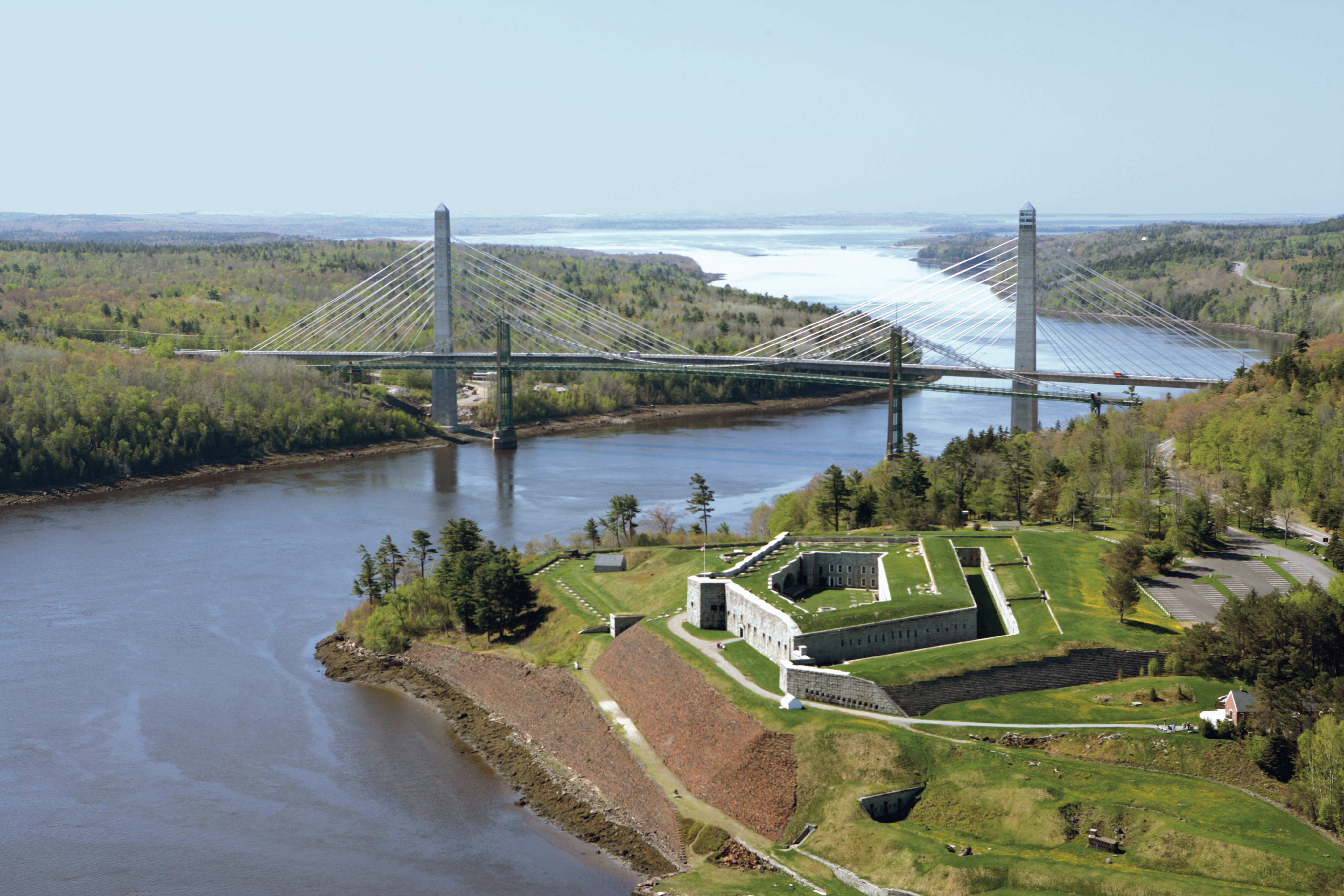
Kentucky’s Fort Knox was the second fort named for the great, rotund artillerist, and the first was Fort Knox on the Penobscot River in Maine, near the now sleepy town of Castine, home of the Maine Maritime Academy.

Fort Knox on the Penobscot River near Castine, Maine.
Source
So, why was a massive granite fort built on the Penobscot River near Castine, Maine?

(Most of this section on Castine comes from here. Which I highly recommend for the full, complex story of this location.)

The Penobscot region was a strategic point, with Castine receiving French settlers seven years before the Pilgrims landed at Plymouth Rock, and only six years after John Smith and his expedition settled at Jamestown. The Penobscot was a key entry into the interior for the fur trade, which was the impetus to much of the exploration and settlement of North America.⁴

The French were busy settling that part of the Atlantic coast as “Acadia” and over the next century or so frequently traded possession of Castine with the British who had settled to the south and considered that “Down East” portion of [then] Massachusetts to be theirs. The Brits twice named it “New Ireland” presumably to complement nearby Nova Scotia

Interrupting the bilateral feuding, the Dutch seized the area around Castine from 1674 to 1676. (The Dutch had claimed much of the land between Connecticut and the Chesapeake as “New Netherlands” around 1613 but were pushed aside by the bigger colonizers. The Dutch had squeezed out the Swedish settlements made along the Delaware river circa 1638-1655. Remember all this when someone tell you national borders are sacrosanct and must be defended by other nations’ blood and treasure.

With the American Revolution, Castine became an American town, and was attacked and captured by the British. Provincial Massachusetts (not the Continental Congress) assembled a massive invasion force with 44 ships in July 1779 for an unmitigated disaster trying to evict the Brits. Americans regained control with the peace agreement at the end of the war.

During the War of 1812, the Brits again attacked and seized Castine, again proclaiming it “New Ireland” and again relinquishing it at the end of the war. Massachusetts settlers (refugees?) flocked to rural Maine, far from Bostonian whims, and in 1820 it split off from Massachusetts and was admitted to the union as a free state to balance the statehood for Missouri, as a slave state.

After nearly two centuries of frequent conflict around Penobscot Bay, and continued mistrust of the British/Canadians to the north, construction began on Fort Knox in 1844, whose name sake had retired to Thomaston, Maine about 20 miles southwest of the new fort. One of the first mostly granite instead of brick masonry “star” forts, construction continued slowly until 1869 when both the importance of the Penobscot River region and usefulness of coastal fortifications had diminished so that it was no longer worth continuing construction. The fort had 74 guns of various types mounted at its height in the1860s, but only a small and transient garrison during the Civil War. A few hundred Connecticut volunteers were stationed there during the Spanish American War. Beginning in 1900, it had only a single Ordnance Sergeant caretaker, until it was declared surplus and sold to the State of Maine in 1923, becoming a state park in 1943.

Thus an old artillery shell led to some familiar and unfamiliar places, like West Point and Fort Knox. We’ll take a look at the shell to understand “Shrapnel” in Part 2.


¹ Speech - It also has MP3 audio of the address which is even more moving in MacArthur’s raspy voice.
The importance of the fur trade to the exploration, settlement and economic growth of North American colonies is sorely neglected. Eric Jay Dolan’s Fur, Fortune, and Empire: The Epic History of the Fur Trade in America is a great read and most highly recommended! (Used copies less than $10 at ABEbooks.com)

Wednesday, July 30, 2025

John Blackshoe Sends: Serendipity History – Elephants? A book report and some brief history...

Big, beautiful beasts, they are. But, I knew almost nothing about them, even though my earliest childhood memory is when a circus came to town, via rail car, and an elephant waved his trunk at ME! I think I waved back, and then hid.

Source
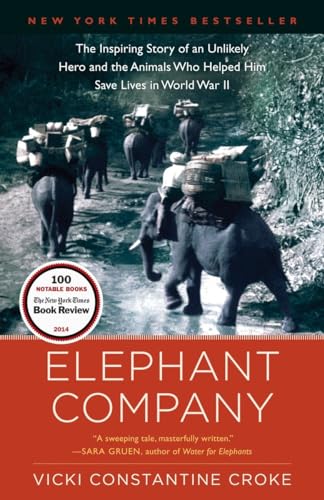
We picked up the audio book version of Elephant Company by Vicki Constantine Croke for a recent trip. It turned out to be really interesting and full of unexpected tidbits.

It is a mixture of the intertwined stories of a magnificent elephant, Bandoola, and how he was raised, used (sometimes abused), and served first in the teak logging industry in Burma, and then in the British SOE during WW2. He is really the main character of the book.

Bandoola was inextricably linked with one James Howard Williams (eventually known as “Elephant Bill”), an iconoclast Brit of some privilege who served in the Middle East during WW1 with the Camel Corps and mules, where he read a book on “The Diseases of the Camel and the Elephant,” which I hope none of us will ever see or read. However, post WW1 he aspired to learn more about elephants, and signed on with the Bombay and Burma Teak Company as a “Forest Assistant.” A job, usually the only Englishman within many miles, responsible for getting teak trees cut and then hauled to the closest river where the logs would be flushed downstream by monsoon rains for processing and shipment to the UK for ship building. Of course, this involved being properly attired, accoutered and provided with suitable tentage, gin, etc as befits the dignity of an English gentleman in a colonial outpost, supervising hordes of locals and the dozens of elephants needed to do the heavy lifting. The company held them responsible for the care, feeding and training of the very expensive investments in 2,000 pachyderms in ten camps. To get to work, he took a steamer to Rangoon, partied a few days in civilization, then took a small steamer (one step above “African Queen” size) a couple of days up the Irrawaddy river to the base of the mountains where the camps were.

To understand “Elephant Bill” Williams, or Bandoola, the author injects a steady stream of information about elephants, their extreme intelligence, social habits, even a bit on mating habits. They are the largest land mammals, with the male Asian elephants running about nine feet high weighing about four tons. They are very social, with a matriarchal leadership. A lot of coverage is given to training elephants, both the traditional “beat them until they obey” approach, and a kinder, gentler rewards and praise approach William learned from the old guy who trained Bandoola. This lead to the Company setting up “elephant school” to train calves on proper behavior and work skills, which seemed to be very effective.

All of this is in the confusing cultural context of the time and place where the Burmese were near revolt against their colonial masters, but dependent on them for trade and maintaining order. Throw in a healthy dose of ethnic or clan differences between Burmese, Indian, Thai, British and eventually Japanese players, and just a bit of failure to communicate keeps it unpredictable.


With the outbreak of WW2, and Japanese overrunning vast areas of Asia, they eventually got to Burma, coming up the rivers, ending the teak trade. British and Indian forces operated in Burma to link with the Chinese to fight the Japs, and building roads was a top priority. “Elephant Bill” volunteered his services and his 1,600 elephants becoming a Lieutenant Colonel. First as part of the Indian Army as mere transport animals, then as part of the General Slim’s 14th Army as a Special Operations Executive unit for bridge building.

As the Japs pushed further inland, unprepared Brits and loyal Burmese and Ghurka families fled further into the interior, suffering horrible losses. Eventually they were in extremely rough terrain, and just barely escaped after using the elephants to help carve out a dangerous trail to get over the last geographic obstacles to reach the Indian border.


This book left a profound appreciation for the elephant species, and their ability to work with man. Also, immense appreciation of Bandoola and Elephant Bill, who were both about the same age. Plus a better understanding of the geography of Burma, and the cultures of its people, and the history of WW2 in that remote corner of the war.

If you like hard copy books, this is available on AbeBooks.com and other places for under $10.00. Since driving prevents me from reading for many hours at a time, I really enjoy audio books. Audio versions may be free at your library or available from digital sources to download to your phone or some such tech wizardry.


This made me dig a little deeper and discover that Elephants have been important military assets for many centuries. Not in our European military annals, but certainly in Asian and some African regions. Their sheer size, and invulnerability to primitive cut and thrust weapons made them nearly invincible on the battlefield. Their bulk and ability to follow commands made them resistant to cavalry attacks, and deadly against Infantry, along with handy at hauling all the stuff an army needed. 

Source
Remember, Hannibal had elephants with him in 218 BC when he crossed the Alps, although more at the start than at the end, elephant chow is scarce in snowy mountains. There are lots more examples if you dig into “War Elephants.”


One British publisher, Helion, (sort of a more scholarly version of Osprey) has a whole book on War Elephants, or at least the period from 1380 to 1700. The publisher’s note shows there is much one can learn on the subject, if interested.

“Elephants and Gunpowder presents for the first time a chronological, detailed and richly illustrated account of the development of warfare in mainland Southeast Asia during the Early Modern Period. It begins by describing the region’s medieval military inheritance that was dominated by the use of war elephants. Firearms began to appear during the late fourteenth century and would be used alongside elephants and cavalry in a long series of wars between Burma (Myanmar) and Siam (Thailand). Exciting sieges and dramatic naval combat are also discussed along with much fascinating material about beliefs in omens and divination and the impact of foreign mercenaries. While cannons fire around them elephants act as mounts for noble hand-to-hand combat, as living battering rams to use against city gates and, in the form of the precious and much coveted white elephant, as both an excuse and a pretext for war itself. The text is complemented by a large number of carefully selected photographs, maps and specially commissioned artwork that present the arms and armaments of the Southeast Asian warrior and his elephants in a way never seen before.”

Source
Elephants are also used for sporting purposes, such as hunting tigers in India. Westley Richards, made “Howdah pistols,” massive double barrel affairs carried as a last resort if the tiger begins to attack the wicker Howdah basket in which the hunter is carried on their elephant. The Illustrated London News of April 1, 1876 had a lengthy illustrated article on HM The Prince of Wales (an old respected one, not the domesticated Ginger spare) including this image:

So, there is a lot to learn about elephants.


Tuesday, July 29, 2025

John Blackshoe Sends: Serendipity History – Welcome Home to those who were Soldiers Once… And Young

Source
“Some had families waiting, for others their only family would be the men they bled beside, there were no bands, flags no honor guards to welcome them home, they went to war because their country ordered them to, but in the end they fought not for country or their flag, they fought for each other.
 
We who have seen war will never stop seeing it, in the silence of the night we will always hear the screams. So this is our story... For we were soldiers once and young.”
Source: Lt. Gen. Harold G. Moore and Joseph L. Galloway, We Were Soldiers Once...and Young: Ia Drang - The Battle That Changed the War in Vietnam


We’ve enjoyed Sarge’s well spun yarn about bold lads who rallied to the colors of whatever nation or principality appealed to them in 1815, and suffered the hardships, glory, boredom and dangers of adventuresome military life. 

The Napoleonic wars ended in 1815 and Europe returned to its customary low intensity conflicts over now forgotten trivia. The brave veterans returned home to family or friends with or without celebrations by entire nations. 

Life went on, and the vast majority shed the uniform and the security of shillings, franks, marks or rubles earned by a soldier. They resumed former occupations or trades, mostly unskilled, to eke out subsistence, inevitably advancing from youthfulness to middle aged, to elderly, then decrepit, and eventually dust unto dust.

British veteran Henry Maidment (ca. 1795-1868) and wife circa 1866 about 50 years after his military service. (Colorized)
(More on them below, based on same source as photo.¹)
Source
We are talking of thousands, hundreds of thousands or millions of soldiers who survived serving their nation, and returned home.

But, what of them after they returned home? Some probably were welcomed by loving families, or discovered family members had perished from disease or accidents. Some might have returned to discover an unfaithful spouse had decamped with Jody’s ancestor, leaving them alone, for better or worse. 

Returning to civilian life was not always a return to normalcy, for once they had “seen the elephant” many were changed for life, physically maimed, debilitated by disease, or cursed by mental health issues common to those who have seen what should never be seen. But, they did the best they could, finding work of some sort, shelter somewhere and perhaps solace with family or friends, or in a bottle.

The shabbily dressed pensioner above is Napoleonic War veteran Henry Maidment (ca. 1795-1868). He proudly wears his Military General Service Medal on his lapel. He fought in the Battles of Talavera, Salamanca, Vittoria, Pyrenees, Nivelle and Toulouse. For this, he earned the Military General Service Medal with clasps. His battalion had even accompanied Napoleon Bonaparte into exile on the island of St Helena in 1815. Each of his major battles was represented by a clasp on the ribbon. Such a medal was valued in 2006 to be worth £3,700 to collectors, but back then it would not buy him a pint at the pub.

Henry was an agricultural labourer who lived in the North Dorset village of Pimperne. 

In 1866, Henry was one of the few surviving British Army veterans who had fought Napoleon Bonaparte’s French Army in the Spanish Peninsular War.

At this stage in life, he could not work and had hit hard times. He was surviving on a parish handout of just two shillings and sixpence (12.5p) per week and a single loaf of bread. The octogenarian pauper had, in reality, a distinguished military record but no military pension. 

Details of Henry Maidment’s medal. 
With a commanding stare like that I bet he was a Sergeant.
Henry died a couple of years after the photo was taken, and buried on 26 March 1868 in the graveyard of St. Peter’s Church, Pimperne. He had lived in an era when an agricultural labourer rarely left his home village. However, as a soldier he experienced Ireland, Portugal, Spain and France and would have visited cities such as Cork, Porto, Toulouse and Bordeaux. (Source)


Veterans of our own Civil War (1861-1865) aged as well. Half a century after the horrific bloodshed at Gettysburg, veterans from both sides returned to Gettysburg to commemorate that event, and mourn their lost comrades. Handshakes between former enemies were exchanged, with wounds of that lost cause slowly healing and our nation reuniting. Sadly, 110 years later haters would engage in a Stalinesque eradication of memorials to half those Americans in that war. History includes the whole truth, not just propaganda beloved by a few in power.

Union and Confederate veterans shaking hands at reunion to commemorate the 50th anniversary of the battle of Gettysburg. (PD)
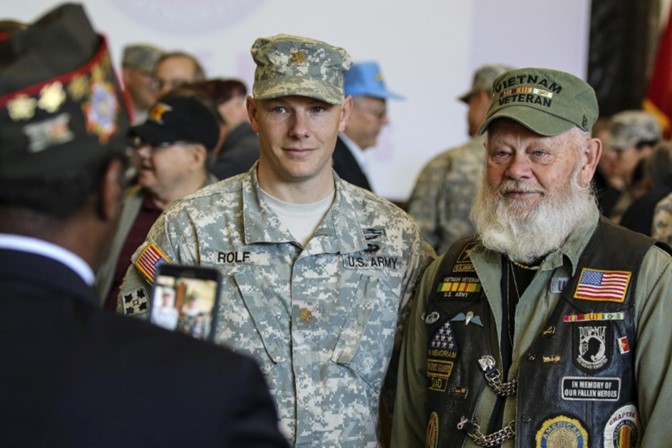
On 29 March 1975 the last American combat troops left Vietnam. Thus ending that game of dominoes which lasted nearly 20 years, and starting a string of second place finishes driven by “higher” despite the heroic efforts of those who actually fought. Vietnam era vets are rapidly rejoining their former comrades in arms on Fiddlers Green or Valhalla, or wherever their theological beliefs might take them.

Unidentified Vietnam Vet from the VA website (cropped)
Source
Some New England Vietnam vets: Vietnam War veterans (from l to r) Howie Thomas, Paul Anderson, Kevin Sullivan and Bill Benson pose together in from of West Haven City Hall in front of the Vietnam Veterans Day banner in West Haven, Conn., on Tuesday April 22, 2025. Christian Abraham/Hearst Connecticut Media
Source 

St. Landry Parish, LA, veterans listen to presentations during 2023 commemoration event at the parish Veteran’s Memorial.
Vets have a special bond, and have experiences others may not understand. They can share among themselves the good times and bad, and perhaps forget some of the bad.

Thank you to all veterans!


¹ This image is available from several sources, but this is colorized and really brings out the fact we are talking about real people. Various sources lack, or have conflicting, biographical information on Maidment. A quick check of genealogical sources confirm the gist of this account of his life.