Part 1 covered a WW1 era artillery shell marked “WEST POINT, KY/ 1918” which lead to looking at connections with West Point, etc. Okay, that was enough about geography and names. Let’s get to the stuff that goes “BOOM!” The shell that initiated this quest is a “Shrapnel shell,” invented by Henry Shrapnel.
 |
Shrapnel shell fired in flight at left, and bursting at right |
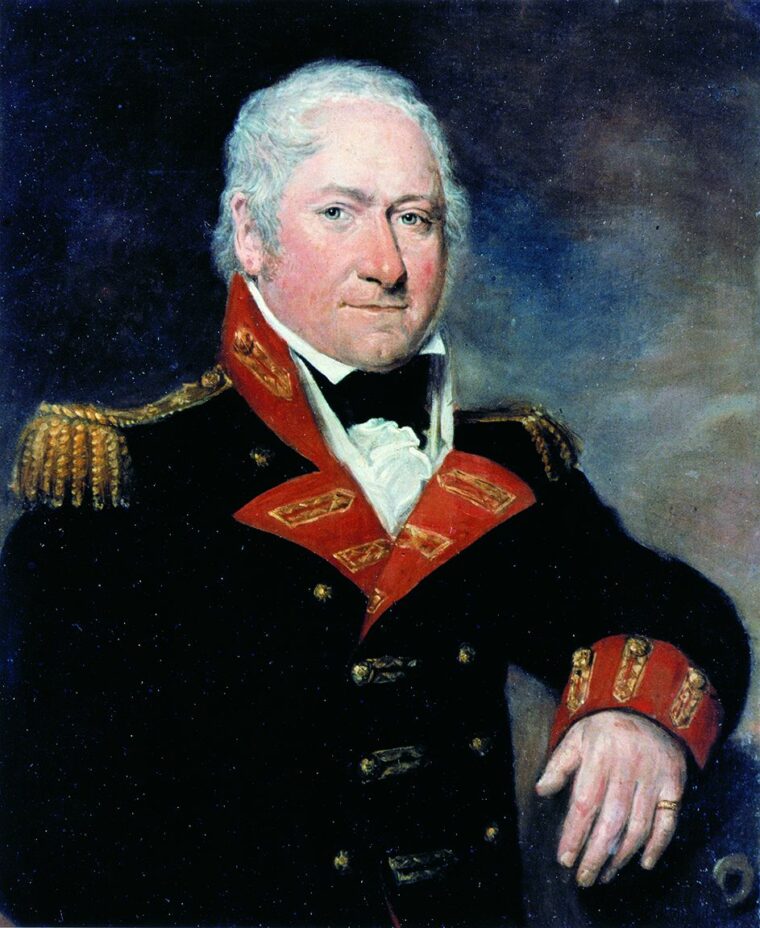
The legacy of two famous artillerists intersect in this artifact from West Point, KY. Both achieved the rank of Major General, both were named Henry, and they really do look somewhat alike. I bet they would have engaged in some fascinating, if arcane, discussions on artillery matters had they ever met.
 |
Major General Henry Shrapnel, Royal Artillery (1761-1842) |
 |
Major General Henry Knox, U.S. Army (1750-1806) |
At any range a single round, solid cannon ball (or “shot”) was deadly, but unlikely to strike more than one or a few people. A hollow explosive “shell” fuzed to burst some distance from the cannon would break into maybe 5-10 pieces which increased potential casualties.
At very short ranges, cannons could fire grape shot (bunches of medium size iron balls) or canister (basically a large can filled with lead or iron balls or scrap metal chunks) effectively becoming a huge shotgun. But, ballistics limited the effective range of grape of canister to maybe 200 yards. There was a need for something more effective against groups of troops at ranges of many hundreds of yards.
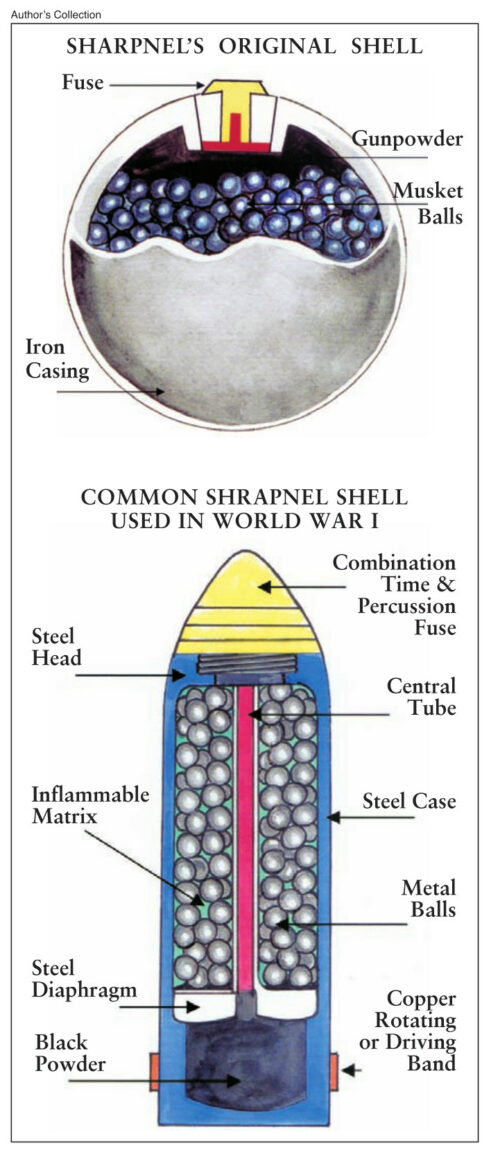
Around 1804 British ordnance officer Henry Shrapnel designed what was later called “spherical case shot” where a 12 pounder (4.62” diameter) shell would include 78 lead or iron balls (about .50 caliber or ½ inch diameter) mixed with the explosive filling so that there would be dozens of fragments and balls churning up the an area many hundreds of yards from the gun when the shell was exploded by the fuze. But, Shrapnel’s newfangled idea was only reluctantly and slowly adopted for use.
It was a still a relatively new concept during the Napoleonic Wars. At Waterloo, one source (which Sarge may or may not agree with²) claims:
Indeed, there are many military students who are of the opinion that Shrapnel’s murderous creation went a long way to being one of the decisive factors at Waterloo. General Sir George Wood, Wellington’s artillery commander, went so far as to state, “Without Shrapnel’s shells, the recovery of the farmhouse at La Haye Sainte, a key position in the battle, would not have been possible.”¹
 |
Spherical Case Shell and Shrapnel Shell |
When breech loading artillery came along, and increased use of elongated (bullet shaped) projectiles, Shrapnel’s concept evolved to what we see in the lower example above. Instead of a spherical burst in all directions. The elongated shells used a small charge behind a pusher plate at the back to blow all the balls out the front, pretty much like a shotgun being fired in the area of the target, with the shell body acting as the barrel, several hundred yards from the gun position. The nose fuze is blown off in the process, and a 4.7 inch shrapnel shell expels 711 balls, each the weight of a .45 auto bullet, to rake an area about a quarter of a football field.
 |
U.S. 4.7 inch “Common” Explosive shell, Shrapnel Shell and 120 x 425mm rimmed cartridge case showing shell in place as a fixed round. |
Ignorance and time have morphed the very specific term “Shrapnel” into a generic name for any fragment from an explosive round, such as splinters, shards or fragments created by explosive shells, while Shrapnel should be reserved for the now rare shells which expel large numbers of spherical shrapnel balls.

The 4.7 inch guns, Model of 1906 were pretty modern (for the time), and could be horse drawn, or pulled by a small bulldozer type tractor. Typical of the single trail designs of the period, elevation was restricted to about -5 to +15 degrees, and only about 8 degrees left to right. Max range was about 8,700 yards with the 45 pound projectile. Only about 209 were completed before the end of WW1, and only about 64 were actually shipped to serve in France.
So, this souvenir from Camp Zachary Taylor’s artillery range at West Point, KY, is a relatively uncommon artifact from WW1. Part of the fun of collecting or studying historical artifacts is the opportunity (or necessity) of learning their serendipitous history.

¹ Shrapnel use at Waterloo.
² OAFS: Yes, I'm throwing the challenge flag on that. The Prussian arrival and the repulse of the Imperial Guard had more to do with the recapture of La Haye Sainte than the Shrapnel round, as its French captors were forced to retreat with the rest of their army. Nice story but not really.




Couple of fascinating posts this Labor Day weekend JB, I see a number of such guns survive near a fair number of VFW/American Legion Posts around the country among other spots.
ReplyDeleteMost of the ones I see are the French 155's from WWI which were modernized with rubber tires for WWII.
DeleteBG
Very nice exegesis on the use of artillery. I'll offer https://49thohio.com/wp-content/uploads/2014/07/Kautz_NCOs_guide.pdf (that SHOULD open to page 106) From the 1864: CUSTOMS OF SERVICE FOR NON-COMMISSIONED OFFICERS AND SOLDIERS
ReplyDeleteAS Derived from Law and Regulations AND PRACTISED IN THE ARMY OF THE UNITED STATES BEING A HAND-BOOK FOR THE RANK AND FILE OF THE ARMY SHOWING WHAT ARE THE RIGHTS AND DUTIES, HOW TO OBTAIN THE FORMER AND PERFORM THE LATTER, AND THEREBY ENABLING THEM TO SEEK PROMOTION AND DISTINCTION IN THE SERVICE OF THEIR COUNTRY.
BY AUGUST V. KAUTZ CAPT. SIXTH U.S. CAVALRY, BRIG.-GEN. U.S. VOLUNTEERS
( I just LOVE those short titles!)
For your culinary pleasure, scroll down to page 115 for how to cook beef!!
Great little book with long title has just about everything you need to know as a soldier (in the U.S. Army as of 1864). I'll pass on their recipes, however.
DeleteJB
JB, wise move. I tried some at reenactments. Grim. Of course, I also tried one on just cornbread, salt pork, and coffee.
DeleteBut, considering that many, maybe most, of the men had never cooked anything it at least gives them a starting point.
That was super interesting JB. Thanks! (And I had no idea there was an actual Shrapnel fellow.)
ReplyDeleteThanks Brother! So many people use the term "shrapnel" incorrectly; when what they are referring to are "shell fragments". The advent of reliable mechanisms to achieve air burst largely put paid to actual shrapnel rounds.
ReplyDeleteBoat Guy
If Major General Henry Knox, was a Kentuckian his ancestors here in KY have certainly taken after his girth.
ReplyDeleteKnox was from Boston, and post-Secretary of War in Washington he retired to Maine, so no hereditary connection to Bluegrass staters.
DeleteSarge's note 2 credits victory to the arrival of the Prussians, contrary to the claims of the head of British artillery that HIS guys won the battle. I think Sarge's version is more credible. JB
ReplyDelete😎
DeleteI guess I'm one of the guys whose use of the word "shrapnel" has been a little off. For nearly 60 years now (Nov 1965-2025) I have had a piece of lead, curiously rifled, with a threaded top, in use a paperweight on my desk. My crew chief gave it to me the day after "THE DAY". He had dug it out of the wing root of my Phantom (McDonnell Douglas, bless you) near the hole where the leading edge flaps, etc., etc. had been removed most violently on a sunny afternoon up North a bit. Good to meet the man who bore the name. I had no idea. Thanks.
ReplyDeleteFuzz, D4