 |
| “WEST POINT, KY / 1918 / 4 Point 7” marked on a fired 4.7 inch Shrapnel shell. Author’s photo. |
On May 12, 1962, General of the Army Douglas MacArthur left the Waldorf Astoria Hotel in New York City, his home from 1952 until his death in 1964. He was on his way to address the U.S. Military Academy Corp of Cadets, which would be his inspirational farewell speech on “Duty, Honor, Country.” He opened by remarking:
As I was leaving the hotel this morning, a doorman asked me, "Where are you bound for, General?" and when I replied, "West Point," he remarked, "Beautiful place, have you ever been there before?"¹
MacArthur had indeed been to West Point, NY, previously, graduating at the top of his class in 1903 after four years as a cadet, and as Superintendent from 1919 to 1922. Most Americans are familiar with the USMA at West Point, New York, and instantly think of that when they hear “West Point.”

Others have heard of the West Point Foundry, located across the Hudson River from the Military Academy, slightly upstream. Established in 1817 to cast iron cannon for the Army, it was a leader in that industry under management of Robert P. Parrott (USMA 1824), producing 2,000 cannon during the Civil War and over a million shells for them. The maker mark WPF and inspector mark RPP are on the black painted Parrot guns on most Civil War battlefields. The Foundry eventually closed when steel replaced cast iron for most military and industrial applications and new foundries grew in Pittsburgh to be closer to steel suppliers. For many the West Point Foundry is a second guess when they hear “West Point.”
Civil War historians may recall West Point on the Pamunkey River in Virginia, the origin of the York River. Created by the confluence of the Mattaponi and Pamunkey rivers, named after local Indian tribes. Jamestown’s founder Captain James Smith Pocahantas, girlfriend of, (not a Senator from Massachusetts) was a member of the Pamunkey tribe.) This “West Point” name is not related to geography, but comes from the settler who built a plantation there, Colonel John West. “West’s Point” evolved to merely West Point. It was a base of operations for the Union Army while they destroyed Confederate supplies east of Richmond in May 1863, before being withdrawn when Lee moved north for the Gettysburg campaign.
Actually, at least 24 places in 20 states are named “West Point.”
But, I was recently surprised to find “West Point, KY” painted on the WW1 Artillery shell shown above, which was “none of the above” locations.
My first guess was that maybe USMA cadets had some adventures in Kentucky in 1918 and created this as a souvenir. Further research revealed a much more interesting story about military bases and how they grew.
When the U.S. entered WW1, our Army was expanded far beyond any previous notions, requiring massive numbers of men, uniforms and equipment, small arms, artillery, and bases to house and train them, and ranges to make them proficient with their new weapons.
Artillery ranges were especially difficult to create due to the large danger areas surrounding the firing points. Most field artillery used 75mm or nearly identical 3 inch guns firing shells weighing about 12-16 pounds. We also had a modest number of Model 1906 4.7 inch guns (120mm) firing 45 to 60 pounds shells, and by the end of the war had adopted French 155mm (6 inch) with 95 pound shells as well. Bigger guns required bigger shooting ranges.
Camp Zachary Taylor was one of 16 new posts built in the summer of 1917 to handle the expansion of the Army. It was located on the southern fringe of Louisville, Kentucky. In less than 90 days the camp began to receive 44,000 troops in newly constructed barracks and eventually over 1700 structures were built on the 4,400 acre camp. One of the camp’s functions was to train artillerymen for the newly formed 84th division. But, the area was too built up for safe artillery firing exercises.
 |
Bayonet fencing practice at Camp Zachary Taylor. They are using heavy wooden dummy rifles the same length as a M1903 Springfield with bayonet fixed. This was NOT due to a lack of real rifles, but to keep their real rifles from getting really beat up. The USMC uses “Mokuju” wooden rifles for bayonet practice in their “Combatives” training for the same reason. |
In December 1917, land was leased at West Point, Kentucky about 22 miles southwest of Camp Zachary Taylor for a new firing range, easily accessible by road, railroad or the Ohio River. Land there had previously been used for military maneuvers involving several thousand troops. This was mainly farmland along the Ohio River at the confluence with the Salt River, site of one of Kentucky’s oldest settlements founded in 1776, and at that time the western most point of “English” settlement. It had taken over 150 years for the edge of the American frontier to move the 600 miles over the Appalachian Mountains from West Point on the Pamunkey to West Point, Kentucky, on the Ohio.
 |
4.7 Inch Field Gun Model of 1906 |
The West Point ranges were only used for a few months, amid growing concerns about frequent flooding of the low lying lands along the river. So, in April 1918 the Army elected to move to higher ground to escape potential flooding problems, and set up a much larger artillery operation in the nearby hamlet of Stithton, KY, forcing the residents to move elsewhere. This new facility was designed as a Field Artillery Brigade Firing Center Cantonment for six brigades, about 45,000 men.²
Major General William Snow was head of the Army Field Artillery (“and those caissons go rolling along…”) and needed this Stithton, Kentucky, training site and another new one in North Carolina in addition to existing artillery posts in South Carolina and Oklahoma.
Of course, every new Army post needed a name, so:
[Snow] … told his deputy to give both camps their names. His one stipulation: they have to be short.
"I'm growing tired of writing Camp Zachary Taylor. I want the names short. They've got to be five letters or less and named after a distinguished artillery officer,'" … So [the deputy] came up with Bragg after Civil War General Braxton Bragg, and Knox after Revolutionary War General and Secretary of War Henry Knox.³
Thus began Camp Knox, later Fort Knox, famous as the home of U.S. Armor and the George S. Patton Museum. (His ivory handled Colt Single Action revolver is in the museum along with several other guns from his personal collection.) But, times change, and artillery is long gone from Fort Knox, and all the armor moved in 2011 to Fort Benning, GA. Meanwhile, the Army built an 883,000 square foot three story, six winged palace for the “Army Human Resources Center of Excellence.” This is the largest office building in the state of Kentucky. This consolidated several far flung paper-shuffling and body snatcher commands into a single location. Thus Fort Knox, named for an artilleryman, famous for armor is now home to personnel management staffies. Perhaps a fitting new name would be Fort Peter Principle.
There is a nice video from Kentucky PBS TV on the history of Camp Zachary Taylor, including a number of motion picture clips of artillery which are undoubtedly from the West Point range. A 4.7 inch gun is shown firing at about 7:19 in the 7:59 minute video.
 |
| Entrance to Fort Knox and the Armor Center some years ago. Source |
But, wait, there’s more!
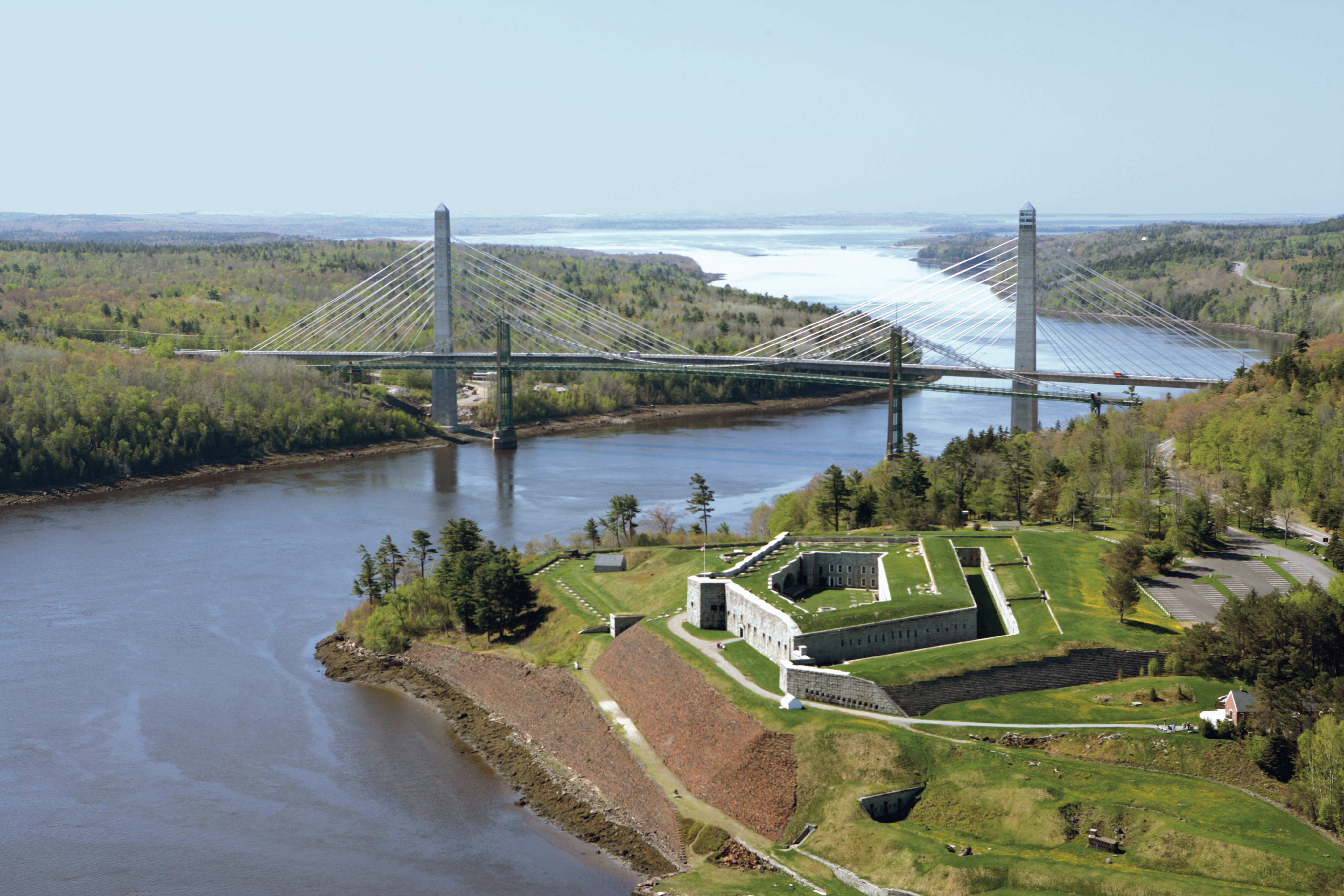
Kentucky’s Fort Knox was the second fort named for the great, rotund artillerist, and the first was Fort Knox on the Penobscot River in Maine, near the now sleepy town of Castine, home of the Maine Maritime Academy.
 |
| Fort Knox on the Penobscot River near Castine, Maine. Source |
So, why was a massive granite fort built on the Penobscot River near Castine, Maine?
(Most of this section on Castine comes from here. Which I highly recommend for the full, complex story of this location.)
The Penobscot region was a strategic point, with Castine receiving French settlers seven years before the Pilgrims landed at Plymouth Rock, and only six years after John Smith and his expedition settled at Jamestown. The Penobscot was a key entry into the interior for the fur trade, which was the impetus to much of the exploration and settlement of North America.⁴
The French were busy settling that part of the Atlantic coast as “Acadia” and over the next century or so frequently traded possession of Castine with the British who had settled to the south and considered that “Down East” portion of [then] Massachusetts to be theirs. The Brits twice named it “New Ireland” presumably to complement nearby Nova Scotia
Interrupting the bilateral feuding, the Dutch seized the area around Castine from 1674 to 1676. (The Dutch had claimed much of the land between Connecticut and the Chesapeake as “New Netherlands” around 1613 but were pushed aside by the bigger colonizers. The Dutch had squeezed out the Swedish settlements made along the Delaware river circa 1638-1655. Remember all this when someone tell you national borders are sacrosanct and must be defended by other nations’ blood and treasure.
With the American Revolution, Castine became an American town, and was attacked and captured by the British. Provincial Massachusetts (not the Continental Congress) assembled a massive invasion force with 44 ships in July 1779 for an unmitigated disaster trying to evict the Brits. Americans regained control with the peace agreement at the end of the war.
During the War of 1812, the Brits again attacked and seized Castine, again proclaiming it “New Ireland” and again relinquishing it at the end of the war. Massachusetts settlers (refugees?) flocked to rural Maine, far from Bostonian whims, and in 1820 it split off from Massachusetts and was admitted to the union as a free state to balance the statehood for Missouri, as a slave state.
After nearly two centuries of frequent conflict around Penobscot Bay, and continued mistrust of the British/Canadians to the north, construction began on Fort Knox in 1844, whose name sake had retired to Thomaston, Maine about 20 miles southwest of the new fort. One of the first mostly granite instead of brick masonry “star” forts, construction continued slowly until 1869 when both the importance of the Penobscot River region and usefulness of coastal fortifications had diminished so that it was no longer worth continuing construction. The fort had 74 guns of various types mounted at its height in the1860s, but only a small and transient garrison during the Civil War. A few hundred Connecticut volunteers were stationed there during the Spanish American War. Beginning in 1900, it had only a single Ordnance Sergeant caretaker, until it was declared surplus and sold to the State of Maine in 1923, becoming a state park in 1943.
Thus an old artillery shell led to some familiar and unfamiliar places, like West Point and Fort Knox. We’ll take a look at the shell to understand “Shrapnel” in Part 2.
¹ Speech - It also has MP3 audio of the address which is
even more moving in MacArthur’s raspy voice.
⁴ The importance of the fur trade to the exploration, settlement and economic growth of North American colonies is sorely neglected. Eric Jay Dolan’s Fur, Fortune, and Empire: The Epic History of the Fur Trade in America is a great read and most highly recommended! (Used copies less than $10 at ABEbooks.com)


GREAT bit of history. Thank you, sir.
ReplyDeleteWell done! Not just the date and time of construction but a bit of how and more importantly the why. Looking forward to tomorrow!
ReplyDeleteSarge, I recommend doubling his salary.
Oh wait…
juvat
Wow! The more you know! Thanks JB! That fort in Maine looks very cool.
ReplyDeleteThe word "moku" or "boku" (Japanese "木") means tree or wood. Thus, mokuju (木銃) is literally "wooden gun". There is a Japanese marital art, jūkendō (銃剣道), which focuses on rifle/bayonet techniques.
(The wooden training weapons we typically train with are called bokuto (木刀), meaning "wooden sword".
Interesting additional facts about these! Thanks.
DeleteJB
I think we have to visit next time we go to Maine.
ReplyDeleteGreat stuff, Brother!
ReplyDeleteBoat Guy
Thanks so much. Great history lesson for this former California resident.
ReplyDelete