Showing posts with label Monday. Show all posts

Monday, August 3, 2026

Raymond L. Knight MOH


 As y’all start reading this, Mrs J and I are on our way to London, where we’ll meet up with Little J and family for our cruise through the Norwegian Fjords. I’ve been told internet is available, but who knows. And…I’ll be 9 hours ahead so don’t expect answers to your comments much after 1300 Texas time. They will resume around midnight Texas time, assuming internet availability, of course.

As Sarge is wont to say, chat among yourselves.

Now, On with the Post!


1st Lt Raymond Knight 

Source


Okay, I couldn't find an awful lot of data on this hero's story beyond what's contained in his Medal of Honor Citation.  But, I'm here to tell ya', strafing is a nerve racking attack.  I did it on pretty much every range mission I flew (dropping practice bombs on a bombing range). A couple of thousand hours in an F-4 and you go to the range a LOT!  

Strafing on Range missions mean you are VERY low to the ground and you close to about a thousand yards distance before pressing the trigger.  You are traveling at about 450 nautical MPH which is probably pretty close to the P-47 attack velocity.  You have 2-3 seconds to fire so no room for mistakes and the ground is VERY close.  And that's in peace time, nobody is firing back at you.  So, IMHO, this is a well deserved Medal of Honor.

On with this Hero's story.

Citation for the award of the Medal of Honor to Lt Raymond L. Knight.

He piloted a fighter-bomber aircraft in a series of low-level strafing missions, destroying 14 grounded enemy aircraft and leading attacks which wrecked 10 others during a critical period of the Allied drive in northern Italy. On the morning of 24 April, he volunteered to lead 2 other aircraft against the strongly defended enemy airdrome at Ghedi. Ordering his fellow pilots to remain aloft, he skimmed the ground through a deadly curtain of antiaircraft fire to reconnoiter the field, locating 8 German aircraft hidden beneath heavy camouflage. He rejoined his flight, briefed them by radio, and then led them with consummate skill through the hail of enemy fire in a low-level attack, destroying 5 aircraft, while his flight accounted for 2 others. Returning to his base, he volunteered to lead 3 other aircraft in reconnaissance of Bergamo airfield, an enemy base near Ghedi and one known to be equally well defended. Again ordering his flight to remain out of range of antiaircraft fire, 1st Lt. Knight flew through an exceptionally intense barrage, which heavily damaged his Thunderbolt, to observe the field at minimum altitude. He discovered a squadron of enemy aircraft under heavy camouflage and led his flight to the assault. Returning alone after this strafing, he made 10 deliberate passes against the field despite being hit by antiaircraft fire twice more, destroying 6 fully loaded enemy twin-engine aircraft and 2 fighters. His skillfully led attack enabled his flight to destroy 4 other twin-engine aircraft and a fighter plane. He then returned to his base in his seriously damaged plane. Early the next morning, when he again attacked Bergamo, he sighted an enemy plane on the runway. Again he led 3 other American pilots in a blistering low-level sweep through vicious antiaircraft fire that damaged his plane so severely that it was virtually nonflyable. Three of the few remaining enemy twin-engine aircraft at that base were destroyed. Realizing the critical need for aircraft in his unit, he declined to parachute to safety over friendly territory and unhesitatingly attempted to return his shattered plane to his home field. With great skill and strength, he flew homeward until caught by treacherous air conditions in the Appennines Mountains [sic], where he crashed and was killed. The gallant action of 1st Lt. Knight eliminated the German aircraft which were poised to wreak havoc on Allied forces pressing to establish the first firm bridgehead across the Po River; his fearless daring and voluntary self-sacrifice averted possible heavy casualties among ground forces and the resultant slowing on the German drive culminated in the collapse of enemy resistance in Italy.
 

Lt Knight with the Battle Damaged P-47 he flew the first day.

Source

I'm not sure, but this picture might have been taken after his first attack.  He returned the next day and died when he took a lot of AAA hits and his extremely damaged aircraft became unflyable and crashed.  He was the last Army Airman to be awarded the  MOH in WWII .  


Source

 
1st Lieutenant Raymond L. Knight (at right) and crew chief Sergeant Marvin Childers, with Republic P-47D-27-RE Thunderbolt 42-26785, marked 6D5. This is the fighter bomber that he flew on the final mission. It was extremely damaged and crashed killing the Lieutenant. The P-47 pictured was named “OH JOHNNIE” after his wife. (U.S. Air Force)
 
Rest in Peace, Warrior! 


 All Sources used for this post.  Some are just used for my better understanding of the event and not actually quoted in the post. 

https://en.wikipedia.org/wiki/Raymond_L._Knight 

https://www.af.mil/Medal-of-Honor/Knight/ 

https://www.thisdayinaviation.com/24-april-1945/ 

https://valor.militarytimes.com/recipient/recipient-2631/   

https://www.thisdayinaviation.com/24-april-1945/ 

https://www.tshaonline.org/handbook/entries/knight-raymond-lee 


Monday, July 27, 2026

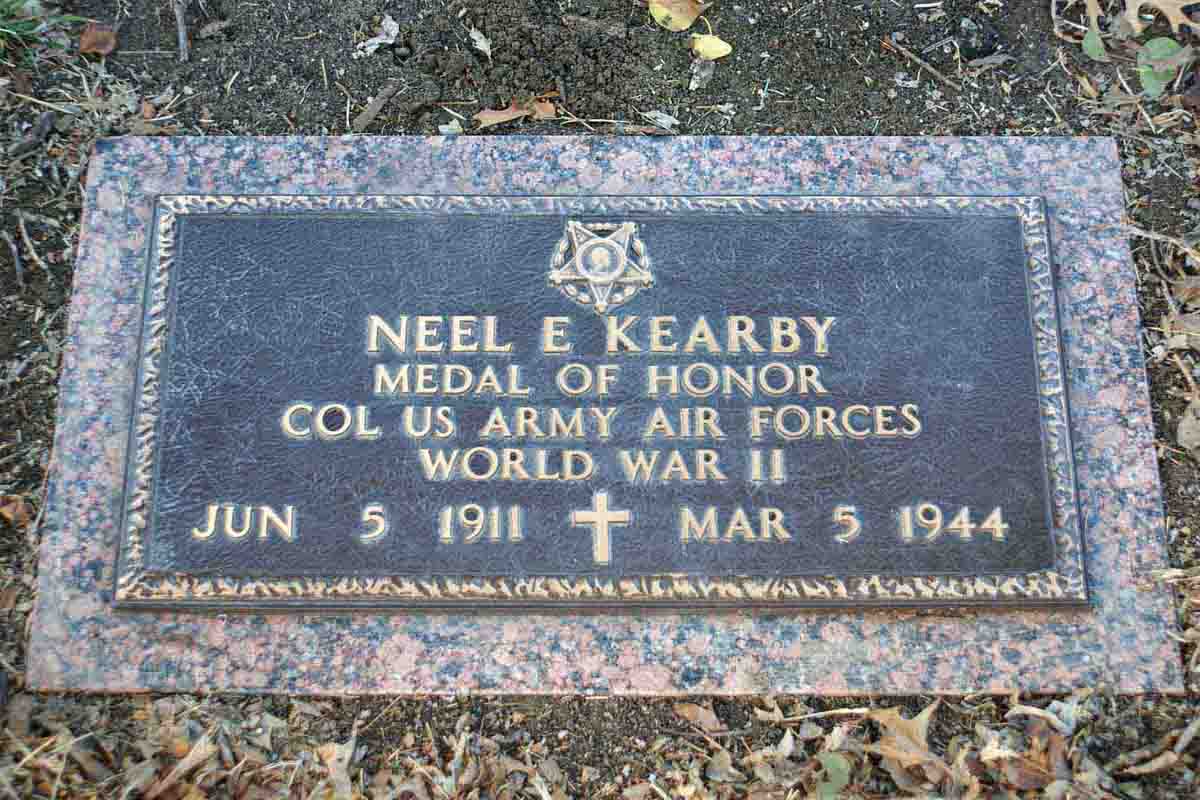
Neel Kearby MOH

Col Neel Kearby

OK, this is another Medal of Honor recipient, Neel Kearby. We've been reading about Bomber crews lately and that's also an extreme exhibition of courage. However, this time the hero was a fighter pilot and did combat in WWII in the Pacific. In addition, he's a Texan born and raised. The only down tic in his record is he attended one of the University of Texas campuses. Boo! A&M or Tech, Yay! Ahh Well! He joined the Army Air Corps in 1937 and earned his wings at Randolph AFB and Kelly AFB both in the San Antonio area. So...He's a Texan!

When WWII broke out, he was in command of a fighter squadron (called Pursuit Squadrons at the time) to protect the Panama Canal using P-39 Airacobras. Not an overly good aircraft, better ones would be coming soon. In October 1942 he took command of the 348th fighter group and trained them to fly the P-47 Thunderbolt.

The group was deployed to Australia and then further deployed to New Guinea where they started fighting the Japanese.
Kearby with his P-47D-2 Thunderbolt, the first Fiery Ginger.
Source
On October 11 1943, Col Kearby lead a 4 ship of P-47 and overflew Wewak Airfield on the north side of New Guinea. Some 40 Japanese fighters were airborne. He and his flight engaged the fighters. The video below will describe some of their tactics. He and his wingmen used their advantage against the Japanese disadvantage. He was higher than the Japanese could fly. His flight would dive from above, shooting from above ,then pull up and climb out and do it again. Kearby himself shot down 6 aircraft on this flight, making him an Ace. In all a total of 9 Japanese were shot down in this engagement. General George Kenney recommended Col Kirby for the Medal of Honor.

On March 5, 1944 he is on a Combat Air Patrol (AKA looking for bad guy aircraft and shooting them down). He has 21 Japanese airplanes that he had shot down on his record. Again they're in the vicinity of the Japanese held airfield at Wewak. He spots 3 Japanese fighter and attacks them. Shooting at one he doesn't get enough hits to bring it down, so reattacks. On doing so, other Japanese fighters attack him and shot him down. According to the local population, he successfully bailed out, got tangled up in his parachute in a tree and died from bullet wounds from the attack.

His remains were recovered and identified in 1947 and were transferred to the United States and he was reburied at Sparkman-Hillcrest Memorial Park Cemetery in 1949.

Larger memorial image loading...
Source

Rest in Peace, Warrior!

statue of Colonel Neel Kearby outside City Hall

Victory

Date

Location

Aircraft

Notes on claim

1

09/04/43

Hopoi

Betty

First aerial victory claim.

2

09/04/43

Hopoi

Oscar

Second aerial victory claim.

3

09/14/43

Malahang

Dinah

Third aerial victory claim.

4

10/11/43

Boram Airfield

Zeke [sic Oscar]

Fourth aerial victory claim.

5

10/11/43

Boram

Zeke [sic Oscar]

Fifth aerial victory claim, became an "ace"

6

10/11/43

Boram

Hap [sic Oscar]

Sixth aerial victory claim.

7

10/11/43

Boram

Hap [sic Oscar]

Seventh aerial victory claim.

8

10/11/43

Boram

Ki-61 Tony

Eighth aerial victory claim.

9

10/11/43

Boram

Ki-61 Tony

Ninth aerial victory claim.

10

10/16/43

Wewak

Zeke

Tenth aerial victory claim.

11

10/19/43

Wewak

F1M2 Pete

Eleventh aerial victory claim.

12

10/19/43

Wewak

F1M2 Pete

Twelfth aerial victory claim.

13

12/03/43

Wewak

Zeke [sic Oscar]

Thirteenth aerial victory claim.

14

12/03/43

Wewak

Zeke [sic Oscar]

Fourteenth aerial victory claim.

15

12/03/43

Wewak

Zeke [sic Oscar]

Fifteenth aerial victory claim.


12/07/43

Boram Airfield

Ki-61 Tony

Claimed as damaged.

16

12/22/43

Wewak

Zeke [sic Oscar]

Sixteenth aerial victory claim.

17

12/23/43

Dagua Airfield

Ki-61 Tony

Seventeenth aerial victory claim.

18

01/03/44

Wewak

Ki-21 Sally [sic]

Eighteenth aerial victory claim.

19

01/03/44

Wewak

Zeke [sic Oscar]

Nineteenth aerial victory claim.

20

01/09/44

Wewak Harbor

Ki-61 Tony

Twenty aerial victory claim.

21

01/09/44

Wewak Harbor

Ki-61 Tony

Twenty-first aerial victory claim.


02/27/44

Cape Hoskins

Ki-21 Sally

Claimed as damaged.

22

03/05/44

Wewak

Nell [sic Ki-48 Lily]

Twenty-second aerial victory claim.

P-47 from LtCol Kirby's Group

Col Kearby's Citation

For conspicuous gallantry and intrepidity above and beyond the call of duty in action with the enemy, Col. Kearby volunteered to lead a flight of 4 fighters to reconnoiter the strongly defended enemy base at Wewak. Having observed enemy installations and reinforcements at 4 airfields, and secured important tactical information, he saw an enemy fighter below him, made a diving attack and shot it down in flames. The small formation then sighted approximately 12 enemy bombers accompanied by 36 fighters. Although his mission had been completed, his fuel was running low, and the numerical odds were 12 to 1, he gave the signal to attack. Diving into the midst of the enemy airplanes he shot down 3 in quick succession. Observing 1 of his comrades with 2 enemy fighters in pursuit, he destroyed both enemy aircraft. The enemy broke off in large numbers to make a multiple attack on his airplane but despite his peril he made one more pass before seeking cloud protection. Coming into the clear, he called his flight together and led them to a friendly base. Col. Kearby brought down 6 enemy aircraft in this action, undertaken with superb daring after his mission was completed

Sources

https://en.wikipedia.org/wiki/Neel_E._Kearby

https://www.nationalmuseum.af.mil/Visit/Museum-Exhibits/Fact-Sheets/Display/Article/196209/col-neel-e-kearby-pacific-thunderbolt-ace/

Pics https://www.findagrave.com/memorial/9805/neel-ernest-kearby#view-photo=25749823

Aerial Victories https://pacificwrecks.com/people/veterans/kearby/index.html

Home town celebration. https://www.arlingtontx.gov/News-Articles/2025/November/A-Look-Back-Remembering-Local-Medal-of-Honor-Recipient-Neel-Kearby