Showing posts with label aircraft. Show all posts

Wednesday, July 22, 2026

More Stealth is good Stealth

Well folks, there I was...a little bit burned out on Medal of Honor stories.  I have a lot of respect for those guys, many of whom did not survive. But I was having trouble keeping the story and facts straight. So I took a break and started putzing around on my laptop looking for something I could use to entertain myself or maybe find a new subject to discuss on Sarge's Blog. Fortunately, I found a little of both.


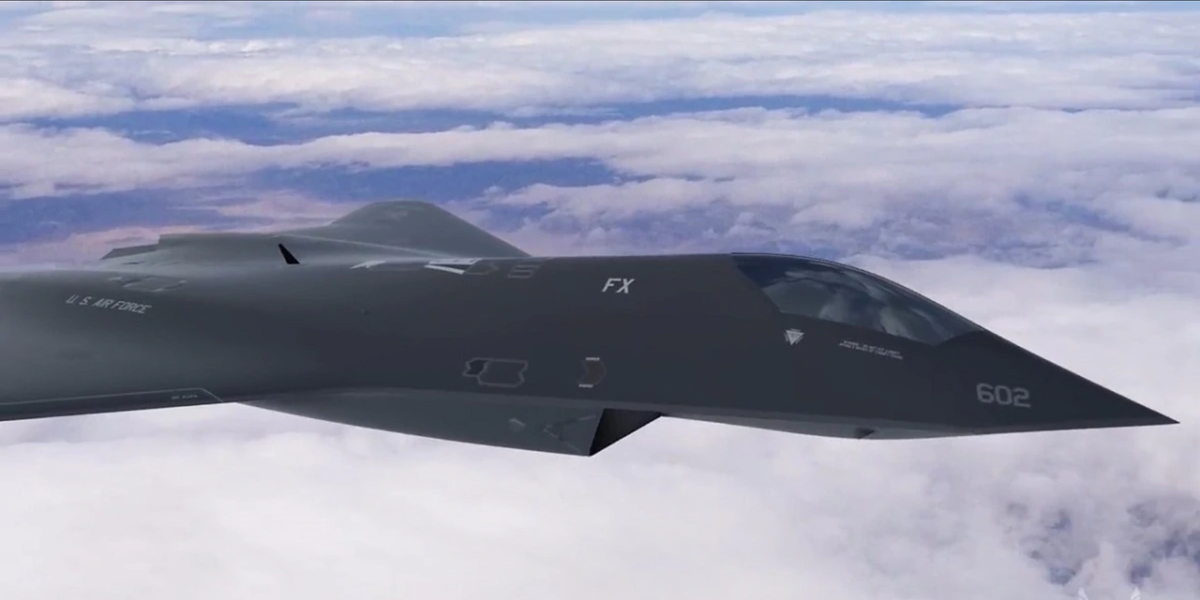
Everything we know about the F-47, USAF's next-gen fighter

Artist conception of a 6th generation fighter

Source

As many of you are aware, our current, newest, Air Superiority fighter, the F-22 and the newest Strike fighter (primary mission is air to ground but has air to air capability), the F-35, are Fifth Generation Fighters. The Eagle is Fourth Generation and a bit long in the tooth, but her air to air kill ratio is 105-0. So gotta love her.

F-15D 

Source

 As I've mentioned here before, back in the day, my name was on the canopy rail of that exact F-15.  Miss her I do.
 
While that Eagle and many of her sisters are still flying, what has become known as the "5th generation fighters" have become the backbone fighter force in the Air Force.
 
Lockheed Martin F-22, Raptor, Stealth Aircraft Editorial Image - Image ...

F-22

Source 


The F-22 and the F-35 both are operational fighters now. "Operational Fighters" is the terminology to describe the fact that they are currently handling "Real World" missions.  However, due to budget considerations, the F-22 fleet, which had been planned for 600ish jets, is currently limited to 183


F-35 

Source


The F-35 fleet has, at the time of this writing, 883 jets.
 
And recently, the first of the 6th Generation fighters has started to be developed and is expected to  become operational starting in 2029. The number of jets of this next generation to be built under the plan  is 185.  Seems a bit small to me, but I'm sure they are hideously expensive.  Hopefully, they are equally extremely capable.
 
I now have a very good idea how my father felt when I told him I was going to be flying the F-15.  He had been an F-86D pilot. 


My how time has passed!  Quite a difference wouldn’t you say?

Source
 
 We shall see what will be.  Peace out y'all.
 
 
 Addendum: Regular reader and commenter Nylon found an additional fighter being developed an F-15X. Info here https://en.wikipedia.org/wiki/Boeing_F-15EX_Eagle_II


Sources

https://militarymachine.com/f-47-ngad-sixth-generation-fighter

https://aviationnews.eu/news/2025/07/meet-the-f%e2%80%9147-americas-sixth%e2%80%91gen-stealth-fighter/

https://hips.hearstapps.com/hmg-prod.s3.amazonaws.com/images/screen-shot-2020-09-15-at-12-31-41-pm-1600198341.png?crop=1xw:0.887120651369356xh;center,top&resize=1200:*

https://simpleflying.com/how-many-f-35s-in-service/ 

https://www.militaryupdate.net/2025/09/how-many-f-22-raptors-does-us-have.html 

https://en.wikipedia.org/wiki/Boeing_F-47

https://en.wikipedia.org/wiki/456th_Fighter-Interceptor_Squadron 


Monday, July 6, 2026

SuperDupersonic +


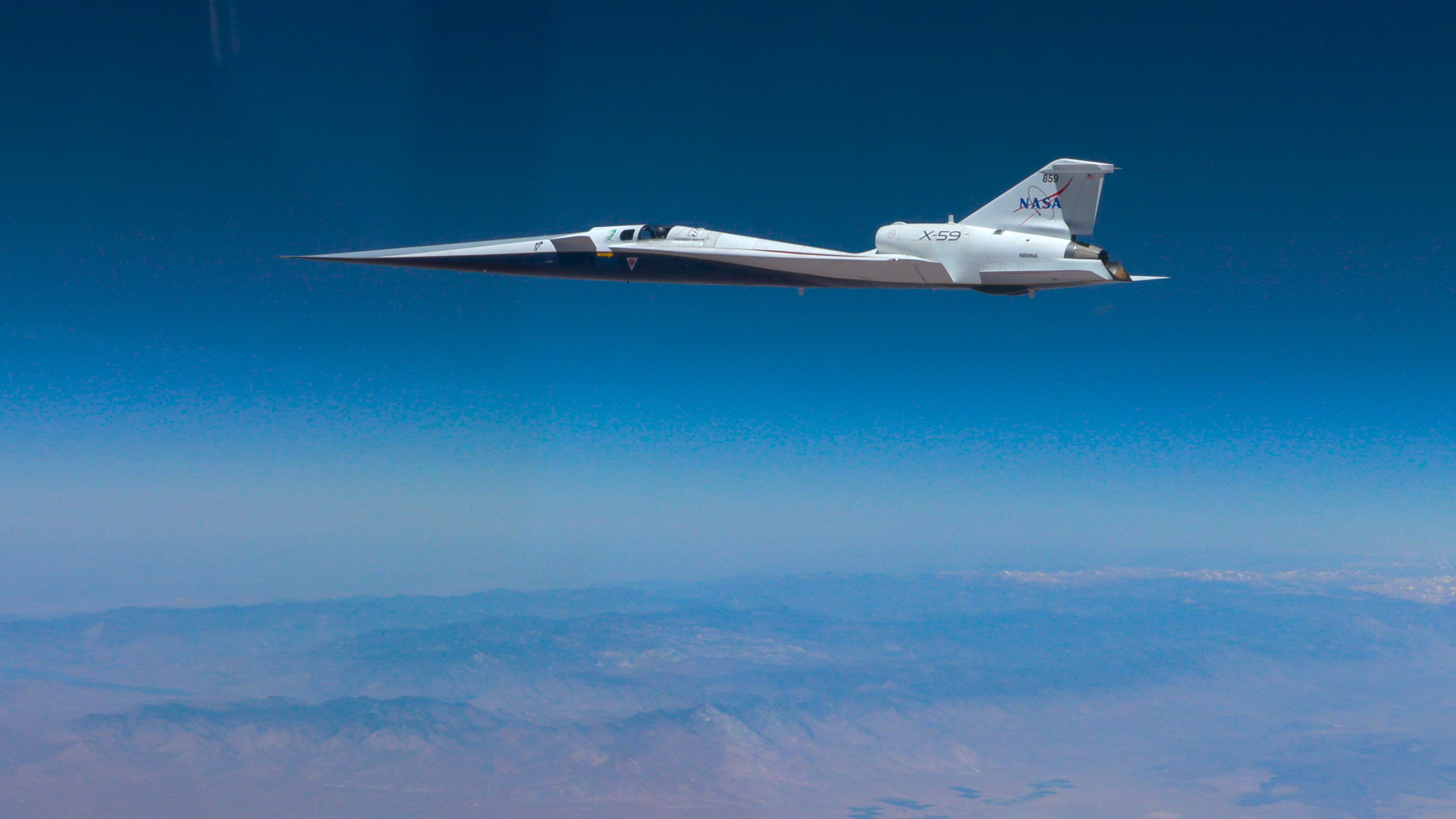
NASA’s X-59 quiet supersonic research aircraft completed its first supersonic flight Friday, June 5, 2026. The aircraft was photographed mid-flight with its needle-like tapered nose pointing to the left as it flew against a dark blue sky above California's Mojave Desert.
Source


 Well, you know me.  If it's got airplanes in the story, I'm interested.  Especially if they're jets and I mean FAAASSSSTTTTT jets.  Apparently, this aircraft, designated the X-59  is a Mach 5 capable aircraft which more than measures up to my interest level. I

 For those of you that are into numbers, Mach 5 is 3,705.4850 Miles per Hour on a standard day (Mach ground speed changes with air temperature and pressure variations). But, regardless of that, it's a fast (very fast) jet.

Addendum: It's 2884 miles by air from JFK to LAX, meaning the airborne time is ~45 minutes in this jet.  Heck, the steward's can't even get the scotch distributed in that time! 

The design will minimize the jet noise significantly. They're advertising that the sonic boom won't be louder than a dull thump!

Pretty cool huh?

It gets a bit cooler.  Its official name is Lockheed Martin X-59 Quesst which is an acronym for Quiet Supersonic Technology. (I wonder why it's Quesst and not Quisst, but what do I know? I'm trying to think of a suggestion for the name, Quiet Dagger maybe?)

I hadn't heard (no pun intended) about this project until I discovered it on the web.  But, evidently it is for real and is actually in a test phase.  I mean the object in the picture above is obviously flying and therefore, real, right?

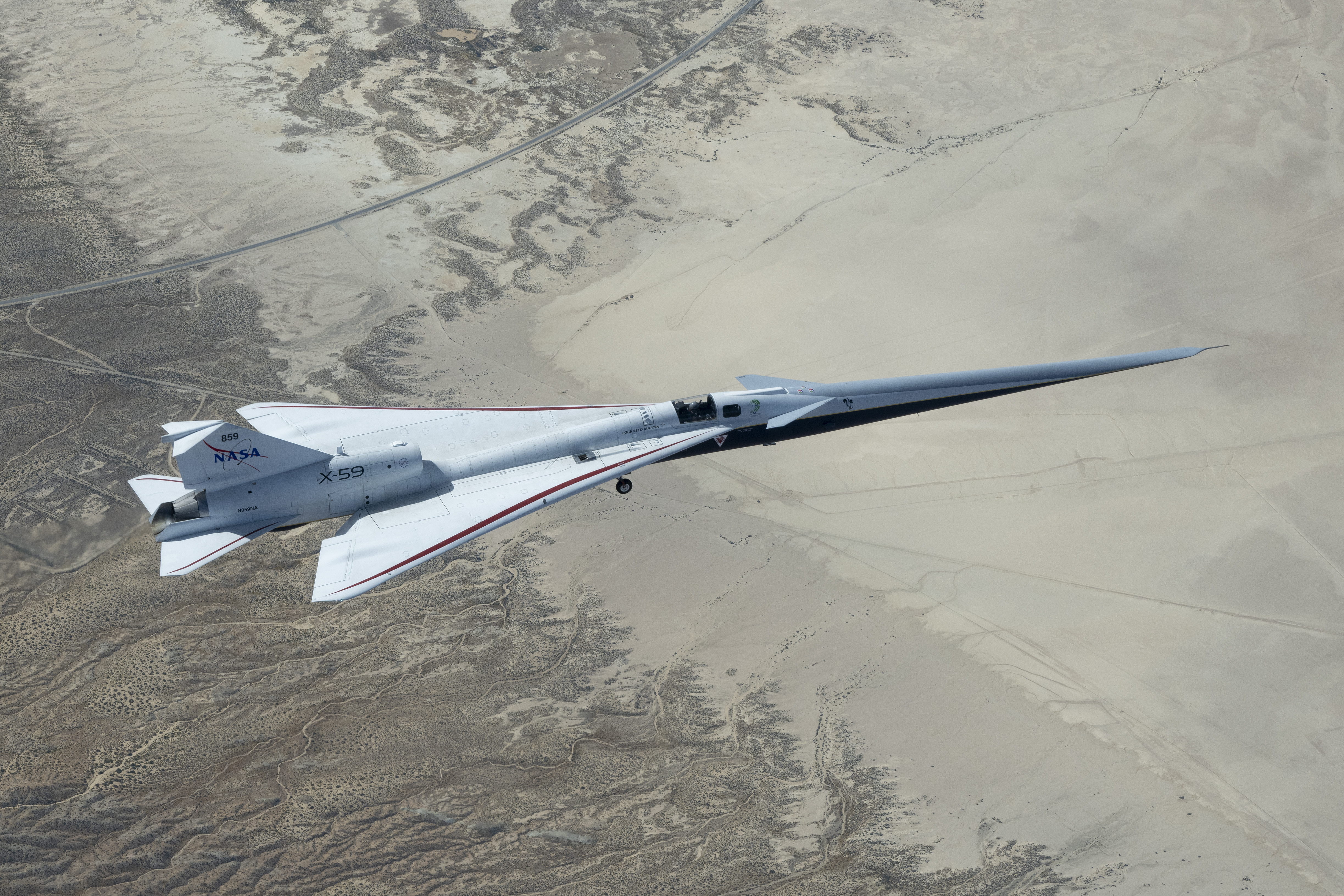
NASA’s X-59 quiet supersonic jet flies over the Mojave Desert during its third flight on Thursday, March 26, 2026, from NASA’s Armstrong Flight Research Center in Edwards, California.
Source


I also found it interesting that one of the ways they are reducing the sonic boom is by increasing the length of the plane while minimizing the wingspan.  Punches a smaller hole through the atmosphere, I guess.


No Beans, that's not me sitting in the simulator despite the physical similarities. More's the pity. 

Source


 Another thing I thought interesting, although a bit disturbing potentially.  There is no forward canopy, meaning you can't see what's out front.  Yes, Beans, that would be the point you're flying to.  That's handled with a TV camera.  You can see out the sides of the canopy though, so I guess if the TV quit, you could rejoin with another airplane and fly a formation approach and get dropped of at the runway by the other pilot.  

I've done that a few times, although I'll confess, I did sneak a couple of peeks at the runway lineup before we touched down.  Never had a problem though, always headed right down the runway. 

At the time of the article, there have been 19 flights since its first take off Oct 28, 2025.  The report is that it handled better than the two test pilots expected.  High praise!

As to the sonic booms, I thought this was a bit humorous.  The test flights require a chase aircraft or two.  These were F-15s (whoop!) and FA-18s.  Since the X-59 had to go supersonic in order to test supersonic flight and the folks on the ground were testing for noise level, they encountered a bit of a problem.  

The chase aircraft had to stay with the test aircraft in case something went wrong. Duh!  But if the test aircraft is supersonic, that means the chase aircraft had to be supersonic.

Guess which sonic boom was the loudest.

Yep! The Eagles and the Hornets.

So...I guess they are making progress.

They plan to test this aircraft out, by flying it over different parts of the the country, I don't understand why it would be different in different places, but, I'm not an expert.  However, there is one consideration that is required. 

The aircraft requires at least 10,000' of runway to takeoff and land. Most airports used by airlines meet that requirement, but are busy.  Airbases generally come close, but...not all meet the 10K' requirement.  So, they'll have to work that out.


Source

 And....a short video of the plane in the air.

M’’


 Hope y'all enjoyed this.  

+ Oh, It's 1700 Texas time, Sunday Evening.  I JUST  found out that my prohibition of driving due to my accident has been dismissed.  Tx Department of Public Safety posted it on their website.  I just found that out.  That's definitely worth a plus!

Thank you, Lord! 

Peace out, y'all! 


 Sources

https://arstechnica.com/gadgets/2026/06/nasas-x-59-frankenjet-tests-supersonic-flight-without-the-sonic-boom/ 


https://www.youtube.com/watch?v=iOTfR1NQ-X8&source_ve_path=OTY3MTQ&embeds_referring_euri=https%3A%2F%2Farstechnica.com%2F 


‘ 


Thursday, June 4, 2026

Air to air combat!


I've been posting Air Force Medal of Honor recipient stories for a week or so.  (Sarge needed a break, I find them interesting, especially the ones I'm unfamiliar with. So, you'll be seeing a few more soon.). 

However, I decided I'd resuscitate a posting from one of the first posts I put up 13 years ago or so.  Through the years, we've discussed one of my heroes a few times.  Here's one of my favorite stories about him.  Unfortunately....

Source

 So...Off we go!

Air to air combat is fun and exciting in practice. I suspect that when it’s for real, the “fun” part drops off. Tell me if I’m wrong.

Ed Rasimus and I were both assigned to the 435TFTS at Holloman AFB NM. Suffice it to say that even though I was qualified as an "experienced" fighter pilot flying time wise, I learned a lot more from Ras during flight briefings and debriefings, and in the air than I thought possible.  Some of the most important things I learned from him were taught in the Squadron Bar. After he PCS’d to Fort Carson for his last assignment in the Air Force as an ALO, I lost touch with him and didn’t reconnect with him until I saw his book “When Thunder Rolled” on Amazon.  Bought it immediately, and started reading.  It was like being in the Bar again; I’d heard most of those stories. A few years ago, I managed to track him down and restablish our friendship.  Unfortunately, he's no longer with us.  Heaven to me would be flying fighters against and with both He and Vegas. Yes, that would be heaven.

But rereading that post really triggered a memory of one flight he and I had together while at Holloman.

Basic Fighter Maneuvers (BFM) are  exactly what the name implies, at the most basic level, how do you maneuver a fighter so as to kill another fighter and/or avoid being killed yourself.  It’s not just "pull on the pole as hard as you can".  It’s using your energy wisely, regaining it when you can, using gravity to enhance the effect.  Most of the Lead In Fighter Training program consisted of BFM rides, and throughout the flying portion of my career, a sizeable portion of my rides were BFM also, whether I was in an Air to Air Squadron or an Air to Ground Squadron.  BFM skills are critical and very perishable. 

BFM rides involved two aircraft, a 1 v 1, and typically there were two types of setups.  In the first setup, one jet takes a position 30 to 45 degrees off the tail of the other and 6000-9000’ away.  In a real world fight, this is a very dangerous position for the person in front to be in.  Once participants are ready, the fight is started with a “Fight’s on” call and maneuvering commences.  The fight typically continues until a kill shot is taken by one or the other fighter, a fighter manages to disengage successfully, the desired learning point has been achieved, or a safety factor is encountered.  (Over G, going through minimum altitude, min fuel etc).

The second type of setup is a neutral setup, typically called a “Butterfly”.  The two jets start in tactical formation about 6-9K’ apart and the flight lead calls for a turn away from each other of 45 degrees.  At some point the flight lead calls for the turn in and both aircraft turn back towards each other for a head on pass.  The flight lead will call fight’s on at some point,  typically immediately prior to the pass so that maneuvering can begin.

This now leads to a decision on the part of both fighter pilots.  Do I want a two circle fight or a one circle fight?  There’s an excellent discussion of this here , but basically, if your turn radius is better than the other jet's, try for a one circle.
 
Back in the day, I used to be able to draw a fight diagram much better.  My apologies.


  If your turn rate is not better than the other, try for a two circle fight because you’ve got more turning room to use.


I say “try”, because the other guy also gets a vote in the fight. He has to turn in the direction you expect him to otherwise ....  I was about to learn how to make that happen.

So,  There I was………….*  Ras and I were scheduled for an IP currency 1 v 1 BFM ride in Beak Charlie, the closest air to air area to Holloman.  Basically, we would be fighting air to air against each other for currency.  Cloudcroft NM was the Western Boundary  Roswell the Eastern and  Ruidoso the Northern.  That proximity meant we’d have maximum gas for fighting.  Typically, when these rides went on the schedule, they were immediately filled by students riding in the back seats, however, this time it was just Ras and I.  (He had told the Duty Officer not to allow any students, you’ll understand why shortly).

Briefing was short and sweet, here’s the frequencies, joker and bingo* fuel levels and a discussion of which BFM setup we were going to use (Butterfly).  We had flown together enough as IPs that not much else was needed.  We step to the jets, crank up, formation takeoff and we’re in the area.  A couple of G awareness turns . (The AT-38B was getting old and we needed to “tune” our bodies to what the mandated G limit was, so that we didn’t overstress the aircraft and reduce its lifespan.  Must have worked, this story occurred about 30 years ago, and the airplanes are still flying.)

Everything’s ready to go, a quick fuel check from Ras and he calls for the turn away.  I check 45 away and rollout, snap my head around so as to keep sight of Ras.  Got him, we continue on heading for a bit and he calls turn in.  I’m pulling right on the g-limit, get pointed at him and unload the aircraft to get some speed back.  We’re about a mile out now and I’m planning for a two circle fight, since I’m a little above him, I plan to slice down to the left leading the turn as much as I can.  At that point, Ras calls fight’s on and pulls up and takes a head on gun shot. 

At the time, the safety rules prohibited any gun shots within 45 degrees either side of head on, so I’d never seen a head on shot.  Also, since the guns on most fighters are boresighted with the aircraft, where the gun is pointed is where the aircraft is pointed. If Ras has taken a gunshot, the gun is pointed at me and so is his aircraft.  Ras passes close aboard.  This has left me somewhat startled and there’s a pause before I start to maneuver.  I roll left and start the pull, expecting Ras to have done the same which should put him somewhere above my tail pointed away.  I can’t see him and call blind (another safety thing, if he calls blind also, we knock it off and get altitude separation).  He calls “continue”.  I’m in big trouble, he sees me!  I’m still frantically searching for him looking over my left (down) shoulder, when something catches the corner of my eye.  I crank around to the right, just in time to see Ras swooping down on the back side of his vertical circle. He's gone for a one circle fight, using the vertical and by virtue of being below me and pulling up for the shot, he's lead turned me.  When he got to the top of his loop, he was slow and inverted, so gravity helped him turn much faster.

Fortunately, he’s not in guns range yet, but he’s closing fast.  I break back right and up, trying to force his nose into lag  (pointed behind me), but I’m running out of airspeed and he’s not.  I see his nose slide out in front of me and I start to make out the intakes on the side of his jet (with my eyesight at the time, that was my indication that he was about 2500’ away, AKA guns range.  With my eyesight now, I think he'd be in my back seat before I saw intakes).  I roll the aircraft until the canopy is about 45 degrees below the horizon and plant the stick in my lap.  I’m jinking…Hard.  Roll the aircraft again,  push the stick forward.  Again,  and Again and Again, but Ras is still back !there, he hasn’t called any shots, but I ain’t getting away either.  I’m expecting a knock it off for lesson learned, but no.  I’m jinking for about a month and a half until we get to bingo.  Knock it off and head home.

Back in the debrief,  Ras walks in with a couple of beers, hands one to me and says “Juvat, there are no safety ROE (Rules of Engagement) in combat, and there’s no knock it off”.  Then he took a couple of sips of beer as he let me ponder that.  He then followed with “Best Jinking I’ve ever seen, I never got a shot.  Let’s talk about how you did that, I want to learn how.”

I miss him.
 
If you'd like to read more of his stories (and I highly recommend you do), he published three books before he passed, One in conjunction with Robin Olds, the other two autobiographies about his assignments (yes, Beans, more than one) in South East Asia.  Excellent stories.
 

 Rest in peace, Warrior! Ed, you deserve it!

Peace out, y'all!

* Joker fuel means "keep an eye on your gas, this is the last engagement".  Bingo fuel means "Knock it off!  Rejoin on me and we're headed home".  Enough gas to get home and land with a safe amount of fuel in case something bad happens at the base.
  • What’s the difference between a fairy tale and a war story?  A fairy tale starts with “Once upon a time” and a war story starts with “So there I was”.  
Monday, June 1, 2026

First Jets


One of the things I've learned while contributing to Sarge's blog is the importance of carefully proof reading your story.  I've also learned that it's a lot more difficult than it sounds.  Your brain tends to read what your brain told you to type.  Which is not always what is actually written.  I had a case of this with my "Juvats" posting recently.  My intention for the subject was the progression of aircraft that the 80th TFS had flown since WWII.  I mistakenly posted a picture of a P80 and captioned it as the first jet fighter.  Which should have said first jet fighter for the Juvats as both the British and Germans had jet fighters before that.  Thanks for pointing that out, Mea Culpa!.  But... On the upside of that mistake, it produced a subject I found interesting for this posting.

So…Here we go with first jet fighters.

ME-262  Schwalbe/Sturmvogel*


According to the Military Aviation Museum (where I got the photo above) the first operational jet fighter was the ME-262 built by Messerschmidt. Much like any new technology it had its good points and its not so good points.  First, it was much (much, much) faster than any of the Allied propeller driven fighters.  Thus, the ME-262 could attack the Bomber fleet and run away before the Allied escort could bring sights to bear.  However, as in any war, tactics are developed to maximize your strengths and minimize the enemy's.  The Allies started positioning P-52 Mustangs over the ME-262 airfields as bombing attacks were being conducted in the vicinity.  If a ME-262 took off, they would attack it while it was still accelerating.  Since the engine’s spool up in the jet took a bit of time, the P-51 diving from altitude had a significant airspeed advantage.  Since there weren't a lot of ME-262's in operation, loss of any was a big victory for the Allies.  But, for purposes of this posting, they were the first operational jet fighter.

 Gloster Meteor


 The Gloster Meteor was the first Allied jet fighter and the only Allied jet to see combat.  It was faster than the Messerschmidt, but a bit less maneuverable.  Not a good characteristic for a Fighter.  Interestingly, it was still flying, albeit as a test bed, in 2023.

P-59 AiraComet

Bell P-59B Airacomet > National Museum of the US Air Force™ > Display 

The P-59 Airacomet was the first US built jet fighter . Planning for the jet began in 1941 and flights began in July 1943.  Unfortunately, it's capabilities did not match the capabilities of the P-51, P47, or P-38, so it never reached production.

 Which brings me to my oops. The P-80 on first commissioning later renamed as the F-80 . This site explains a lot about the P-80 as a jet fighter.  As most of you know the king of the air in Korea was the F-86 which took over the air to air role there.  277 P/F-80s were lost there.  1 loss is bad, 277 is terrible.  They were soon remodeled and turned in to the T-33 which were still flying missions when I came on active duty and pilot training.

No, Beans, I never flew one, they were just for flying stuff and people around at the time. The T-37 and T-38 were in service by then.

 MIG-9 Fargo

Source


The first Russian jet was the  Mikoyan-Gurevich MiG-9, NATO code named "Fargo".  Production started in 1946 and ended in 1948.  Obviously, it did not fly in WWII.  610 were built.  As I read this article I came to realize that the Soviets were not able to produce this "jet" before the war ended.  Lots (Lots and Lots) of problems.

The Nakajima Kikka (橘花 for those of you who read  Japanese)


As one can see, it bears quite a similar look as the ME-262.  I don't know, but it wouldn't surprise me if there wasn't a bit of cooperation going on.  It had zero influence on the war as it flew only once, and that was in August 1945. 

 And Finally! 

Caproni Campini N.1

Source

The aircraft pictured above was Italy's entry into the "first" jet fighter competition.  Design and testing was started in 1940 and flown in 1941.  2 models were built and flown.  One was either destroyed by Allied bombing or by the Italians to avoid it's capture.  The one above was discovered by the Allies after they defeated the Italian Army.

So.  There are the first jet fighters and fighter prototypes from WWII. 

And, even though I like all of them, this is my favorite Fighter.


Source

 No surprise there!

Thanks for the idea Dearieme!  Peace out y'all.  


*Schwalbe/Sturmvogel. Schwalbe if it was air to air, Sturmvogel if it was Air to Ground