Big, beautiful beasts, they are. But, I knew almost nothing about them, even though my earliest childhood memory is when a circus came to town, via rail car, and an elephant waved his trunk at ME! I think I waved back, and then hid.
 |
| Source |
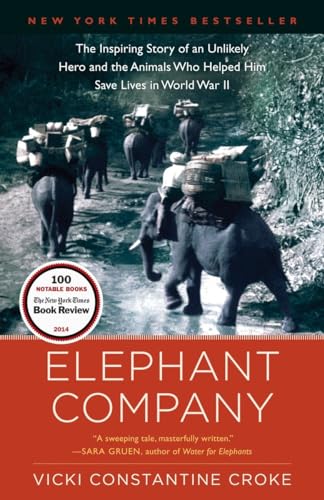
We picked up the audio book version of Elephant Company by Vicki Constantine Croke for a recent trip. It turned out to be really interesting and full of unexpected tidbits.
It is a mixture of the intertwined stories of a magnificent elephant, Bandoola, and how he was raised, used (sometimes abused), and served first in the teak logging industry in Burma, and then in the British SOE during WW2. He is really the main character of the book.
Bandoola was inextricably linked with one James Howard Williams (eventually known as “Elephant Bill”), an iconoclast Brit of some privilege who served in the Middle East during WW1 with the Camel Corps and mules, where he read a book on “The Diseases of the Camel and the Elephant,” which I hope none of us will ever see or read. However, post WW1 he aspired to learn more about elephants, and signed on with the Bombay and Burma Teak Company as a “Forest Assistant.” A job, usually the only Englishman within many miles, responsible for getting teak trees cut and then hauled to the closest river where the logs would be flushed downstream by monsoon rains for processing and shipment to the UK for ship building. Of course, this involved being properly attired, accoutered and provided with suitable tentage, gin, etc as befits the dignity of an English gentleman in a colonial outpost, supervising hordes of locals and the dozens of elephants needed to do the heavy lifting. The company held them responsible for the care, feeding and training of the very expensive investments in 2,000 pachyderms in ten camps. To get to work, he took a steamer to Rangoon, partied a few days in civilization, then took a small steamer (one step above “African Queen” size) a couple of days up the Irrawaddy river to the base of the mountains where the camps were.
To understand “Elephant Bill” Williams, or Bandoola, the author injects a steady stream of information about elephants, their extreme intelligence, social habits, even a bit on mating habits. They are the largest land mammals, with the male Asian elephants running about nine feet high weighing about four tons. They are very social, with a matriarchal leadership. A lot of coverage is given to training elephants, both the traditional “beat them until they obey” approach, and a kinder, gentler rewards and praise approach William learned from the old guy who trained Bandoola. This lead to the Company setting up “elephant school” to train calves on proper behavior and work skills, which seemed to be very effective.
All of this is in the confusing cultural context of the time and place where the Burmese were near revolt against their colonial masters, but dependent on them for trade and maintaining order. Throw in a healthy dose of ethnic or clan differences between Burmese, Indian, Thai, British and eventually Japanese players, and just a bit of failure to communicate keeps it unpredictable.

With the outbreak of WW2, and Japanese overrunning vast areas of Asia, they eventually got to Burma, coming up the rivers, ending the teak trade. British and Indian forces operated in Burma to link with the Chinese to fight the Japs, and building roads was a top priority. “Elephant Bill” volunteered his services and his 1,600 elephants becoming a Lieutenant Colonel. First as part of the Indian Army as mere transport animals, then as part of the General Slim’s 14th Army as a Special Operations Executive unit for bridge building.
As the Japs pushed further inland, unprepared Brits and loyal Burmese and Ghurka families fled further into the interior, suffering horrible losses. Eventually they were in extremely rough terrain, and just barely escaped after using the elephants to help carve out a dangerous trail to get over the last geographic obstacles to reach the Indian border.
This book left a profound appreciation for the elephant species, and their ability to work with man. Also, immense appreciation of Bandoola and Elephant Bill, who were both about the same age. Plus a better understanding of the geography of Burma, and the cultures of its people, and the history of WW2 in that remote corner of the war.
If you like hard copy books, this is available on AbeBooks.com and other places for under $10.00. Since driving prevents me from reading for many hours at a time, I really enjoy audio books. Audio versions may be free at your library or available from digital sources to download to your phone or some such tech wizardry.
This made me dig a little deeper and discover that Elephants have been important military assets for many centuries. Not in our European military annals, but certainly in Asian and some African regions. Their sheer size, and invulnerability to primitive cut and thrust weapons made them nearly invincible on the battlefield. Their bulk and ability to follow commands made them resistant to cavalry attacks, and deadly against Infantry, along with handy at hauling all the stuff an army needed.
 |
| Source |
One British publisher, Helion, (sort of a more scholarly version of Osprey) has a whole book on War Elephants, or at least the period from 1380 to 1700. The publisher’s note shows there is much one can learn on the subject, if interested.
“Elephants and Gunpowder presents for the first time a chronological, detailed and richly illustrated account of the development of warfare in mainland Southeast Asia during the Early Modern Period. It begins by describing the region’s medieval military inheritance that was dominated by the use of war elephants. Firearms began to appear during the late fourteenth century and would be used alongside elephants and cavalry in a long series of wars between Burma (Myanmar) and Siam (Thailand). Exciting sieges and dramatic naval combat are also discussed along with much fascinating material about beliefs in omens and divination and the impact of foreign mercenaries. While cannons fire around them elephants act as mounts for noble hand-to-hand combat, as living battering rams to use against city gates and, in the form of the precious and much coveted white elephant, as both an excuse and a pretext for war itself. The text is complemented by a large number of carefully selected photographs, maps and specially commissioned artwork that present the arms and armaments of the Southeast Asian warrior and his elephants in a way never seen before.”
 |
| Source |
Elephants are also used for sporting purposes, such as hunting tigers in India. Westley Richards, made “Howdah pistols,” massive double barrel affairs carried as a last resort if the tiger begins to attack the wicker Howdah basket in which the hunter is carried on their elephant. The Illustrated London News of April 1, 1876 had a lengthy illustrated article on HM The Prince of Wales (an old respected one, not the domesticated Ginger spare) including this image:

So, there is a lot to learn about elephants.

Exam question for schoolboy (and girl) physicists: could a Montgolfier balloon lift an adult Indian elephant off the ground?
ReplyDeleteShow your working!
If you speak Swahili, here’swhere you can find the the formula ( I think)
Deletehttps://www.engineeringtoolbox.com/hot-air-balloon-lifting-force-d_562.html
Good luck
juvat
That's Vicky's eldest, Bertie. A rapscallion and a rouge. Not like his Mom, or his sons.
ReplyDeleteElephants are pretty cool, and very smart. When I lived in Baraboo, WI, home of the Ringling Brothers, the State of Wisconsin has a circus museum. The elephants are smart enough that the would occasionally escape, and wander the streets of Baraboo, until they were rounded up, and led home
Gentle Beasts, I approve of them.
JB,
ReplyDeleteMy knowledge of elephants has been expanded at least 1000%. Thanks
juvat
JB, elephants figured in part of the war making machine of the Khmer empire. We saw many carvings of them during our visit to Cambodia this year.
ReplyDeleteSadly, the Cambodian elephant population has largely declined due to habitat destruction.
Thanks for the post! Really interesting!
Hannibal cadre rode African elephants. Those in the picture are Indian elephants. heads and ears are different.
ReplyDeleteAmong one of the stranger sports is Elephant Polo played in Nepal and Thailand. Driver and player are mounted on each elephant, the latter with a very long mallet. Apparently, the elephants are enthusiastic as well as they thunder down the field.
ReplyDelete