 |
| Source |
“Some had families waiting, for others their only family would be the men they bled beside, there were no bands, flags no honor guards to welcome them home, they went to war because their country ordered them to, but in the end they fought not for country or their flag, they fought for each other.We who have seen war will never stop seeing it, in the silence of the night we will always hear the screams. So this is our story... For we were soldiers once and young.”
Source: Lt. Gen. Harold G. Moore and Joseph L. Galloway, We Were Soldiers Once...and Young: Ia Drang - The Battle That Changed the War in Vietnam

We’ve enjoyed Sarge’s well spun yarn about bold lads who rallied to the colors of whatever nation or principality appealed to them in 1815, and suffered the hardships, glory, boredom and dangers of adventuresome military life.
The Napoleonic wars ended in 1815 and Europe returned to its customary low intensity conflicts over now forgotten trivia. The brave veterans returned home to family or friends with or without celebrations by entire nations.
Life went on, and the vast majority shed the uniform and the security of shillings, franks, marks or rubles earned by a soldier. They resumed former occupations or trades, mostly unskilled, to eke out subsistence, inevitably advancing from youthfulness to middle aged, to elderly, then decrepit, and eventually dust unto dust.
 |
| British veteran Henry Maidment (ca. 1795-1868) and wife circa 1866 about 50 years after his military service. (Colorized) (More on them below, based on same source as photo.¹) Source |
We are talking of thousands, hundreds of thousands or millions of soldiers who survived serving their nation, and returned home.
But, what of them after they returned home? Some probably were welcomed by loving families, or discovered family members had perished from disease or accidents. Some might have returned to discover an unfaithful spouse had decamped with Jody’s ancestor, leaving them alone, for better or worse.
Returning to civilian life was not always a return to normalcy, for once they had “seen the elephant” many were changed for life, physically maimed, debilitated by disease, or cursed by mental health issues common to those who have seen what should never be seen. But, they did the best they could, finding work of some sort, shelter somewhere and perhaps solace with family or friends, or in a bottle.
The shabbily dressed pensioner above is Napoleonic War veteran Henry Maidment (ca. 1795-1868). He proudly wears his Military General Service Medal on his lapel. He fought in the Battles of Talavera, Salamanca, Vittoria, Pyrenees, Nivelle and Toulouse. For this, he earned the Military General Service Medal with clasps. His battalion had even accompanied Napoleon Bonaparte into exile on the island of St Helena in 1815. Each of his major battles was represented by a clasp on the ribbon. Such a medal was valued in 2006 to be worth £3,700 to collectors, but back then it would not buy him a pint at the pub.
Henry was an agricultural labourer who lived in the North Dorset village of Pimperne.
In 1866, Henry was one of the few surviving British Army veterans who had fought Napoleon Bonaparte’s French Army in the Spanish Peninsular War.
At this stage in life, he could not work and had hit hard times. He was surviving on a parish handout of just two shillings and sixpence (12.5p) per week and a single loaf of bread. The octogenarian pauper had, in reality, a distinguished military record but no military pension.
 |
Details of Henry Maidment’s medal. With a commanding stare like that I bet he was a Sergeant. |
Henry died a couple of years after the photo was taken, and buried on 26 March 1868 in the graveyard of St. Peter’s Church, Pimperne. He had lived in an era when an agricultural labourer rarely left his home village. However, as a soldier he experienced Ireland, Portugal, Spain and France and would have visited cities such as Cork, Porto, Toulouse and Bordeaux. (Source)

Veterans of our own Civil War (1861-1865) aged as well. Half a century after the horrific bloodshed at Gettysburg, veterans from both sides returned to Gettysburg to commemorate that event, and mourn their lost comrades. Handshakes between former enemies were exchanged, with wounds of that lost cause slowly healing and our nation reuniting. Sadly, 110 years later haters would engage in a Stalinesque eradication of memorials to half those Americans in that war. History includes the whole truth, not just propaganda beloved by a few in power.
 |
| Union and Confederate veterans shaking hands at reunion to commemorate the 50th anniversary of the battle of Gettysburg. (PD) |
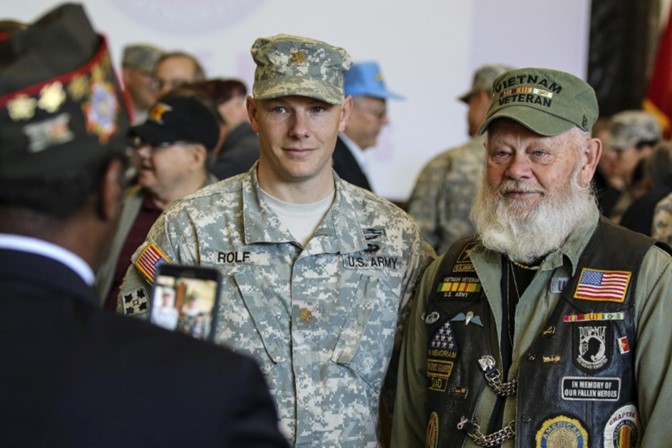
On 29 March 1975 the last American combat troops left Vietnam. Thus ending that game of dominoes which lasted nearly 20 years, and starting a string of second place finishes driven by “higher” despite the heroic efforts of those who actually fought. Vietnam era vets are rapidly rejoining their former comrades in arms on Fiddlers Green or Valhalla, or wherever their theological beliefs might take them.
 |
| Unidentified Vietnam Vet from the VA website (cropped) Source |
 |
| Some New England Vietnam vets: Vietnam War veterans (from l to r) Howie Thomas, Paul Anderson, Kevin Sullivan and Bill Benson pose together in from of West Haven City Hall in front of the Vietnam Veterans Day banner in West Haven, Conn., on Tuesday April 22, 2025. Christian Abraham/Hearst Connecticut Media Source |
 |
St. Landry Parish, LA, veterans listen to presentations during 2023 commemoration event at the parish Veteran’s Memorial. |
Vets have a special bond, and have experiences others may not understand. They can share among themselves the good times and bad, and perhaps forget some of the bad.
Thank you to all veterans!
¹ This image is available from several sources, but this is colorized and really brings out the fact we are talking about real people. Various sources lack, or have conflicting, biographical information on Maidment. A quick check of genealogical sources confirm the gist of this account of his life.



A snip of Kipling's poem about Tommy
ReplyDeleteYou talk o' better food for us, an' schools, an' fires, an' all:
We'll wait for extry rations if you treat us rational.
Don't mess about the cook-room slops, but prove it to our face
The Widow's Uniform is not the soldier-man's disgrace.
For it's Tommy this, an' Tommy that, an' "Chuck him out, the brute!"
But it's "Saviour of 'is country" when the guns begin to shoot;
An' it's Tommy this, an' Tommy that, an' anything you please;
An' Tommy ain't a bloomin' fool -- you bet that Tommy sees!
Tommy sees, yet we rise up to defend our country yet again as trouble comes.
I am frankly grateful for my service and the retirement check and Tricare. But history shows a harsher situation.
Been 75 years since the Korean War kicked off, Time flies. Going to second JB with thanks to all the veterans out there and God Bless.
ReplyDeleteSobering post, JB. Thanks for writing it.
ReplyDeleteThe cohort a little ahead of me are the Vietnam Veterans. Hard to think that thousands that have been a sort of invisible presence in my life will have disappeared, more quickly than ever over the next few decades.
I raise a glass to this post! Hear hear! My dad was a vet, who hung out with vets, so I always admired them. Now I am one so I really get it.
ReplyDeleteFunny (if you want to call it that)
ReplyDeleteThere were quite a num,ber of us who enlisted (or volunteered) for the various services back in the mid-'60s hoping/expecting to be sent to SEA and instead wound up doing the equivalent of digging latrines here in the good ole USA under some acerbic sergeant/colonel for the duration of our contract with Uncle Sam.
We didn't join up to get free travel to anywhere in the world; we joined up to fight (and die, if necessary) our country's enemies.
And yes, I understand it takes about 7 support personnel to put each man in the field, but we could have done that just as well in civilian status.
Hope I'm not bitching too loudly, but when somebody says "Thank you for your service" I feel ashamed, particularly if I'm in the company of someone who was in the front lines.
I have felt somewhat the same for over 50 years, being sent to Germany instead of Vietnam. But then I also read in SEA 10 were support personnel for every one in a combat unit.
DeleteMuch earlier in WW2, a group of recruits with engineering ability were selected for a Special Engineering Detachment and sent to live in barracks in a remote desolate location in New Mexico where they were assigned to punch cards and run them through card sorting machines. Understandably, morale and productivity were low working at such a useless task with a war on. Dr Richard Feynman got permission from Oppenheimer to tell them what they were doing (security was TIGHT!). They were modeling the energy release for designs of an atomic bomb. Morale and productivity soared. Feynman noted that they did not really need any supervision after that.
DeleteDenise Kiernan's "The Girls of Atomic City" covers the massive number of women who worked at Oak Ridge processing nuclear fuel amidst extreme security, and the dismal working conditions and shaky morale there. When they heard that "the gadget" worked, they were elated.
DeleteJB
I read that Vietnam vets had it particularly rough. You were discharged from a combat zone individually, not as a unit and 24 hours later you were back in "The World". No time to decompress on a ship with your fellow comrades. And of course combat vets rarely talk to those outside of their experiences.
ReplyDeleteI'm trying to solve a small mystery. I recently returned from visiting my last aunt and went to the grave of my uncle. They were surprised when the VA had his headstone ready that he had been awarded a bronze star. He never talked about his time in the War, but they know he was in the trenches 6 days after D-Day. Other than that, they never knew anything about his time there.
Anon- If you can provide as much of name, rank, unit, date of birth/death as possible, I will be glad to snoop around a little. No guarantee anything will be found, but sometimes....
DeleteJohn Blackshoe