Showing posts with label What If - 1815 Vignette. Show all posts

Tuesday, August 18, 2026

The End of an Era

The Marquess of Anglesey at Waterloo¹
Jan Willem Pieneman (PD)
The Earl of Uxbridge rode up to the gathering of staff officers around the Prince of Orange in a foul mood. He had just come from the far left flank, where with his cavalry he had been trying to delay the advance of a sizeable French force. The few prisoners they had taken claimed they were under the command of Maréchal Vandamme.

Uxbridge had scoffed at that, "Vandamme is nothing more than a Général de Division, he's not a bloody marshal!'

The ensign he'd torn a strip from had looked offended, then had pointed out that one of the prisoners, a captain, had sworn seeing Bonaparte promote Vandamme at Ligny. If, as the man had said, his Excellency, the Earl, didn't believe him, then perhaps the Earl should go and see for himself.

He had damned the man's insolence but regardless of Vandamme's rank, his forces were coming on string and weren't all that far behind.

"De Lancey! What in the seven hells is going on here?" Uxbridge also took the time to throw a disrespectful look at the Prince.

"La Haye Sainte has fallen, the 95th are holding the Frenchies at bay for the moment, but their ammunition is not limitless. The Prince here, insists that we throw in the last of Pack's brigade to drive them off. Ompteda has already been torn apart attempting that. There is more French cavalry down in that valley than I can scarce believe!"

"Where the bloody hell is the Duke!?" Uxbridge barked, not seeing his commander anywhere nearby.

"He's back at the village, he's badly wounded, Doctor Hume says he might not survive the day."

Uxbridge's face went pale, the Duke, mortally wounded? Now this sprig of Dutch aristocracy was attempting to take command?

Leaning in, he grasped the bridle of the Prince's horse, "Begging your pardon, Your Majesty, but your army has scarce two thousand men on the field. This is no longer an allied army, it's a bloody British army. Now sod off."

The Prince turned beet red, "How dare you ..."

Turning to a sergeant of hussars who had accompanied him throughout this long day, Uxbridge barked, "Sergeant Wolsey, please escort the Prince to the nearest Dutch contingent. There may some left out on the left, Boney's boys have been driving them from the field, but mayhaps a few stragglers from his lot might be needing his leadership, we don't need it here."

Without another word to the Prince, Uxbridge turned back to De Lancey, "What say you, Sir William?"

De Lancey looked down at the ground and took a deep breath, "I'm sorry, my Lord, I see no alternative but to retreat on Ghent. As fast as bloody possible."

At that moment everyone felt the ground shaking, the French cavalry!

"For now, Sir, we need to take shelter in yon square!" De Lancey shouted then turned his mount.

Vive l'Empereur!
Édouard Detaille (PD)
The Emperor turned and looked for Grouchy, the man was busy describing what he wanted next, Napoléon was impressed with the man's eye for detail. He had sent a brigade of light cavalry up the slope in support of the heavy brigade which had sabered a Hanoverian brigade to pieces next to the farm of La Haye Sainte. Napoléon could sense that the critical point in the battle was upon them.

"Ney!"

Le Rougeaud had been fuming the entire afternoon, like a hunting dog held back on the leash, scenting blood, he wanted to be released into the fray.

"Sire!"

Napoléon thought the man was ready to vomit flames from his mouth, he was so keyed up.

"Take my Guard and drive those people from that ridge. Grouchy will provide support. I believe d'Erlon has his lads up there already, they just need a push and I think the whole facade will come crashing down."

Ney smiled from ear to ear, drawing his sword he galloped back to where two brigades of Guardsmen stood, ready for action. Napoléon watched, he was reluctant to send in his grenadiers and chasseurs, but now was the moment, this was what he paid them for.

The Attack of the Middle Guard Against Wellington's Center at the Battle of Waterloo
Giuseppe Rava
Source
Maréchal of France Michel Ney felt that this, this very moment, had to be the most special of his long career. He was riding at the head of the "immortals" as the rest of the army called them. Not because of their prowess in battle, but because they were seldom committed to battle. Each man in their ranks had proven himself in war, membership in the Guard was a reward for long, dedicated service.

But in the back of every man's mind they knew, that occasionally, le Tondu would call on them to justify their existence. When the battle was in doubt or when the enemy needed one final blow to finish things, the Guard would march.

In the front of the advance were the Middle Guard, so called to distinguish them from the older, more experienced men in the senior regiments known as the Old Guard, and from the more junior regiments of the Young Guard. Behind them marched the Old Guard, a solid corps of the most fierce soldiers in Europe.

The Old Guard wore the tall bearskins which distinguished them on the battlefield, most of the Middle Guard wore whatever could be scraped together after the Emperor's reappearance in France earlier in the year. Some had bearskins, a number had shakos and many even wore nothing more martial than a fatigue cap. But to dismiss them because of their appearance could be fatal.

One Hanoverian regiment of young soldiers and inexperienced officers made that very mistake. They attempted to charge the oncoming 3rd Regiment of Chasseurs à Pied² with their bayonets. A volley knocked many of those young men off their feet, then the chasseurs lowered their own bayonets and plunged into the confusion.

The Hanoverians fled, leaving disaster in their wake.

A Cameron, piper Kenneth McKay of the 79th Highlanders urging on the Highland Line at the Battle of Waterloo in 1815
William Lockhart Bogle (PD)
"We stand here, laddies! The Duke is counting on us!"

The young captain of the 92nd Highlanders, now commanding the amalgamated survivors of Quatre Bras, scarcely 400 men of all three Highland regiments present at that debacle, watched with his heart in his throat as the Imperial Guard slammed into the British line not a hundred paces to their right.

Across the valley, what looked like a wave of steel was coming down the slope and then up the slope towards his own position. Heavy French cavalry, cuirassiers and carabiniers³ their sabers glittering, the sun shining off their breastplates, the captain felt the need to urinate become incessant, then he heard it and his heart steadied.

Pipe Major Kenneth McKay of the 79th had stepped out of the ranks, his pipes penetrated the din of musketry, the roar of cannon, and the screams of the combatants. The captain recognized the tune, for a moment he was back in the Highlands, back in his home, then he blinked and shouted, "Make ready!"

The Highland volley emptied many a saddle, but to no avail, the last survivors of Quatre Bras perished under the hooves and heavy sabers of the cuirassiers.

Le maréchal Ney et ses aides-de-camp conduisant la charge de cavalerie à Waterloo.
Louis Dumoulin (PD)
The sounds of battle were gone, all that was left were the screams and moans of the wounded. The night was full of horrors as the peasants and uniformed marauders made their way over the field of battle, robbing the dead and the not quite dead of their valuables. Some of the wounded were quietly dispatched if they were determined to retain their property.

The Emperor had pickets stationed around the area to try and dissuade these practices, as old as warfare. He knew it would have little effect, but he felt the need to try.

"Sire?"

Napoléon looked up, snapping back to the present from his thoughts, "What is it, de la Bédoyère? Have they found him?"

The Comte de la Bédoyère, one of the Emperor's aides, stepped into the lamp light with a disheveled Englishman, from the look of the man, he was a surgeon.

"Sire, this is Doctor Hume, Wellington's physician. He has been treating the Duke. He is still alive, though barely."

"Convey me to him."

The small party stepped into the farmer's house, in a back bedroom, alone, was Sir Arthur Wellesley, the Duke of Wellington. Napoléon stopped in the doorway, if things had been different, that might have been him lying on the bed, dying after an ignominious defeat. Today though, it was his opponent, his most inveterate opponent in Spain, Napoléon had never met Wellington in battle before this day. But the man had defeated many of the Emperor's best marshals, for that, he had Napoléon's respect.

The Emperor turned, "Send for Larrey."

"Sire, I don't think there is anything that ..."

"Do it."

He approached the bed, Wellington opened his eyes, weakly he spoke, "Ah, General Bonaparte, well met, Sir."

Being addressed by his family name and his old rank rather grated on the Emperor's nerves, but he could be magnanimous when needed.

"Your men fought well today, Your Grace. They died well."

Wellington smiled softly, then died.

Their was silence in the room, Napoléon stood there for a long moment, gazing down at his dead foe.

Napoléon spoke, softly, "Mon général, votre gloire vivra éternellement."

Then the Emperor turned on his heel and left the building.

The Comte de la Bédoyère later swore that there was a tear running down Napoléon's cheek in the dim lamplight of the Great Duke's death chamber.

The Battle of Waterloo was over, the French had won and were now moving on Brussels.


¹ Henry Willian Paget, known as Lord Uxbridge during the Waterloo campaign.
² Literally "Hunters on foot," French Imperial Guard light infantry
³ Cuirassiers and Carabiners at Waterloo wore steel back and breast plates. The cuirasses of the Carabiniers were covered in brass sheathing. Both types wore helmets and were big men riding big horses.
⁴ Marshal Ney and his aides-de-camp leading the cavalry charge at Waterloo.
⁵ My general, your glory will live forever.

Saturday, August 15, 2026

It Begins ...

Source
Newly minted Marshal of France, Dominique Joseph René Vandamme sat his horse, strong emotions were warring inside of him, as they often did. On the march towards Wavre, his wing of the army had caught, and destroyed, a Prussian division, that of von Krafft.¹ Interrogations of prisoners taken revealed that most of the corps to which von Krafft belonged to was routed and headed towards Liege, only two divisions had kept together. Now there was one, that of von Bose.

"What of their cavalry?" he snapped at the young officer who had questioned the prisoners.

"Most of them were dispersed covering von Pirch's retreat, at most there is a single division remaining, that of von Sohr. They have a single battery of horse artillery² and one of foot."

Maréchal Vandamme dismissed the man with a grunt, turning to an aide he barked, "Have Vichery, Péchaux, and Maurin³ report to me, everyone else is to turn and march west."

"West, Sir?"

"Yes, to Mont St. Jean, I promised the Emperor I would support him there once the Prussians were dealt with. I believe the divisions of Vichery, Péchaux, and Maurin should be sufficient to deal with the remnants of the Prussian Army. Hulot will remain attached to III Corps."

"Sir, what of Lobau? The last message we had from him indicated that he was being pushed back by von Thielmann."

"Général de Division Lobau is on his own. Victory will be decided here, in the north, not outside Namur. Now go, we must be headed west within the hour!"

Now that the decision was made, the warring thoughts within him could cease. He knew his Emperor, he wanted to be in at the kill, not chasing these damned Prussians around the Belgian countryside!

L'artillerie à cheval de la Garde impériale prenant position.
Alphonse Lalauze (PD)
The Emperor sat his mount atop the slope near the little inn called La Belle Alliance. The grand battery was nearly complete, it had been slow to take shape as the ground was still muddy in spots. He turned as a battery of his Guard's horse artillery clattered past on the main road, all of them screaming "Vive l'Empereur!"

He tipped his famous hat then turned to Davout, "The time?"

Davout had been consulting his pocket watch, wearing his spectacles which he knew the Emperor hated. Looking up, he blushed. Regaining his composure he answered Napoléon ...

"Nearly half past one of the clock, Sire. I recommend we begin the bombardment. I have already issued the orders to Reille and d'Erlon to begin their part once the grand battery opens fire."

The Emperor scanned the field once more, then nodded to Davout, "You may commence."

Wellington at Waterloo
Ernest Crofts
Source
Copenhagen was nervous, the Duke hoped that no one noticed as the horse was reacting to his rider's own nervousness. As he watched the French mustering a grand battery, not all that far from where he sat his horse, he wondered where Bonaparte might try his line. It seemed to be weak everywhere. He kept glancing to his right, wondering if it was already too late to withdraw to Ghent and the Channel.

"Your Grace, it looks as though Boney intends to scare us off the field."

The Duke turned to see who had made the remark, wondering why the man couldn't keep silent. He saw that it was his chief of engineers.

"Sir James, I daresay Bonaparte intends to soften us up a bit before launching his infantry this way. Perhaps he doesn't realize our lack of strength."

Sir William de Lancey chimed in, "Soult has experience in the Peninsula, no doubt he told Boney of our preference of deploying on reverse slopes to stay out of the reach of his artillery."

"Perhaps, now let us all remain ..."

Everyone saw the smoke from a single cannon across the valley, the report of the gun would arrive shortly after the ball which issued from the mouth of that piece.

Sir Alexander Gordon shifted in his saddle, about to make a comment when the ball in question drove him from the back of his horse. He died without a sound.

"Dear God, but that was a lucky shot," someone among the staff offered.

"Not for Gordon. Now gentlemen, let us move to the rear a bit, we are a conspicuous target." Copenhagen was already moving before the last word came out of the Duke's mouth.

French foot artillery
Source
The pounding from the French artillery seemed to have lasted hours but had actually been going on for scarcely 30 minutes. The Duke had ordered his men to lie down, to at least spare them the horror of standing there and just taking it. To an observer across the valley, it would seem that the British infantry had been swallowed up by the ground.

Davout looked to the Emperor, who deferred to Maréchal Soult.

"Wellington will have his front line lie down, they are still there, no doubt there are more on the other side of the ridge."

"Let the battle ripen, Davout. When it is time, I shall let you know."

"Very well, Sire."


The Duke was down, Copenhagen had been hit by a piece of bursting shell, the horse had reared up and either threw his rider, or the Duke had jumped free. Amidst the smoke and the noise, his staff couldn't see him.

Copenhagen staggered to the rear, then collapsed.

"Your Grace!" Sir William called out, frantically looking for the Duke.

Wellington staggered to his feet, hatless, his chest was soaked in blood. Sir William assumed that it was his horse's blood, he dismounted and went to his commanding officer.

"Your Grace, are you hit?" Sir William wrapped an arm around Wellington, trying to help him stay upright. Then he shouted at one of the cavalry escorts, "Sergeant, your horse!"

"I'm afraid it's all over for me, Sir William."

The Duke staggered again, then dropped to one knee, fresh blood coming from his mouth.

De Lancey looked about, frantically looking for Wellington's surgeon, then he spotted the man, rushing towards them.

"Doctor Hume, the Duke ..."

Hume assisted the Duke to lie back on the ground, the blood issuing from the Duke's mouth looked problematic, "I have him, Sir William, where is the Prince?⁵ I'm afraid he'll have to take command, the Duke is in no condition to continue."

The storming of La Haye Sainte
Richard Knötel (PD)
Général de Brigade Baron Joachim Jérôme Quiot du Passage looked around as his men surged through the gate of the farmhouse. The Germans inside were fighting desperately but with no visible support either around them or above them on the ridge, they were now looking over their shoulders, looking for a place to run.

"Press them you scoundrels! Attack!" the General was screaming himself hoarse until he was struck in the throat by a shot from the top of the farmhouse.

"Rifles! The bastards are riflemen!" came shouts from around the fallen officer.

"No quarter! No quarter!" The cry was taken up by the entire brigade.


On the ridge the staff was scrambling to get control of the situation, Prince William was trying to induce the British cavalry to charge down the road to relieve La Haye Sainte. Those men were looking to their officers, who were looking for a British officer to confirm the command.

"Charge, damn you! Your King's German Legion comrades are looking to you!"

"I don't see any KGL chaps to our front, d'you Mickey?" The words of one Irish sergeant summarized the attitude of the regiment, while Sir William, Prince of Orange, might know what was happening to their front, the British cavalry did not.

At a critical point in the battle, confusion reined in the upper ranks of the British Army at Mont St. Jean.


¹ The Prussian Army actually didn't have divisions in name, what other armies called divisions, the Prussians called brigades. So in actuality, Vandamme destroyed von Krafft's brigade, a force of some 6,700 men. Two regiments of regulars with a single regiment of Landwehr.
² In horse artillery batteries, every man was mounted, in foot batteries everyone walked. Horse artillery was much faster to get into action, but their guns tended to be lighter in weight of shot.
³ Vichery and Péchaux commanded infantry divisions in IV Corps, Maurin commanded the cavalry division belonging to that corps.
⁴ The Imperial Guard horse artillery taking up position.
⁵ General William, the Prince of Orange. He was the highest ranking officer on the scene. Some of the British called him "Slender Billy." He was popular with the troops. At this point in the story, Lord Uxbridge, whom Wellington had designated as his second in command, was on the far left flank of the British position.

Friday, August 14, 2026

Decisions at Dawn

Dawn of Waterloo
Elizabeth Thompson, Lady Butler (PD)
The Duke of Wellington stood in the courtyard of the Chateau de Goumont staring into the cooking fire where a number of Guardsmen were cooking their breakfast. On a smaller fire there was a pot, a teapot he surmised. His glance fell on that pot, without thinking, he sighed. The last three days had been disastrous.

"Tea, Your Grace?"

He turned to look at a sergeant of the Coldstream Guards, he thought he recognized the man.

"It's Graham,¹ isn't it?"

"As it ever was Your Grace," pausing he lifted the enameled cup and offered it, "still hot it is."

The Duke held the cup in both hands, the tea smelled very good, he drank deeply, emptying the cup, then handed it back to the sergeant.

"You're Irish, isn't that right Sergeant?"

"Yes, indeed, Your Grace, County Monaghan to be sure."

"Thank you for the tea, where is your commander?"

Graham nodded towards the manor house, "Lieutenant Colonel Macdonell² is inside, Sir."

"Thank you again, Sergeant. Keep an eye on things here today, I fear it shall be bad today. Very bad."


"That's it then, keep your lads well in hand today Morrisey. I fear the Frenchies are rather thicker on the ground than we are. Oh, and ..." Macdonell paused as he saw a familiar figure enter the room, he stood up.

"Your Grace."

"Macdonell. I am counting on you and your lads today. We are very thin on the ground and I expect no help from the Prussians. If we need to withdraw, your position here will be the hinge. I do not intend to withdraw to Brussels but via Braine-l'Alleud then Halle, I intend to make for Ghent with all haste should this position become untenable. Are we clear?"

"Your Grace, we shall remain here until you order us to leave, or until we have died at our posts."

Uncharacteristically, the Duke thrust his hand out, Macdonell took it in his own strong grip. Neither man said a word, but the emotion in the room was thick. Eventually Lieutenant Colonel Gordon,³ one of the Duke's principal aides, broke the silence.

"Your Grace, we must be off ..."

Wellington nodded, then released Macdonell's hand, without a word he spun on his heel and went out to where Copenhagen was waiting.

"Your Grace ..."

"I know, Sir Alexander, I know. This will no doubt be the hardest day of our careers. Perhaps the rain will continue and we can simply steal away into the mist."

Gordon looked to the sky, as if to defy the Duke, the rain began to lessen.

"One can hope, Your Grace."

Napoléon in 1806
Édouard Detaille (PD)
The Emperor was up early, the noise of his staff moving around in the room adjacent to his sleeping chamber had woken him from a deep sleep. Oddly enough, he felt well-rested and the pain that had been dogging him for so many days had subsided. Not even a dull ache remained.

His Mamelouk servant, Ali⁴ heard the Emperor stir and cautiously checked on his charge.

"Sire?"

"I am all right, Ali. Surprisingly well, is there any breakfast?"

"I will see to it, Sire."

Napoléon got out of bed and dressed himself, not waiting for his valet. As he finished buttoning the undress jacket of the Chasseurs à Cheval of the Imperial Guard, he heard a tap on the door.

"Enter."

He was surprised to see two of his marshals, not Ali with his breakfast. He had a sudden sick feeling, had some ill tidings arrived in the night?

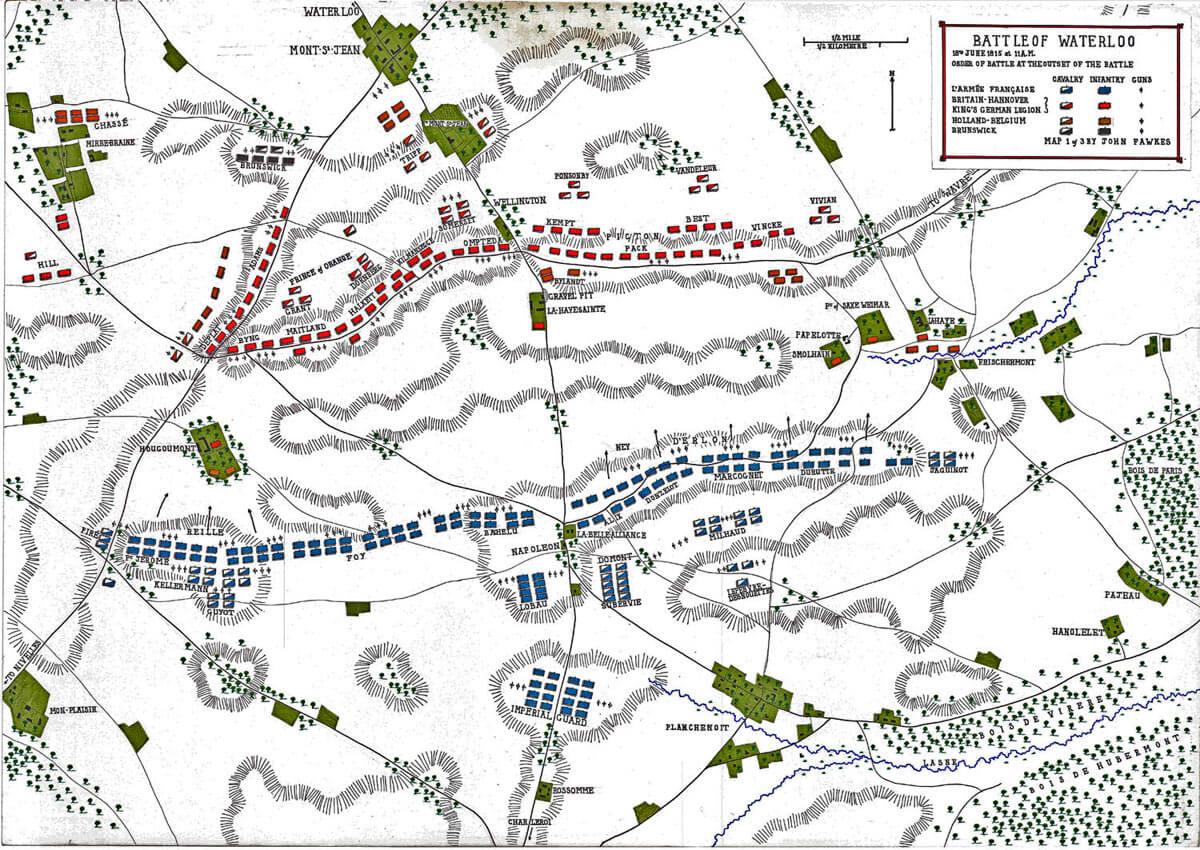
Davout spoke while Berthier stood behind him, "Sire, it appears that Wellington has elected to make a stand on the Mont St. Jean ridge. He doesn't really have enough men to cover the entire position. He is very weak on his left, we think ..." he turned to Berthier who stepped forward with a map.

Source
Compare this version with the original at the source,
both sides lines are considerably thinner.
"Here, as you can see here Sire," Berthier pointed to the map, "it seems that Wellington is leaning to his right, towards La Manche.⁵ I daresay he is hedging his bets and with a strong enough push, he will withdraw in that direction."

With his left hand behind his back, the Emperor leaned over the map, he placed his finger near the right edge, near a place marked "Frischermont," then traced his finger over the hamlets and farms labeled "Papelotte," "La Haye," and "Smolhain." His eyes strayed to the positions of units Berthier's staff had drawn in.

"Saxe-Weimar, what does he have here, perhaps a regiment?"

"Our scouts tell us that he has three weak battalions holding this area. They also seem to be the only remaining forces of the Netherlands in Wellington's lines."

"The others? Early reports showed three Dutch-Belgian divisions under Wellington's command, where are they?"

Davout answered, "The divisions of Perponcher and Chassé were destroyed around Quatre Bras. Stedman's division was last reported to be retreating through Brussels. It seems the Netherlands has abandoned their British and German allies."

The Emperor seemed to growl, then he said, "Those damned Dutchmen did considerable damage to Reille's corps, from the looks of it, II Corps doesn't have enough men to advance aggressively." He slapped the map where a substantial chateau labeled "Hougoumont" was situated.

No one spoke, unbeknownst to the Emperor, his brother, Prince Jérôme, had died of his wounds overnight, at Genappe.

"Sire, it is true that your brother's division was badly hurt at Quatre Bras, he, uh ..." Davout hesitated.

"What is it?" Napoléon snapped.

"The Prince was wounded at ..."

"I know that, so what ..."

It then struck the Emperor that his youngest brother was dead.

"Not one of you thought to tell me that the Prince was dead?"

Berthier spoke up, we received word only an hour ago, Sire. My condolences."

Napoléon got a far away look on his face, he stayed silent for a moment, then spoke.

"We shall mourn the dead later. For now, what do you propose, Davout?"

The marshal looked at the map, then ran his finger along a slight ridge just south of the La Haye Sainte farm.

"I propose a grand battery here, with which we will pound Wellington's center. While this is going on, I propose sending Foy and Bachelu forward to draw Wellington's attention to his right center. Then I should think we send d'Erlon straight at the English left. They are weak there."

The Emperor nodded, "I agree. Any news from Vandamme?"

"A single Prussian corps, that of von Pirch, withdrew towards Wavre. Vandamme has been harrying them without rest. I have sent for more information, but we had a courier from Vandamme saying that that Prussian corps was dissipating under his attacks, he likened it to a mist fading under a hot summer sun ..." Berthier paused.

The Emperor chuckled, "I never knew Vandamme to wax poetic."

"One of his aides I'm sure, Sire. If I know Vandamme he would have mentioned something about 'kicking their arses,' not mist dissipating in the hot sun." Soult entered with that remark, then turned to his Emperor.

"The army is in position, Sire. The fields are sodden, it might be a while before we can move our guns to create that grand battery Davout has suggested."

"Very well, let us have breakfast gentlemen, we have time before we destroy Wellington. That, is inevitable."

As the leaders of the French army gathered to eat, Wellington rode his lines. He had some hard decisions to make.

Should he stand and fight, with no word having come from the Prussians, or should he withdraw towards the Channel ports? Regardless of his decision, he would be raked over the coals in Parliament by those who had never seen a battle.

His heart said "stand," his head said "flee."

As the sun rose over the fields between Mont St. Jean and La Belle Alliance, Wellington knew that it was going to be a long, hard day, no matter which option he chose.


¹ Sergeant James Graham was a sergeant in the Coldstream Guards, said to be the bravest man in the British Army by the Duke himself.
² Lieutenant Colonel Sir James Macdonell commanded the 2nd Battalion of the Coldstream Guards at Waterloo
³ Lieutenant Colonel Sir Alexander Gordon was a Scottish officer in the British Army. The bed where he died of his wounds after the battle is still present in the inn at Waterloo where Wellington had his headquarters.
⁴ Louis-Étienne Saint-Denis (22 September 1788 – 3 May 1856) was a member of the Mamelukes of the Imperial Guard, leading him to be known in his lifetime as "Mamelouk Ali". He was most notable as a faithful servant to Napoleon I during his two exiles on Elba and Saint Helena. Wikipedia
⁵ What the French called the English Channel, literally means "the sleeve."

Wednesday, August 12, 2026

Before We Continue ...

L'Aigle blessé¹
Monument to the French army at Waterloo

Source
Okay, I admit it, I enjoy writing about things that many people may not be familiar with. Now most folks know what the Battle of Waterloo was about, the British beat the French and Napoléon got sent to a rock off the coast of Africa (the island of Saint Helena to be exact). No, he didn't "surrender" at Waterloo, as much as I like the band ABBA, they got that wrong. And if you get your history from Ridley Scott films, well, perhaps you'd best move on.

Anyhoo, in this latest historical fiction of mine, I've tried to layout what could have given the French the victory. We're almost there, the Battle of Waterloo is imminent, but it's going to be smaller and perhaps even bloodier than the real thing. The French have virtually destroyed the Prussian Army, its commander and chief-of-staff lie dead on the battlefield, much of the Netherlands army (consisting of Dutch and Belgian troops) has been roughly handled and their loyalty to the Allied cause might be on shaky ground. (After all, many of those soldiers had been in Napoléon's army within the couple of years prior to Waterloo.)

But where are we at now? How did we get here? Time for a couple of maps to illustrate what's been going on over the past few posts. (These maps were all derived from this excellent map at this website.)

Here is where we began, on Wednesday, the 14th of June, 1815:


Wellington's army is scattered across Belgium as he couldn't be sure if the French were going to advance on Brussels via Charleroi, or through Mons. The first option would split Wellington from his Prussian allies, the second would sever his supply lines to the English Channel. Neither option appealed to him, but he had to cover all of his bases.

The Prussian army is spread from Charleroi to Liege, with one corps south of Namur. The French army is concentrated around Beaumont, in France, ready to strike north.

In the actual campaign the French started off on the wrong foot. A division commander defected to the Prussians and two corps, Vandamme's and Gérard's, got entangled on the first morning primarily because the Emperor's chief of staff, Maréchal Soult, didn't get the orders out on time, allegedly. So things started slow, in my account, everything went off like clockwork (and Napoléon had gotten rid of the traitor before the campaign).

As the 15th of June dawns, the French have energetically moved against the Prussians around Ligny (having driven Ziethen's forward screen around Charleroi back on the 14th) and Maréchal Davout is driving the left wing of the Armée du Nord north towards Genappe, fighting has already occurred around Quatre Bras (which historically didn't occur until the 16th).

The French VI Corps, under Lobau, by dint of hard marching moved overnight to block the roads north out of Namur. Which Thielmann's III Prussian Corps discovers as they attempt to cross a bridge over the Sambre, which was sabotaged during the night.

The Prussian IV Corps, under Bülow, has yet to receive any orders so they still sit outside, and within, the city of Liege. Later in the morning, a courier gets through and they begin their march to Sombreffe, far too late to assist the main Prussian army (I and II Corps) under Generalfeldmarschall von Blücher.

Wellington, still unsure of the main French thrust is holding his forces close in hand. The Netherlands cavalry division near Mons has fallen back on orders received from the Prince of Orange who is convinced that the main French thrust is coming up from Charleroi.

The Duke of Wellington has ordered Picton's British division and the Duke of Brunswick's corps south, but only to Genappe.


The French are now concentrated between the armies of Wellington and the Prussians, now under the command of von Pirch. Lobau's VI Corps, badly hurt, is still battling with Thielmann's corps just north of Namur. Thielmann has been hurt as well, mostly through bad morale amongst his mostly Landwehr formations.

low, having witnessed hundreds of stragglers and deserters headed for the Rhine, has stopped his forward movement and is preparing to defend Liege, which is not on the French radar at the moment.

Perponcher's Netherlands Division has been largely destroyed, Ziethen's Prussian corps as well, those men not dead or wounded on the field are fleeing towards Liege. The deaths of von Gneisenau and von Blücher have left the Prussians with no firm hand on the controls.

Picton's division and the Brunswick corps are still holding near Genappe but have taken heavy casualties. As torrential rains begin late on the 16th and continue through most of the day on the 17th, the French push is slowed down. Though this allows Wellington time to build his position up at Mont St. Jean, he has far fewer troops to deploy there than he had historically.

The French are still counting their own cost, but morale in the Armée du Nord is sky high. Napoléon is still suffering badly from his piles, but a day out of the saddle while Davout directs the pursuit of the Anglo-Allied army while Soult pursues what is left of the Prussians will give the Emperor a chance of good health on the 18th.

Historically he failed, in this tale, he is set to spend the night of the 18th in the Palais Royale in Brussels. The Duke of Wellington will be approaching absolute exhaustion by that day, he has scarcely slept in two days.

Will history repeat itself in this tale? It doesn't look good.


¹ The wounded eagle.

Tuesday, August 11, 2026

The Road to Brussels

Wellington at Waterloo
Robert Alexander Hillingfor
d
Source
"How many, Sir William?"

Sir William Howe de Lancey consulted his notes, reports had been coming in since late afternoon of yesterday. They painted a grim picture.

"We have perhaps 40,000 men remaining, Your Grace. Though the reports are incomplete, I reckon that we have no more than 75 guns remaining to us."

The Duke of Wellington's horse, Copenhagen, pranced nervously, sensing his rider's state of mind. And in truth, the Duke was nervous. Things looked very bad and he had yet to hear any report from his Prussian allies.

"What of von Müffling,¹ any word from the Prussians?"

"No, Your Grace. All we know is that the Prussians suffered a massive defeat near Ligny. There are reports that they are retreating in great disorder and that the field marshal is dead."

"Blücher? Dead?"

"I'm afraid so, Your Grace."

Kellerman’s Cuirassiers capture the Colours of the British 69th Foot’s 2nd Battalion at Quatre Bras
Victor Huen

Source
Seven miles to the south of Wellington's headquarters, Wellington's 3rd Division, under Sir Charles Alten,² had reached the main Brussels road after hard marching from the direction of Nivelles. The sky had burst in the meantime, drenching the men as the rain came down hard. Amidst the thunder and the lightning, the 69th Regiment of Foot, being in the lead, gained the roadway only to discover that the French were approaching in great force.

The 69th formed square in a hurry but to no avail, they were still forming when they were hit by a sizeable force of French heavy cavalry emerging from the pouring rain. They were badly torn up and they lost one of their colors.

The remainder of Alten's division was still deploying when the main body of the French Armée du Nord hit them as they were trying to deploy.

De Lancey's estimate of 40,000 men dropped to around 35,000 as most of the 3rd Division was destroyed.

Napoleon I in 1814
Jean-Louis-Ernest Meissonier (PD)
The Emperor was on horseback, watching his triumphant army marching north. HIs doctor had given him just enough laudanum to somewhat quell the pain. But being in the saddle was not helping. After a division of Reille's had marched past, he dismounted and tried not to stagger as he entered an inn in Genappe, on the road to Brussels.

The dining room was a mess of bloody bandages, scraps of torn uniforms, and various bits and pieces of medical apparatus. The Dutch had been using the inn as a hospital during the action at Quatre Bras. According to one prisoner, the Prince of Orange himself had been treated here before being evacuated to Brussels.

Napoléon entered one of the larger rooms on the ground floor where Berthier had set up headquarters. He saw Davout, Ney, and Berthier huddled over a map. Soult should have been there, but was not.

"Where is Soult!?" he barked, though the laudanum was starting to make him feel drowsy, his temper was flaring.

"Sire, Maréchal Soult is forward, directing the fighting there, we caught an English division deploying alongside the road, Kellerman's heavies tore one regiment to pieces and drove the rest of the redcoats to disperse." Ney had answered the question.

"What are the casualties in my Guard, Ney?"

Ney drew himself erect and looked the Emperor directly in the eye, "Perhaps a thousand have fallen, Sire. The Guard covered themselves in glory."

"Damn it, Ney ..."

Before he could continue, Davout cut him off. "We have the victory, Sire. We can recruit more Guardsmen, the victory they bought you at Ligny made victory possible. Wellington's forces are on the run, scouts tell us that they seem to be gathering along the ridge before Mont St. Jean, but they don't have enough men to cover the position adequately."

The laudanum hit him, hard, his vision grew blurry, so he simply said, "Very well, carry on, I must lie down. Keep the army moving. Davout, drive the English out of Belgium!"

After the Emperor left, the three marshals all stood there, staring at each other until Berthier broke the silence.

"You all know what to do. I have messages from Gérard's chief of staff and from Lobau. What is left of III Corps is marching to join us. What was left of Lobau's men after their gallant stand against the Prussians at Namur remains on that battlefield in case the Prussians wish to try again. Vandamme and d'Erlon are driving what remains of the Prussians before them. A few formed units are marching north to Wavre, Vandamme will destroy them with two divisions while d'Erlon continues to push towards Liege. I will give you further orders, if necessary, once the Emperor awakens."

Source
A dismounted officer of horse artillery raised his helmet as the Duke trotted past. Wellington nodded but kept riding on, he had to reach the field at Mont St. Jean before nightfall. The French were driving hard up the road, even in the torrential downpours which kept popping up. He feared that he wouldn't have enough men to hold the ridge and began to consider pulling back to the fortifications around Brussels.

Those fortifications were in a sad state, having gone unmaintained for a number of years. He felt that he had no choice but to make a stand on the ridge to the south of his headquarters. He had already sent a message to King Louis XVIII and his court at Ghent, recommending in the strongest terms that they evacuate across the Channel, back to England.

As he rode, he saw a party of horsemen, in Prussian uniforms, coming up from the south. He recognized his liaison officer, von Müffling. The man reined in next to the Duke.

"Your Grace, bad news I'm afraid ..."

"Blücher, the field marshal, is he ..."

"Dead, Your Grace, as is von Gneisenau, his chief of staff. The headquarters was overrun north of Sombreffe by French dragoons, all were killed or taken prisoner."

"What of your forces?"

"A single corps, that of von Pirch, is marching on Wavre, but the French are hot on their heels, giving them no rest. Thielmann's corps is south of Namur, I don't know anything more than that."

"What of Bülow, and Zieten, are they ..."

"Bülow has withdrawn into the defenses at Liege and refuses to move, Zieten's corps was destroyed at Ligny, Zieten is dead, the remainder of his forces either rotting on the field or marching south as French captives. My apologies, Your Grace, it seems as if my country has no more role to play in this campaign."

The Duke of Wellington sat upon Copenhagen, afraid to speak for fear of losing his temper. He watched as von Müffling and his party rode north. Then he turned to de Lancey.

"Sir William, we must make haste for, what's the name of the farm?"

"La Haye Sainte, Your Grace."

Leaning in so that no one else would hear, he whispered, "Evacuate the people from Brussels, I want Bonaparte to hold no British civilians hostage should we lose this gamble."

"Yes, Your Grace. And for the government?"

"Tell them nothing, lest they panic prematurely."


¹ Karl Freiherr von Müffling, Wellington's liaison with the Prussian army.
² Lieutenant-General Count Sir Charles Alten, a Hanoverian officer serving with the British army, his division consisted of a mix of British and Hanoverian regiments.