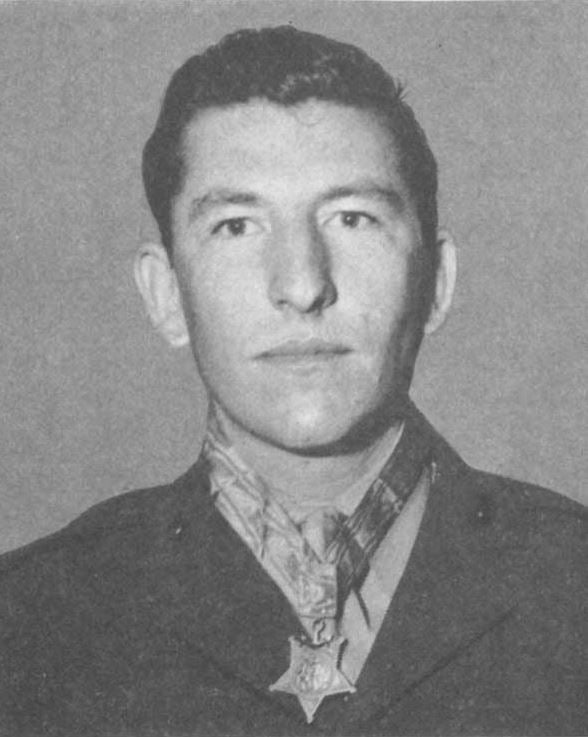
Today we'll be discussing William G. Harrell, a United States Marine who earned the Medal of Honor on Iwo Jima. Most of Sarge's readers are Military and Retired Military and as such have a fairly large knowledge about Military History. The Battle of Iwo Jima was an exceptionally hard battle on a dangerous island that had to be captured by the Marines. I had always thought so, and when I read through this Marine's "adventure", I came to realize I had NO IDEA how hard it was. So...Hang on to your seats, here we go.
 |
| Source |
Master Sergeant Harrell graduated High School in 1939 and attended Texas A&M for the next two years (You know what happened then) and joined the Marines in 1942. After completing training in 1943, he deployed to the Pacific Theater, participating in the invasion of Saipan June 15 to July 9 1944, a very difficult invasion as it was one of the Marine's first. A lot of hard learned lessons came about.
He followed that with the invasion of Iwo Jima. Suffice it to say, it was likely that Saipan was child's play compared to Iwo Jima.
While on Iwo Jima, Sgt Harrell and PFC Carter were dispatched out front of their company headquarters to watch for the enemy from a foxhole. The Japanese started an attack and the PFC's rifle jammed. Sgt Harrell sent him back to get another. While gone, the Japanese threw a grenade into their foxhole which blew off Sgt Harrell's left hand. PFC Carter returned but that rifle also jammed. Sgt Harrell, thinking he was dying from his injury, ordered Carter to return to the company command post about 20 yards behind them.
Carter left and returned with a second rifle and a stretcher. While he was gone, Sgt Harrell fought off another charge although the Japanese attack involved another grenade toss which severed his right hand, and also killed the attacking Japanese. When daybreak came and reinforcements arrived, they found the two were surrounded by 12 dead Japanese . PFC Carter was awarded the Navy Cross while Sgt Harrell was presented with the Medal of Honor.
Sounds to me, that both did their job above and beyond (Well above and beyond) the call of duty.
On October 5 1945, President Truman presented him with the Medal of Honor.
 |
| Source |
The Citation for the presentation of Sergeant Major's Medal of Honor.
The President of the United States takes pleasure in presenting the MEDAL OF HONOR to
SERGEANT WILLIAM G. HARRELL
UNITED STATES MARINE CORPS
for service as set forth in the following CITATION:
For conspicuous gallantry and intrepidity at the risk of his life above and beyond the call of duty as Leader of an Assault Group, serving with the First Battalion, Twenty-Eight Marines, Fifth Marine Division, during hand- to-hand combat with enemy Japanese at Iwo Jima, Volcano Islands, on March 3, 1945. Standing watch alternately with another Marine in a terrain studded with caves and ravines, Sergeant Harrell was holding a position in a perimeter defense around the company command post when Japanese troops infiltrated our lines in the early hours of dawn. Awakened by a sudden attack, he quickly opened fire with his carbine and killed two of the enemy as they emerged from a ravine in the light of a star-shell burst. Unmindful of his danger as hostile grenades fell closer, he waged a fierce lone battle until an exploding missile tore off his left hand and fractured his thigh; he was attempting to reload the carbine when his companion returned from the command post with another weapon. Wounded again by a Japanese who rushed the foxhole wielding a saber in the darkness, Sergeant Harrell succeeded in drawing his pistol and killing his opponent and then ordered his wounded companion to a place of safety. Exhausted by profuse bleeding but still unbeaten, he fearlessly met the challenge of two more enemy troops who charged his position and placed a grenade near his head. Killing one man with his pistol, he grasped the sputtering grenade with his good right hand and, pushing it painfully toward the crouching soldier, saw his remaining assailant destroyed but his own hand severed in the explosion. At dawn Sergeant Harrell was evacuated from a position hedged by the bodies of twelve dead Japanese, at least five of whom he had personally destroyed in his self-sacrificing defense of the command post. His grim fortitude exceptional valor and indomitable fighting spirit against almost insurmountable odds reflect the highest credit upon himself and enhance the finest traditions of the United States Naval Service.
/S/ HARRY S. TRUMAN
I'm sorry, but I don't choose to discuss his final passing in 1964.
Sources
https://en.wikipedia.org/wiki/William_G._Harrell
https://www.tshaonline.org/handbook/entries/harrell-william-george
https://www.cmohs.org/recipients/william-g-harrell

No comments:
Post a Comment
Just be polite... that's all I ask. (For Buck)
Can't be nice, go somewhere else...
NOTE: Comments on posts over 5 days old go into moderation, automatically.