This is a tough one. It touches on the horrors of war. So, be prepared.
 |
| Source |
In October 1941, the 19th Bombardment Group of which Capt Pease was a member deployed to Clark Field in the Phillipines. On December 20th the Group evacuated the Phillipines to Queensland where they launched 16-18 hour missions to attack Japanese bases.
I got the following portion of the story from this link in Wikipedia. I've tried and can't describe it any better, so I've copied it in full.
On August 6, 1942, one engine of Pease's B-17 failed during a mission, forcing a return to its base at Mareeba Airfield for repairs. The 19th BG had already scheduled a "maximum effort" mission against Rabaul, New Britain, on August 7 but Pease and his crew, with their aircraft out of commission, were not scheduled. Pease understood the importance of the mission and was determined to rejoin the group. Only one B-17 at Mareeba was able to fly, a "war-weary" bomber relegated to training. Its engines needed an overhaul, some armament had been dismounted, and the electric fuel-transfer pump had been used for replacement parts. Pease had a fuel tank installed in the bomb bay, with a handpump rigged to transfer fuel, and in less than three hours, was en route to Port Moresby with his crew, all of whom had also volunteered for the mission. They landed at 1:00 a.m. after working or flying almost continuously since 6:00 a.m. the previous day.
With only three hours' crew rest, Pease took off with the group to attack Rabaul's Vunakanau airdrome. While 40 to 50 miles (64 to 80 km) from the target, the group was attacked by more than 30 Japanese fighters. Pease and his crew claimed several of the fighters, fought their way to the target, and bombed successfully, but sustained heavy damage in the attacks.
After leaving the target area, Pease's crippled B-17 fell behind the rest of the formation. Once again attacked by fighters, he was seen to jettison the burning bomb bay fuel tank before falling back out of sight. Pease and his crew were presumed killed in action. Before the B-17 crashed, however, Pease and another crew member were able to bail out; both were captured and taken to a POW camp in Rabaul. Pease languished there until October 8, 1942. On that date, Pease, three other Americans, and two Australians were forced to dig their own grave, then were beheaded. Postwar, the remains of three of Pease's crew were found and identified; however, the remains of Pease and those killed with him were not recovered
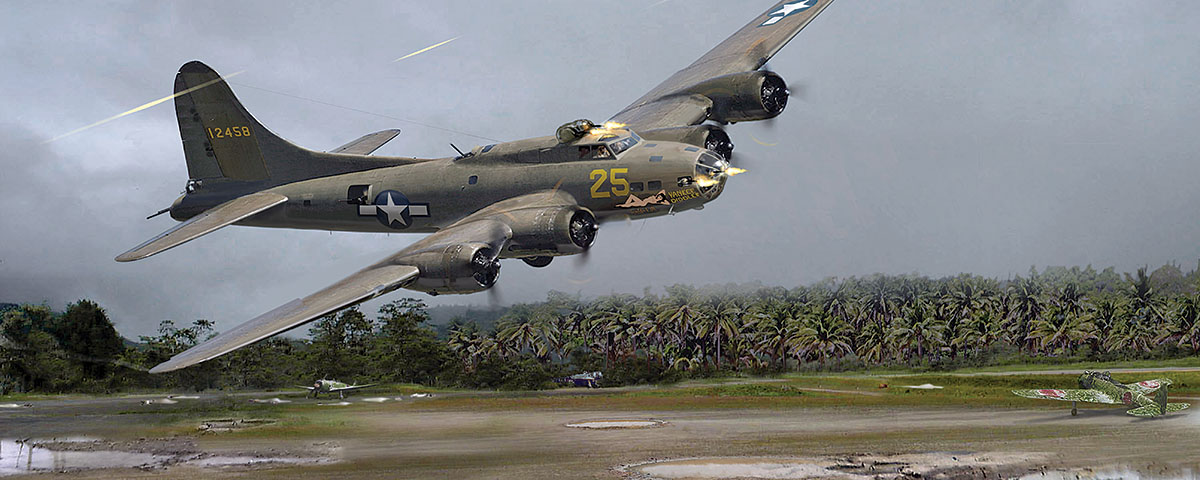 |
B-17 similar to the one flown in this post |
December 2 1942, the Medal of Honor was presented to Captain Pease's parents by President Roosevelt. The recommendation had been issued by Major General Kenney with an endorsement personally written by General MacArthur.
You'll notice that some of the factors in this story did not make it into the Citation below.
- Medal of Honor Citation
For conspicuous gallantry and intrepidity above and beyond the call of duty in action with the enemy on 6–7 August 1942. When 1 engine of the bombardment airplane of which he was pilot failed during a bombing mission over New Guinea, Capt. Pease was forced to return to a base in Australia. Knowing that all available airplanes of his group were to participate the next day in an attack on an enemy-held airdrome near Rabaul, New Britain, although he was not scheduled to take part in this mission, Capt. Pease selected the most serviceable airplane at this base and prepared it for combat, knowing that it had been found and declared unserviceable for combat missions. With the members of his combat crew, who volunteered to accompany him, he rejoined his squadron at Port Moresby, New Guinea, at 1 a.m. on 7 August, after having flown almost continuously since early the preceding morning. With only 3 hours' rest, he took off with his squadron for the attack. Throughout the long flight to Rabaul, New Britain, he managed by skillful flying of his unserviceable airplane to maintain his position in the group. When the formation was intercepted by about 30 enemy fighter airplanes before reaching the target, Capt. Pease, on the wing which bore the brunt of the hostile attack, by gallant action and the accurate shooting by his crew, succeeded in destroying several Zeros before dropping his bombs on the hostile base as planned, this in spite of continuous enemy attacks. The fight with the enemy pursuit lasted 25 minutes until the group dived into cloud cover. After leaving the target, Capt. Pease's aircraft fell behind the balance of the group due to unknown difficulties as a result of the combat, and was unable to reach this cover before the enemy pursuit succeeded in igniting 1 of his bomb bay tanks. He was seen to drop the flaming tank. It is believed that Capt. Pease's airplane and crew were subsequently shot down in flames, as they did not return to their base. In voluntarily performing this mission Capt. Pease contributed materially to the success of the group, and displayed high devotion to duty, valor, and complete contempt for personal danger. His undaunted bravery has been a great inspiration to the officers and men of his unit.
As I said, a hard story to read.
Peace out y'all
Sources
https://en.wikipedia.org/wiki/Harl_Pease
https://www.lanbob.com/lanbob/H-42Auth/PH93P-MOH.htm
https://historynet.com/old-soldiers-pacific-b-17-armed-transports/ B-17 Pic

You're right juvat, a tough read this day. Thanks for these posts, reading them is the least I can do for such men.
ReplyDeleteNylon,
DeleteDefinitely a clash of cultures. Fortunately, the Japanese have become more civilized. Although there still is a culture that thinks decapitation is ok.juvat
Wow, a tough read.
ReplyDeleteAmen
Deletejuvat
Wow Juvat, just wow. To Nylon12's point, by sharing their stories we honour their memory.
ReplyDeleteI agree. We studied some of the more famous recipients in ROTC. Got me wondering if I could stand up to the challenge if needed. Fortunately…
Deletejuvat
Ah, I learned something today! About a great man (and his crew should share in the honors).
ReplyDeleteI have driven past Pease Air National Guard Base (nee Pease Air Force Base 1957-1991) at Portsmouth, NH, many times, and sometimes wondered about the name. Perhaps a local agricultural commodity, or a misspelling since it was a SAC base, where "Peace is our profession?"
Now I know.
Captain Pease was a New Hampshire native.
It is also somewhat satisfying that Pease AFB became home to the 509th Bombardment Wing in the 1960s, having delivered some retribution for mistreatment of Captain Pease in 1945.
JB
JB,
DeleteYeah I should have mentioned that, I think I'll do something about it. Thanks
juvat
I'm sure that bombing mission was flown as interference for the landings at Guadalcanal on the same day. Martin Caidin's book The Ragged, Rugged Warriors, describes some of the struggles of men who, "overworked and overtired", had been taking heavy losses for months (a mission on May 24th had cost five out of six B-25s). I notice there is no mention of escorting fighters. Capt. Pease and his volunteer crew all said: "This mission is important. The presence of one more aircraft might make a difference. We will nurse this gimpy bird into the air and fly against the strongest enemy base in the Southwest Pacific rather than get left behind in safety." I'm sure that the captain, if he had survived, would have said, as others have said, that he accepted it on behalf of his fellows who could not.
ReplyDeleteOne small fact, American fighters at that time in the war had nowhere near the range needed to escort the bombers. The P-38's had a longer range but still not enough. Wasn't until a few island up the chain were captured and the P-51 arrived in the Pacific that things got better.
Deletejuvat
I agree completely about your last paragraph. A lot of folks like him thankfully!
Deletejuvat
There are reasons for the saying "War is Hell".
ReplyDeleteJust saying...
Suz
Suz,
DeleteYeah, there are. But giving your life for your crew and your country, I've gotta believe, has a big impact on the guy upstairs decision of where you're going to spend eternity. I think the guys on my list and their crews are major league contenders for the better place. I mean there was one guy who did that very thing with the Romans and provided the example for all. Just sayin'.
juvat