Saturday, May 6, 2017

Unit Cohesion

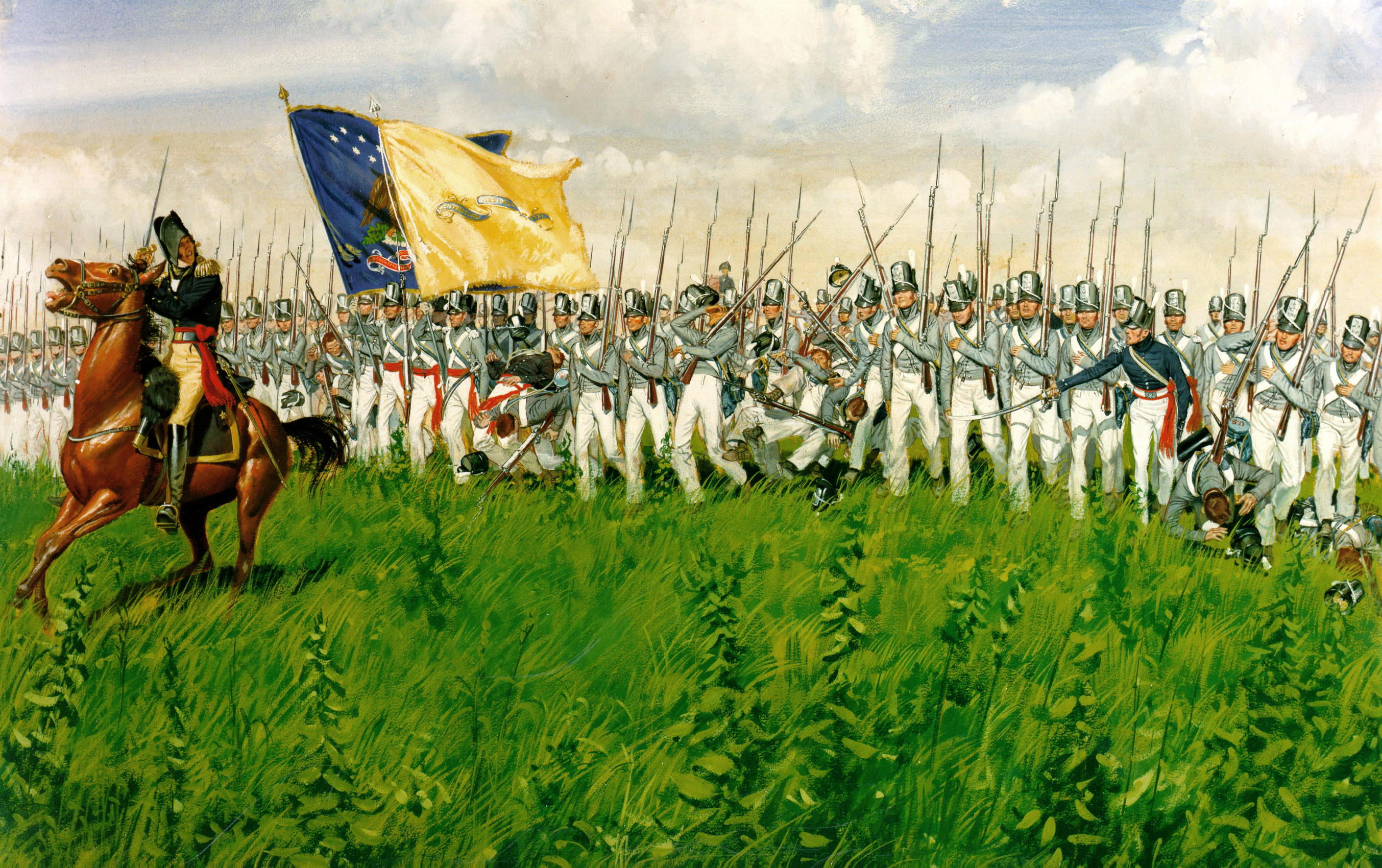
Battle of Chippewa - H. Charles McBarron, Jr. (Source)
Unit cohesion - "the bonding together of soldiers in such a way as to sustain their will and commitment to each other, the unit, and mission accomplishment, despite combat or mission stress" - General Edward C. Meyer, Chief of Staff of the United States Army (22 June 1979 - 21 June 1983)

Many civilians assume that soldiers fight for an ideal, a flag, their nation, their family, or any number of other concepts. While this might be why someone joins up to fight*  it's not what sustains soldiers in combat.

Talk to just about any veteran and they'll tell you why they fought, it was for the guy next to them, their buddies in their unit. If they wax eloquent on God, country, motherhood, and apple pie, walk away, they're probably not a combat veteran.

Perhaps back in the mists of time things were different. Some tribal societies still practice warfare as a rite of passage, a means of proving their manhood (and in tribal societies it's all about the men), and sometimes it is in deadly earnest as one group tries to drive out another. Then it's fight or die.

As time went by, warfare went through many phases, but down at what I like to call the "grunt level," it's always about the guy next to you. From the Roman Legion down to the guys in the mountains of Afghanistan, you fight because you don't want to let your buddies down. (What keeps a person in the military falls outside the scope of this post. I'm only looking at those moments when the bullets are flying, people are dying, and Hell is coming to dinner.)

Being in combat is a pretty frightening thing, over the years lots of folks have looked at ways to keep the troops together and keep them fighting. Back in the days of the Legion fighting was shoulder to shoulder, your shield (always held on the left) protected you, and the guy to your left. If the guy to your right took off or went down and no one stepped up to take his place, the only thing protecting you then was your own sword.

In the Legions discipline and training held the men together. Of course, the penalty for desertion or cowardice in battle was pretty severe, crucifixion is a very painful way to die and was considered quite shameful. (Ordinary Roman citizens could not be crucified, join the Legions and that prohibition didn't hold.) Nevertheless, for most of Rome's history the morale of the Legions was very high and the desire of the individual soldier not to let down his fellow soldiers was a motivator.

With less motivated troops fear is a useful tool. In armies during the time of Frederick the Great, some sergeants and junior officers would march behind the advancing troops with swords drawn, the implication being, "if you advance the enemy might kill you, try to run, and we will kill you." (Which reminds me of the scene in Enemy At The Gates where poorly equipped and trained Russian troops are ordered to advance into German machine gun fire at Stalingrad. When they fall back, routed, their own side - mostly NKVD - open fire on the survivors. Advance or die!)

But driving frightened conscripts into battle is no way to win a war. A battle or two might be won, but the side with superior equipment, training, and morale will usually win out in the end.

So how do you get soldiers to stand and fight?

One way is through unit cohesion. Men who are recruited at the same time, go through training together, and are deployed together are much more likely to fight well than a unit made up of replacements. One lesson the US Army learned (or should have learned) post Vietnam was not to keep a unit in the line and refresh its ranks with replacements. The smart way to do things is to move entire units in and out of combat. It is always necessary to build depleted units back up, but doing it away from combat enhances unit cohesion. Gives the troops time to develop bonds, to build unit cohesion.

Of course, that can sometimes go too far. Witness the cockpit of the Junkers Ju-88 -

(Source)
Looks great doesn't it? The entire crew is together, cheek by jowl, within easy supporting distance of each other and there is no way any member of the crew can slack off without it being noticed by the others. So this is excellent, right?

Well, that canopy is all glass and wide open. One burst from an enemy aircraft and the only guy who might survive is the ventral gunner (#7). Kind of makes you feel a bit exposed doesn't it?

An extreme example perhaps, after all, even most of the crew of a B-17 as clustered towards the nose with four gunners aft of the bomb bay: two waist gunners, ball turret (belly) gunner and the tail gunner. Those, last two were very, very lonely positions. You were very isolated from the rest of the crew.

Studies were done by S. L. A. Marshall of the U.S. Army during World War II of men in combat. He would interview men shortly after they had been in combat. His studies showed something which at first surprised me.

Most of the troops in line units (that is, non-elite) didn't even fire their weapons during combat. Especially the individual riflemen. If they did fire, it was unaimed fire, think "spray and pray." Why is that do you suppose? Take a look at the trooper in the next photo.

(Source)
He's all by himself in a foxhole. Odds are pretty good that his buddies will be too busy to see what he's doing and the sergeants and officers are also occupied. So why should he stick his head up to fire? Hell, he might get hit. If you just keep your head down, you might survive anything other than a direct hit by artillery.

Now look at the next two guys. They share a hole and, more importantly, one of them has an automatic weapon. While the M279, Squad Automatic Weapon, or SAW, isn't exactly a crew served weapon, (one man can operate it very effectively) it's representative of earlier machine guns which were normally operated by a crew of at least two men.

Marshall found that during combat, the men operating crew served weapons, especially machine guns, were very good at laying fire upon the enemy. They fired effectively and throughout an engagement. Why? Well, machine guns are, for one, awesome. They are an awful lot of fun to fire and you really have a feeling of raw power when operating one. Two, well there's more than one guy. You can't really shirk your duties, the other guy will notice, and will probably let the sarge know that you were slacking off during the battle.

(Source)
So having small groups is an excellent thing (though too many in one spot is a bad thing, the old "one grenade gets all of you") having those small groups train together and stay together is another, very excellent thing. You get to know who you can rely on and who you can trust. Those you can't rely on or trust usually don't last long.

It's like Patton said, "An army is a team, it lives, eats, and fights as a team." Yup, individuality in combat is a bunch of nonsense. Hell, even snipers don't operate alone, you always have a sniper and a spotter.

It's all about the team.

Anyway, that's the way I understand it. The best outfits I was in during my Air Force career were teams, first, last, and always. We worked together, we partied together. The one thing I missed when I was assigned stateside was that last bit. We'd go our separate ways after work, we didn't spend much time together off duty. Maybe that's why I loved my overseas assignments.

When you're plunked down in some foreign land, you tend to stick together.

Russ knows, Shaun knows, Juvat knows, Tuna knows. If you're on a good team, you can do anything.

Seriously.


* Unless they were conscripted, then it's go to war or go to jail, or worse.

Friday, May 5, 2017

Korea, Vikings, and Lithuania?

Sveiki iš Lietuvos! (Source)
From time to time the stats here at The Chant get inflated by a sudden influx of hits from Eastern Europe, normally Russia. Not that I'm pointing fingers Vlad, but jeez.

(Source)
At any rate, we had a lot of hits yesterday. A lot of them on one post, an old one from Tuna.

Yes, the story of maybe Korea getting Tuna's old ride, the S-3 Viking, the mighty War Hoover!

S-3A of VS-37, USS Constellation, 1986 (US Navy photo)
So Sarge, the War Hoover, Korea, we should maybe guess that the other piece of today's post title might provide a clue as to where all those hits came from?


Now I'm no mathematician, nor am I a statistician, but 249 hits from Lithuania, and 249 hits on a post from 2014? I'm seeing a possible correlation there. Coincidence? I think not.

So my guess is that Tuna has his very own fan club out there in the lovely Baltic land of Lithuania.

(Source)
Ah yes, don't we all?

Either that or the Lithuanians are really interested in the possibility of the Korean Navy getting the S-3. I mean Korea is in the news lately, so perhaps it stands to reason.

Maybe it's just old Viking crew dogs that the Lithuanians dig.

Because I have evidence which might indicate that the Lithuanian ladies don't really dig Air Force guys.

(Source)
Just a hunch.

Though that Senior Airman in the foreground seems just a bit too happy.

Can't say I blame him...


Thursday, May 4, 2017

The Herd

(Source)
We humans are not really a herd animal, we're not loners either, not by any means. We can tolerate it, but it's not good for us. No, our species is made up of family groups. Those groups at one time would gather into tribes (in some places that's still the case). Larger groupings were found to be conducive to survival, both in terms of the ability to protect the group and through dividing up the jobs: some folks out hunting and gathering, other folks staying back at the camp/cave/what-have-you tending the fires, mending stuff, making stuff, and taking care of the young 'uns.

We are most comfortable in cooperative groupings which share a common background.

Now a comment on my post the other day got me to thinking, again. (And yes, it's starting to make my head hurt.)
Definitely a brain bender. Is it evil if I and my society destroys another because we see them as a threat? The victors write history, and so get to define what the 'greater good' was. What short term "pains" (i.e. deaths, to take it to the absolute) are worthy of longer term "gains"? And who gets to make the judgement? One sees this played out whenever the use of the atomic bombs on Japan is discussed. "Bad" vs "evil" on the way to a "good" outcome.

I'm also pondering if the First Principle is universal. If my society believes in it, but the society down the block doesn't. Or is the Principle true, and the challenge is that all men are also self-directed beings of Free Will. Who may decide to subordinate their will to that of others.
Much to ponder.

/L.J.
That bit of subordinating one's will to that of others really made me think. After some time of pondering and digging into the books, I am pretty sure that that whole submission, subordination thing is pretty good in small groups. After all, someone has to actually be in charge. Well, I don't know about "have to," but I think it's the way we're wired. Put a bunch of people together, give 'em a task (like go into the wilderness and survive) and someone is eventually going to emerge as the leader. Sometimes, if the group is large enough, it might even be several leaders, each possibly responsible for some aspect of the group's survival.

So if someone is in charge, someone else (usually several someones) is not in charge. They get to be the worker bees, if you will.

Which leads to another comment I saw some place (and yes, I forgot to note where I saw it, if someone recognizes this, please let me know)...
The truth is, Socialism fails because it gives power to a few, and people are greedy, self-centered creatures. It is part of what in Judeo-Christianity is known as the ‘sin nature’.

We cannot trust any human being, even ourselves, to not at some point act in a self-centered manner. We need a system of checks and balances, of accountability, a buddy system, to keep ourselves in line.

Even more so our governments. - Graybeard
Too much all for one, one for all, ain't such a good thing.

We tend to get crazy if there are too many of us with time on our hands. Especially if we get angry about something, then our species can do things they wouldn't think of doing if they were on their own.

A large crowd can be panicked, just like a herd of sheep/cattle/horses/whatever. In that panic they will overturn anything in their path, they will even trample and kill the slower members of the mob.

Get a mob riled up about something, good or bad, and the crazy takes over.
Hey, we're pissed because of Trump! Let's burn the town down, let's block traffic, let's break stuff. (Replace "Trump" with whatever cause du jour springs to mind, it doesn't really matter.)
Hey, we're happy because our team won the big game! Let's burn the town down, let's block traffic, let's break stuff.
It makes no sense to me, how could people behave that way? Well, I think it's because when there are too many of us in one place, we subordinate our will to that of the mob. We are no longer individuals, we have become part of a collective, the hive mind takes over, and bad things happen.

I lived in Germany for seven plus years, I love the land and its people. I often asked myself, how could these peoples' parents and grandparents murder over 18 million people? (That figure includes Jews, Russian civilians and POWs, gypsies, homosexuals, and every other sort of group that the Nazis didn't like.)

While individuals did the killing, the group made the individuals feel less culpable for their actions. It was the group, the hive if you will, who murdered all of those people. At least that's how the individuals got through it. Many didn't, they lost their sanity, many killed themselves when the enormity of what they had done sunk in.

But as part of a large group, people can do anything. If the leaders of the group are intent on evil and destruction, that's what will happen.

We're pretty decent individually and in small groups. Get too many of us in the same place with a "cause," and things can get scary in a hurry.

One of our problems right now in this country is that are too many groups with grievances, both real and imagined, being manipulated by unscrupulous people with very sketchy goals. If you ever feel the need to be part of a mob, ask yourself, who benefits from this? If I block a roadway as part of some nebulous protest, who benefits? If I get thrown in jail, who cares? If the whole thing makes the news, the people behind the scenes are happy. They really don't care what happens to the little people. They are merely pawns in some greater game. A game which benefits only a few, not the many.

Don't be a pawn, don't stampede with the rest of the herd.

Think!!

This kinda crap is really pissing me off.

Sarge, out.


I need to post more plane pr0n and historical stories, this serious stuff really makes my head hurt.

Wednesday, May 3, 2017

R.I.P. Colonel


Colonel Leo Thorsness, Vietnam veteran, Medal of Honor recipient, Thud pilot extraordinaire, and a personal hero of mine has entered the clearing at the end of the path.

I weep as the border of his portrait in the blog header goes from green to black.

'Tis a sad day.

We're starting to lose the Vietnam generation, honor them while you still can. I try.

Godspeed Sir. We'll see you on the other side.


A Couple of Birds, A Couple of Videos

"White 35", serial number 110639, Me 262B-1a two-seat trainer.
I received two more photos from our man Frost the other day. Thought I'd share those with you today rather than wait for another time. The Me-262 Schwalbe in the opening photo was actually captured in Germany in 1945. She was handed over to the Navy for testing and apparently spent a lot of time outdoors in Pennsylvania before she was fixed up and put on display at the Naval Aviation Museum. You can read their write up on "White 35" here.

Some Me-262 stats:
     Maximum speed: 559 mph
     Range: 652 mi
     Service ceiling: 37,565 ft
     Rate of climb: 3,900 ft/min (At max weight - single seat version)
     Armed with 4 × 30 mm MK 108 cannon (Yes, that is the same caliber as the A-10 Warthog's gun)
     Could also carry rockets and bombs.

I have seen a number of examples of the Me-262, my favorite museum (the Military Aviation Museum in Pungo, Virginia) has a flyable example. Of course, Pungo is my favorite because the majority of their aircraft are flyable. I don't know if they have any static display birds. It's nice to know that those birds can still take to the air. There's something a bit sad about seeing a flying machine which will never fly again.

Speaking of Pungo and the Me-262...


Nice Fw-190 as well!

N1K2 Shiden-Kai (George)
One of the best fighters produced by Japan, Kawanishi's N1K2, of which Wikipedia has this to say -
The N1K2-J Shiden-Kai proved to be one of the best dogfighting aircraft produced by either side. Along with high speed the Shiden-Kai offered pilots an agile aircraft with a roll rate of 82°/sec at 386 km/h (240 mph) backing four powerful 20 mm cannons in the wings. As a bomber interceptor the N1K2-J fared less well, hampered as it was by a poor rate of climb and reduced engine performance at high altitude.

The N1K2-J Shiden-Kai offered a formidable if demanding aircraft in limited quantities. As a result, the planes were distributed to elite units like the IJN 343rd Air Group (343 Kōkūtai Naval Fighter Group) constituted on 25 December 1944 and commanded by Minoru Genda. The new 343rd Kōkūtai claimed Japan's finest fighter pilots such as Muto and Genda.
I should note that Genda Minoru (the proper order of his name) was one of the planners of the attack on Pearl Harbor. The Naval Aviation Museum's write up of this display is here. I did a little digging, apparently the Air Force Museum has one of these as well. (Another place I need to go visit, and soon. Would have gone last year and met up with Juvat, but other things arose. Which involved hospitals, surgery, and pain. Lots of pain. But enough said about that, the better.)


Had a chat with The WSO yesterday, well we chat nearly every day, and she's enjoying her new job quite a bit.

What's that? What does she do? Ah, glad you asked.

LUSH is out of the Navy now but still works with the Navy. She's now gainfully employed at NAS Lemoore working the F/A-18E/F flight simulator. They're actually teaching her how to be a sim pilot so she can be the self-loading stick actuator in the front seat during WSO training.

Apparently on Tuesday they had her practicing landing in a 30 mph crosswind. Doing what she called a "half-crab kick out," as I recall. Sounds like fun. What's a crosswind landing? Check this out -


I've been on a flight or two where there was a wee bit of a crosswind, almost like I was in the front seat, even though I was well in the back. A bit more excitement than most people crave. I just realize that when it's "my time," then it doesn't matter where I am, or what I'm doing. So I just enjoy the ride.

(Though some of the landings/takeoffs in that second video are a bit too sporty for my tastes.)

I also like a bit of turbulence, gimme a bit o' bounce (yes, at altitude) and I get all excited. It's even more fun watching the less experienced passengers when the ride is bumpy. Not that I enjoy their misery.

Much.

(Am I evil? Or just a jerk? Who knows? Sometimes a bit of both I suppose.)

I need to get back into the air.


Tuesday, May 2, 2017

Good Versus Evil

Temptation of Christ - Ary Scheffer (Source)
Just going to throw a few thoughts out here today, some things I have been pondering for a while, some things which many a great (and not so great) philosopher has also given quite a bit of thought to, down through the centuries. With all that is going on in the world, and in my own slice of heaven, I have to wonder about the nature of good, and evil.

First off, my buddy Shaun has some interesting thoughts on the topic. Before continuing further, you should go read this post of his. 'Twas that post which got me to cogitating. Which isn't always a good thing. As I have mentioned in these spaces in the past, sometimes I think too much. (The converse of that statement has some validity as well.)

Now when Shaun writes of the First Principle, I do believe he means this -
We hold these truths to be self-evident, that all men are created equal, that they are endowed by their Creator with certain unalienable Rights, that among these are Life, Liberty and the pursuit of Happiness. - Declaration of Independence, Preamble
While I wholeheartedly support the sentiment expressed in those powerful words (with the caveat that "men" here means all of humanity) I do have a couple of bones to pick with the Founders.

First off, what they really meant to say (and as an historian, amateur or not, there are facts to back me up on this) is that the men of the Thirteen Colonies were equal to the men of the home country, that is to say, Great Britain.

They did not mean to include women (who could not vote at that time), they did not mean to include slaves and indentured servants (the former having little hope of freedom, ever, and the latter's hope of freedom subject to the scruples, or lack thereof, of the man who "owned" their service), and they certainly did not include the native peoples of the North American continent.

The Declaration of Independence was a start towards what we have today. We're not there yet, as now, legally, all American citizens are born with a clean slate, so to speak, as in they are theoretically able to take themselves as far as their hard work and natural talents can take them. Which is all well and good until you look at reality.

I might note that those born with a disability are not by any means created equal in comparison with those born without a disability. But the point is, the law does not allow anyone to place any obstacles in a person's way based on their gender, "color," religion, sexual orientation, or other distinguishing characteristics (real or imagined).

While that's what the law is, in practice, if you grow up in a poor neighborhood with really bad schools, you need to work many times harder than, let's say, a middle class kid from Vermont. (Even if we were what you might call, lower middle class. Not sure exactly where we fell on the scale of wealth, but it wasn't down near the bottom, nor anywhere near the top. Somewhere just below the middle, I'd guess.)

Now what does all that have to do with the concepts of good and evil?

Now Shaun made the argument in his post -
...that there are no good people and there are no bad people. There are just people. People who take actions which are both good and bad.
The statement taken at face value, seems to make perfect sense. People are not bad, nor are they good, the things they do in life, the actions they take may be construed as good, or bad. So the person who stole my card number and used it to make some purchase at Walmart out in Oklahoma over the weekend, isn't a bad person, they just chose to do a bad thing. Which while it did not cost me any money, did cause me a great deal of inconvenience. And really, really, pissed me off.

Now how about the fellow in 1930s Germany who joined the Nazi Party because all the "cool kids" were doing it? Say he later joined the SS-Totenkopfverbände*, because that way he didn't have to go to Russia and fight in combat. Were that man's actions bad? I mean, if he didn't do it someone else would. After all, the State ordered this done, how could he be considered bad? If the murder of Jews, homosexuals, gypsies, and others was countenanced by, in fact dictated by, the State, how could an individual be held accountable?

Well, the Nuremberg Tribunal did hold the individuals accountable. Whether they felt guilty, or bad, or evil, or not. They were held accountable for their actions. They were judged to be, if not evil, at the very least, criminals. Bad people.

Am I equating the person out in Oklahoma with a concentration camp guard? Well, yes I am, just a little. If one chooses to do a small bad thing, where does that lead? If you feel justified in taking that which is not yours, where does it stop? From theft to genocide is a large leap, I know, but both are, to some extent, bad. I would go so far as to say evil.

One definition of evil, as a noun, is:
profound immorality, wickedness, and depravity, especially when regarded as a supernatural force
Synonyms: wickedness, bad, badness, wrongdoing, sin, ill, immorality, vice, iniquity, degeneracy, corruption, depravity, villainy, nefariousness, malevolence
I think we can see already that there are degrees of evil. A concentration camp guard could no doubt be judged as being profoundly immoral and depraved. The card number thief charging a purchase to someone else's account might just be bad, or nefarious. If one has a strict interpretation of the Scriptures, both are doomed to eternal damnation. Or maybe not.

Admission of sin and the act of repentance can cleanse one of their sin (well, there's more to it than that, but I'm not here to debate religion, at least not today), forgiveness is there for those who seek it. Even the SS guy? Yes, even him.

Do I think mankind is inherently wicked? No.

Do I think good people can choose to do bad, even evil things? That depends.

Consistent bad behavior, doing bad things, even evil things lie outside of what defines a "good" person. Just what is good anyway? Let's hit the dictionary again -
that which is morally right; righteousness.

Synonyms: virtue, righteousness, goodness, morality, integrity, rectitude, honesty, truth, honor, probity, propriety, worthiness, merit, blamelessness, purity
Can a human be "good" according to that definition? Yes, but it takes effort. It's a lot harder than being bad, or evil. At least I think so.

I think that once one chooses to do bad things, to be evil if you will, then one will continue to do so unless some external force makes one stop. Especially if it's profitable.

Do evil often enough, then I believe you are evil. Your actions define who you are and what you are, like it or not.

The same holds true for those who go out of their way to be good. Does this mean more than just doing one's job in life? Go to work, pay your bills, love your spouse, your kids, your neighbor, try to obey the law. Or does one have to do charity work, donate money to orphanages and the like? Who decides?

I don't know.

They say the road to Hell is paved with good intentions, I think the road to Hell is paved, brick by brick, mile by mile, with evil deeds and treating one's fellows badly. It's also paved by the inaction of those who might have changed things but stood by and did nothing.
All that is necessary for the triumph of evil is that good men do nothing. - Edmund Burke
If you stand by and do nothing in the face of evil, how can you be called "good"?

I really don't know. All I know is that there is great evil in the world. It's up to those of us who can, to stand up to it.

My thoughts. What are yours?

Sarge, out.


* Death's Head Units, these provided the guard force for the concentration camps.

Monday, May 1, 2017

Your way or...the Navy way!

As I was working in my wood shop earlier, I was pondering what the subject of this post should be.  I had used my one free, Sarge Allowed, semi-annual Rant last week.  So, six more months of sunshine, campers!  

It wasn't time yet for another Medal of Honor post, that will be coming soon as the end of the school year approacheth and that's when the fecal matter usually impacts the spinning air mover.

Formation school was in town this weekend, but it looked like it was only T-6/SNJs (ONLY, juvat?  Like you wouldn't trade parts of your anatomy to own a T-6?)  I did get this photo as the passed over Rancho Juvat.
The structure on the left is my woodshop.  They were close enough that their radial engine noise was louder than my table saw.  They're tormenting me, I say!

Finally I haven't been to a museum in a while, so I've got nothing on that front.

Which leaves what Tuna refers to as "Juvat regularly regales us of flight ops as an Eagle driver."

What can I say?  I talk with my hands and have a big watch!  Realizing that I had told a lot of stories, most of which details can be taken as gospel.  (Really! No kidding!  It's all true, I was there!)

I had to find one I hadn't told here yet.  Then it hit me,  I've alluded to this story a few times, but never actually "regaled" it.

So....There I was *

A newly winged pilot, I've been granted a chance at attaining the only thing I've ever wanted to do in my 24 years of living, fly fighters in the Air Force.  I've made it through Lead-in Fighter Training with only a slight hiccup.  (IPs should not tell a student to "Go get 'em, Tiger!" as the student releases brakes as #4 in a formation with a rejoin out of traffic, unless he looks forward to writing the comment "On rejoin out of traffic, Lt Juvat showed his burner cans to the flight lead inverted as he passed in front of the formation".  Just sayin'.  Besides, it was extra flying time to make up that pinked ride.)

Anyhoo,  I graduated from LIFT and continued westward to lovely "it's a DRY heat" Phoenix AZ for F-4 RTU arriving there in June.  We have a bit of ground school to learn the systems of the mighty F-4C and several simulator rides to make sure we understand those systems as well as the emergency procedures required to safely return the aircraft to the able hands of Sarge's maintenance brethren if something were to go wrong.
Sarge?  We've got a code 2 flyable on aisle 2!
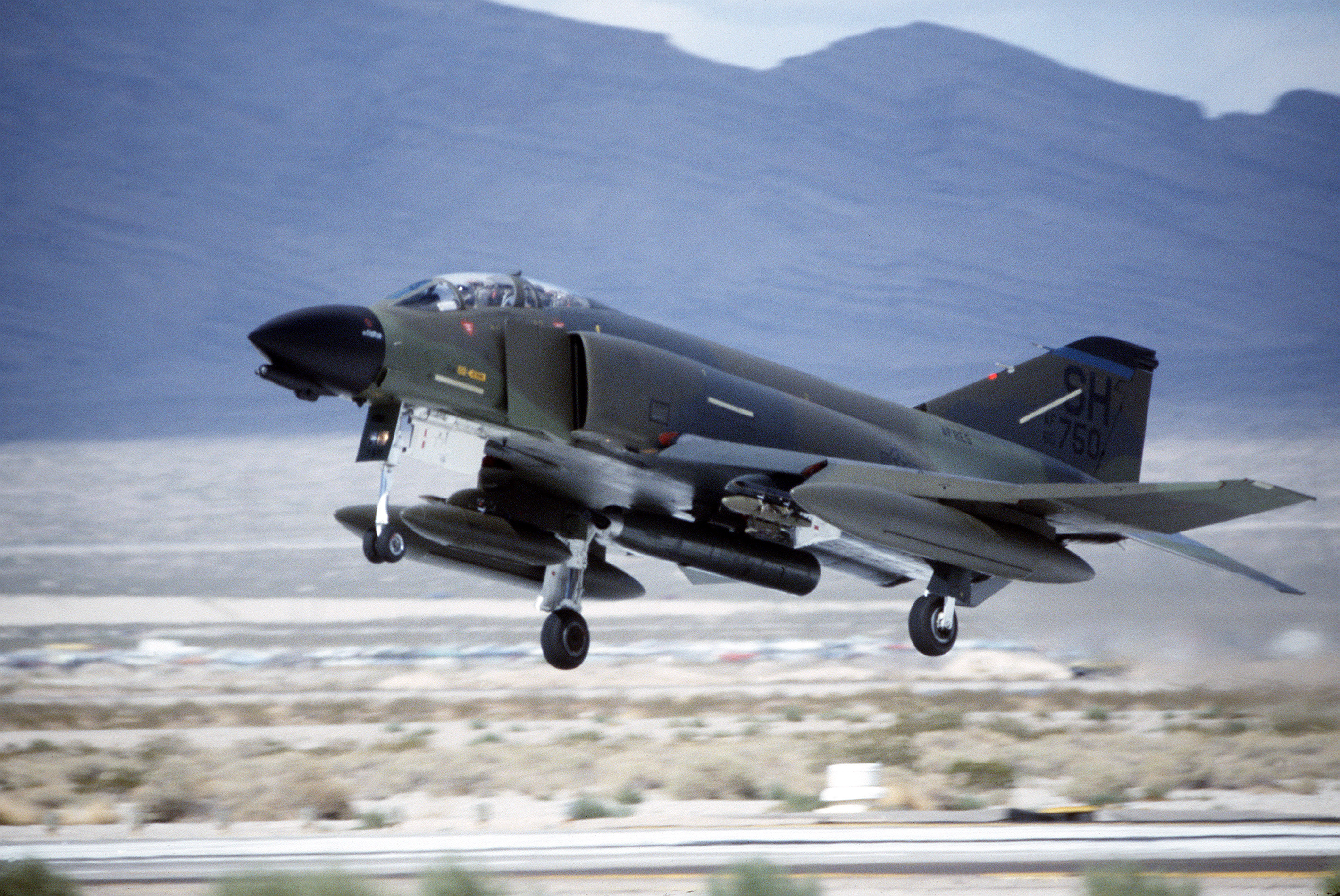
Source

The F-4C was a complex aircraft and was built before a lot of thought was put in about cockpit management.  There wasn't really a standardized cockpit configuration.  Many switches would be in one place on one tail number and in another place entirely of a different one.  

This lead to many switch errors when we got to the air to ground portion of the syllabus.

But we're not there yet.

Finally after weeks of studying the Dash-1 (available here if you're having trouble sleeping), simulating horrifyingly complex emergencies which usually resulted in a simulated ejection, numerous tests and many adult recreational beverages consumed while consulting with several known names mentioned favorably in the annals of the Red River Fighter Pilots Association in the Squadron bar informal debrief area, we are ready to commit aviation in the F-4.

RTU was divided into a few sections, to include ones that concentrated on Air to Air and Air to Ground, but the first section was dedicated to see if Lt Juvat could actually take an F-4 off the ground, fly it around the airspace in Arizona, stay out of Mexico (not a given), then return to his home airfield and land the jet successfully.  I would get 5 rides to gain that skill set as well as demonstrate that I could fly instruments in that aircraft.  At the completion of those rides, I would get a check ride, which if I flunked  would mean B-52s for me.  "Ready to start # 8, Captain!"

I did not want to flunk that ride.

As an aside, I quickly found out that flying instrument approaches in the F-4 at Luke AFB in July from the front seat was monumentally easier than doing so from the back seat of a T-38 with a canvas bag blocking your view outside.  

It's Monday morning, and the alarm goes off about 0300, I've got a 0400 briefing for my first ride which will take-off right at daybreak, about 0600.  

It's summer in Phoenix.  The F-4's air conditioner begins functioning at 20,000'.  We want our missions to be over with before the combination of the Outside Air Temperature and the refractive properties of the canopy achieve a temperature that melts our flying helmets.

It really doesn't matter though,  I haven't slept much.  I'm going to fly an actual fighter!  One that's been in a war!  That's actually camouflaged.  
Source

I'm excited.

We've briefed, stepped to the jet, preflighted, started (without any emergency indications, something that NEVER happens in the sim), taxied out, gone through the arming area and now been cleared for takeoff.

Run the engines up to 85% (any more and the airplane will start moving forward.  The brakes will keep the tires from rolling, so... that's a bad thing).  Everything looks normal.  Brakes off, throttles through the AB detent.  Nozzles swing indicating two good burner lights,  and we're off.

Except, my brain is several hundred feet behind the airplane!

The nose rotates, we're airborne and the IP is calling "Gear, put up the Gear!" 

Oh, yeah! Don't want to overspeed the gear doors.

Now, the IP is yelling "Burners".  Oh, yeah, Sun City, don't want to wake up the senior citizens who have the Wing King's office number memorized.

We're successfully airborne and headed to our airspace.  It's a beautiful day in Arizona and I'm flying a fighter!  

We enter the airspace, which was somewhere near Sedona, and start our area work.  That consists primarily of advanced handling, meaning High Angle of Attack stuff.  

The F-4C would mistreat a pilot who did not handle High AOA maneuvering adroitly.  It was considered "Poor Form" to return to base without a drag chute because you needed to deploy that device to recover from an out of control situation.

It was even poorer form to eject from an aircraft because you put it out of control and didn't have the altitude to recover it.  

Neither situation arose on this flight, or thankfully on any other flight in my career.

Now, it's time to come back in and land.

We come down initial, pitch out and I configure the aircraft.  The IP will demo the first one, which is a fete in and of itself from the back seat.  We come around and aim at the approach end.  The IP holds the stick as we settle in and just before touchdown, I feel him add a couple of rpms to the engine.  We go around and as I take the aircraft, I ask him why he does that.  

He replies that "it adds a little bit more cushion to the landing, making it smoother."

OK. 

I come around, configure, settle in on final aimed at the touchdown zone, and as I'm about to touchdown, add a bit of power.  

"Nice Landing, juvat!" I hear from the back. "Do it again!"

Which I do.

Full stop, deploy drag chute, Dearm, shut down, and debrief, my inaugural ride as a fighter pilot is complete.

We debrief in significant detail, and finally I'm dismissed.  I check tomorrow's schedule and note that I'm flying with a different IP.

The next day, everything proceeds as it had the day before.  On takeoff, I was only slightly behind the aircraft and nobody at Sun City needed to call the Wing King about me.  The area work was fine and we RTB on schedule.  

I come down initial, no back seat demo this time, and pitch out, configure and am settling in on final.  I cross over the overrun and start the technique I'd learned the day before on how to "smooth out " the landing of the F-4.

As I add power and start the flare, I hear a yell from the IP, "Go 'round, Go 'round, Burners!"

Throttles slam into burner.  Gears up, flaps up.  I'm thinking was there something I didn't see on the runway?

The IP says "I've got the jet." and shakes the stick.  "You've got the jet" and take my hand off the controls.  

"What the F**K where you trying to do?  Kill us?"

"No Sir"

"Let me show you how to land the F-4!"

I configure it for him (Gear and flap controls were not available in the back seat, nor were Afterburners).

He begins his final turn and as I can tell, we're significantly steeper than we were the day before.  

He's got an aimpoint in the touchdown zone and we're diving on it like a peregrine falcon going for one of Sarge's rabbits.

The jet's at the point where I'd start the flare, but he's doing nothing.

He just freezes the controls and doesn't do anything with the power.

There's, what to me anyway, a massive impact as we hit the runway.  The throttles advance and as we get airborne, I'm checking everything for damage indications.

He shakes the stick and says "You've got the aircraft.  THAT's how you land the F-4!"

OK.

I come around and while on downwind tie my squadron scarf around my head and yell "Banzai!" as I begin the final turn.

Put the aimpoint at the end of the runway and drive the aircraft into the runway.

"Excellent landing.  Make the next one a full stop!"

Back in the debrief, we discuss the ride and when dismissed, I check the schedule, I've got another sortie again in the morning.  

It's with the IP I had my first sortie with.

Back in the traffic pattern, I'm beginning my final turn (Yes, Aaron, my scarf was tied around my head) and am beginning my kamikaze attack on the runway, when I hear a VERY concerned voice in the back seat say.

"Please, for the love of god, go around.  Burners!"
Source

I comply.  He demonstrates the next landing and includes the RPM boost "to smooth" the landing.

The lightbulb clicks.

As I come around to land, I ask him whether my second IP happened to be a Navy exchange pilot.

"Why, yes.  Why do you ask?"

A few days later, I'm scheduled for the Qual Check.  I ask the squadron scheduler what service the Check Pilot is in.

He responds "Air Force, why?"

"No reason, I just want to smoothly pass the ride."


*SJC- If you haven't been to the acronym page, this particular acronym means Standard Juvat Commentary meaning everything stated in this story is the honest to goodness truth and should be taken as hard fact, even if the story begins with So....There I was.