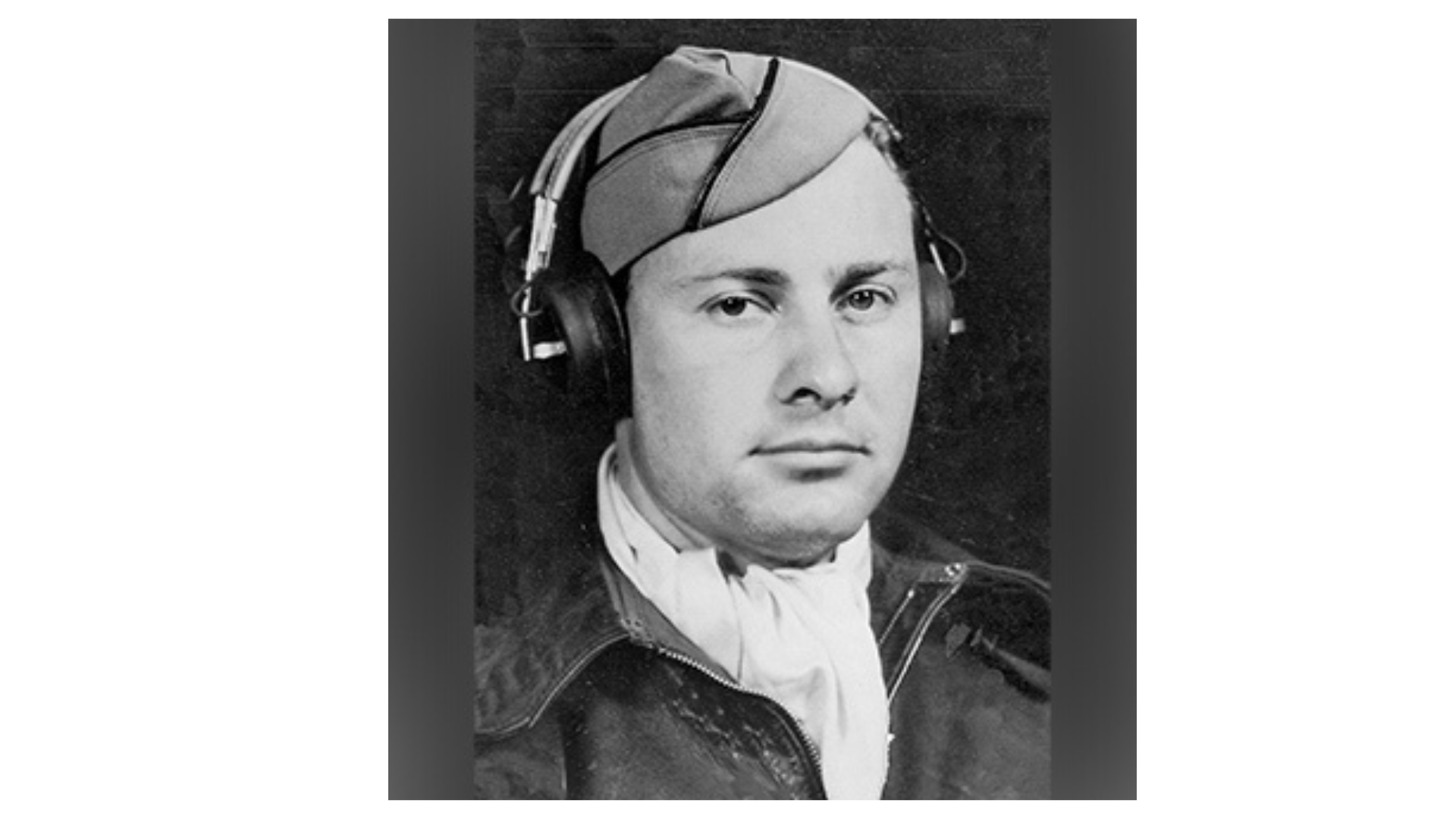
I caught sight of this hero on a Texas A&M website that showed pictures of the 9 former cadets who had received the Medal of Honor. However, he was only at A&M for a year when his Lutheran Uncles convinced him to transfer to TCU. But, once an Aggie always an Aggie (at least that's what my kids have told me!) After Graduation, he joined the Army Air Corps and went through the Cadet Pilot training program finally getting his wings. That stoked my curiosity as Carswell AFB has been around for a very long time. So...Here we go.
 |
| Source |
After getting commissioned and his Pilot Wings, he progressed through the ranks prior to Pearl Harbor when he had reached the rank of Major.

Source

He was assigned to B-24 J model which had an onboard targeting radar. Assigned to the Pacific, he and his crew would attack Japanese convoys at very low level in the hundreds of feet above the sea instead of the usual 20K feet. Having dropped a bomb or two in my day, I understand the reason. The closer you are to the target, the more accurate you get. Dropping bombs from 20K feet is difficult to be accurate. Doing so from 500' is much more accurate.
But...
It's also easier for the enemy as well as the importance of avoiding flying debris from the explosion.
On the night of October 26, 1944, he and his crew are flying single ship and find a Japanese convoy. They attack and after the pass, elect to make a second pass. Generally not a good idea to re-attack an alerted target. His second attack is successful in hitting the target, but the target also was successful in hitting his bomber. As he left the target area, he bomber had lost 2 engines and a third one was running rough. The hydraulic system was damaged, making the aircraft difficult to control, and a fuel tank was ruptured and venting fuel. They were able to get out of the fight and over land where he directed the crew to bail out. Unfortunately, the bombardier's parachute was destroyed in the battle. Additionally, his Co-Pilot was injured also. Major Carswell decided to try to bring the plane back to home base. As they got over the island, they tried to fly over the mountains, but the plane didn't have enough power to get over them. The three were killed on impact.
War IS hell!
Before this mission, he had also been recommended for a Distinguished Flying Cross. This was approved before the accident/shootdown occurred. Hence both citation are listed below.
Citation for Major Horace S. Carswell Jr. Medal of Honor
He piloted a B-24 bomber in a one-plane strike against a Japanese convoy in the South China Sea on the night of 26 October 1944. Taking the enemy force of 12 ships escorted by at least two destroyers by surprise, he made one bombing run at 600 feet, scoring a near miss on one warship and escaping without drawing fire. He circled and, fully realizing that the convoy was thoroughly alerted and would meet his next attack with a barrage of anitaircraft fire, began a second low-level run which culminated in two direct hits on a large tanker. A hail of steel from Japanese guns riddled the bomber, knocking out two engines, damaging a third, crippling the hydraulic system, puncturing one gasoline tank, ripping uncounted holes in the aircraft, and wounding the copilot; but by a magnificent display of flying skill, Maj. Carswell controlled the plane's plunge toward the sea and carefully forced it into a halting climb in the direction of the China shore. On reaching land, where it would have been possible to abandon the staggering bomber, one of the crew discovered that his parachute had been ripped by flak and rendered useless; the pilot, hoping to cross mountainous terrain and reach a base, continued onward until the third engine failed. He ordered the crew to bail out while he struggled to maintain altitude, and, refusing to save himself, chose to remain with his comrade and attempt a crash landing. He died when the plane struck a mountainside and burned. With consummate gallantry and intrepidity, Maj. Carswell gave his life in a supreme effort to save all members of his crew. His sacrifice, far beyond that required of him, was in keeping with the traditional bravery of America's war heroes.
Distinguished Flying Cross Citation
The President of the United States of America, authorized by Act of Congress July 9, 1918, takes pride in presenting the Distinguished Service Cross (Posthumously) to Major (Air Corps) Horace Seaver Carswell, Jr., United States Army Air Forces, for extraordinary heroism in connection with military operations against an armed enemy while serving as Pilot of a B-24 Heavy Bomber in the 374th Bombardment Squadron, 308th Bombardment Group (H), Fourteenth Air Force, while participating in a bombing mission on 16 October 1944, against enemy Japanese surface vessels in the South China Sea. During a sea-sweep mission along the China Coast, a task force of six Japanese naval vessels was located by means of radio equipment. A destroyer and a cruiser were singled out for attack. During four runs over the target at an altitude of 400 feet and under intense fire from the supporting vessels, both were sunk. The plane was not struck and returned to the mainland with less than one hour's supply of gas. The exceptional courage, gallantry, cool judgment and skill demonstrated by Major Carswell in attacking such a large naval task force with his lone plane in the face of almost certain destruction, reflect great credit upon himself, the Army Air Forces and the Army of the United States.

You can bet at some point there he uttered "I'm NOT gonna leave you, dammit! Shut up and let me fly!" Or words to that effect.
ReplyDeleteAs one of the most arrogant SOBs to ever wear stars once said, "It is foolish and wrong to mourn the men who died. Rather we should thank God that such men lived."
Joe,
DeleteAhh, yes! George S. Patton. Yeah, he was a tad arrogant (understatement there), but he won battles. I believe that in wars, that's the prime objective.
juvat
Low level bombing is chancy enough at best with a single or double engine aircraft, an aircraft like the B-24.....agile does not come to mind. Another Hero trying to save crew members, putting others ahead of his own try at safety juvat.
ReplyDeleteBeen there done that. Dropped a high drag 500lb in a 10 degree dive attack in the F-4. Pulled and rolled into a turn. The bomb was flying formation with me, fins still closed. I checked out the max available G in my Afterburner get out of dodge climb. Fortunately the bomb’s time of flight wasn’t long enough for it to arm. Would have hated to be on the explosive de-arm team that morning.
Deletejuvat
Oh....almost forgot Happy Birthday!
ReplyDeleteJoe,
DeleteI’m confused, who’s birthday is it.
juvat
The Air Force's ...
DeleteAhhh,
Deletejuvat
Like Joe, I am sure at some point he told the remaining crew "Shut up and let me fly".
ReplyDeleteThank God indeed such men were (and are) among us.
Agreed
Deletejuvat