Sunday, April 5, 2020

How To Lose a War, Luftwaffe Style

The fifth prototype He 177, the V5, with Stammkennzeichen* code "PM+OD" and early cockpit design used on the first eight prototypes.
(Read me)
So here we are Day Something-Or-Other of "working" from home, exile, Sparkling Isolation, "corn teen," whatever you want to call it.

There are days I get the feeling that with a lot of folks staying home, there's a lot more interaction on the Internet than I'm used to, especially over on koobecaF. Kinda feels like this...


Shakespeare it ain't...

Anyhoo, I am tired of the Internet, I'm all Internetted out, so to speak. So you get a video today. It's like the gym coach is substituting for your regular teacher. (We always got a film when that happened.)

Though I have more time to do the research for the historical posts, well, ya know, there are days I just want to kick back, take off my shoes, and have a beer. What with the events on Guam and the discussion attending all that, not to mention that virus-thingee, I want to have multiple beers. Who knew there were so many experts on the Uniform Code of Military Justice and epidemiologists on koobecaF? I had no ideer...

Sigh...

Anyhoo, here's a fairly good (yes, yes, I know, fairly long as well, 21 minutes give or take, but really, what else do you have to do) video on how the Luftwaffe dropped the ball in World War II. Not a day goes by that I am not thankful that the head of the Luftwaffe, der Dicke, Hermann Göring was a drug-addled nitwit. (Though truth be told, once the Allies weaned him off the drugs so he could stand trial, he wasn't really that stupid. Just evil and drug-addled during the war.)

Enjoy, there is some really good historical footage in this.


Juvat will take care of you Monday, I'll be back Tuesday.

Gotta go keep the Internet safe for...

Well, not democracy, that's for sure. It's a constitutional republic for me!


Stammkennzeichen = factory radio code.

Saturday, April 4, 2020

Lost in the Desert

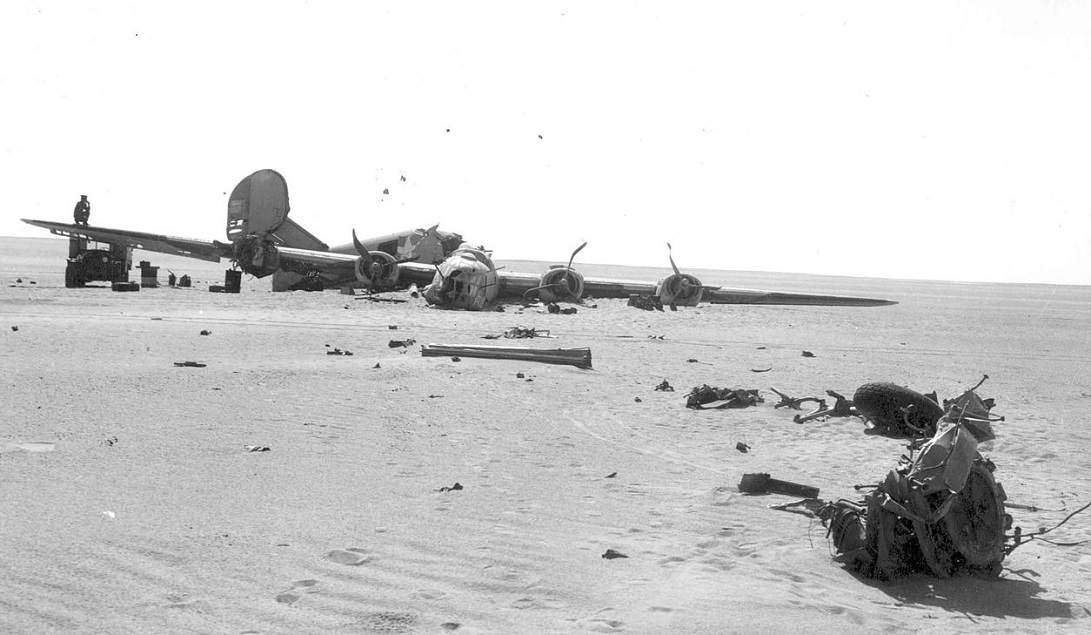
The Wreckage of Consolidated B-24D Liberator, Lady Be Good
The Libyan desert is a harsh, unforgiving environment. Dry and sparse, the temperatures can soar to over 130° during the day and drop to temperatures hovering around freezing during the night. It is a place inimical to human existence. The exigencies of war have as little pity for life as does the desert.

Seventy-seven years ago today the B-24D Liberator Lady Be Good lifted off from Soluch Field in Libya to bomb targets in the vicinity of Naples, Italy. A round trip of over 1,400 miles, well within the capabilities of the aircraft.
The plane, which was one of the last to depart, took off at 1415 hours. It joined the formation of eleven other Liberators and continued on to Naples. A sandstorm caused eight of the B-24s to return to Soluch, leaving four aircraft to continue the operation. When the Lady Be Good arrived over Naples at 1950 hours at 24,900 feet, poor visibility was obscuring the primary target. Two of the B-24s attacked the secondary target on the return trip while the other two aircraft dumped their bombs into the Mediterranean to reduce weight and save fuel.

Lady Be Good was separated from the other three aircraft and flew on to Soluch alone. It was the crews' first mission.

At 0012 hours the pilot, Lt. William Hatton, radioed to say his automatic direction finder was not working and asked for a location of base. The crew apparently overflew Soluch, failing to see the flares fired to attract their attention. They continued southward over North Africa, deeper into the Sahara Desert, for the next two hours.

At 0200 hours, as fuel became critically low, the crew decided to bail out. The abandoned Lady Be Good flew a further 16 miles before it crash-landed into the Calanscio Sand Sea.

Largely because it was believed that the aircraft had probably crashed at sea, a subsequent search and rescue mission from Soluch failed to find any trace of the aircraft or its crew. The disappearance of the
Lady Be Good became a mystery. (Source)
For fifteen years...

Location of the Lady Be Good crash site in relation to Soluch Field
The crew of Lady Be Good.
Left to right: 1Lt. W.J. Hatton, pilot; 2Lt. R.F. Toner, copilot; 2Lt. D.P. Hays, navigator; 2Lt. J.S. Woravka, bombardier;
TSgt. H.J. Ripslinger, engineer; TSgt. R.E. LaMotte, radio operator; SSgt. G.E. Shelly, gunner;
SSgt. V.L. Moore, gunner; and SSgt. S.E. Adams, gunner.
(U.S. Air Force photo)
An animated dramatization of the events leading to the loss of the Lady Be Good.


In November of 1958 aircraft wreckage was sighted by an oil exploration team from British Petroleum. They reported the find to Wheelus Air Base. No attempt was made by the Air Force to investigate the crash site because there were no records of any American aircraft going down in that area.
On February 27, 1959, British oil surveyor Gordon Bowerman and British geologists Donald Sheridan and John Martin spotted the wreckage near 26°42′45.7″N 24°01′27″E, 440 miles southeast of Soluch, following up the first sighting from the air on May 16, 1958, by the crew of a Silver City Airways Dakota, piloted by Captain Allan Frost, and another on June 15. A recovery team made initial trips from Wheelus Air Base to the crash site on May 26, 1959.
Although the plane was broken into two pieces, it was immaculately preserved, with functioning machine guns, a working radio, and some supplies of food and water. A thermos of tea was found to be drinkable. No human remains were found on board the aircraft nor in the surrounding crash site, nor were parachutes found.
Most of the evidence from the wreckage indicated that the men had bailed out. However, the log book of the navigator, 2nd Lt D.P. "Deep" Hays, which was still on board, made no mention of the aircraft's movements after the crew commenced their return leg from Naples. (Source)
After fifteen years the wreckage of the Lady Be Good had been discovered, an aircraft which had been assumed to have gone down in the Mediterranean, found far to the south of the field from which the crew had departed on their first mission.

And their last.

What of those crewman? What were the fates of 1Lt Hatton, 2Lt Toner, 2Lt Hays,  2Lt Woravka, TSgt Ripslinger, TSgt LaMotte, SSgt Shelly, SSgt Moore, and SSgt Adams? There were no bodies in the wreckage. Where was the crew?

Nearly two years after the discovery of the aircraft, the Army went looking.
In February 1960, the United States Army conducted a formal search of the area for the remains of the crew. Five bodies – those of 1Lt Hatton, 2Lt Toner, 2Lt Hays, TSgt LaMotte and SSgt Adams – were found on February 11. The team concluded that other bodies were likely buried beneath sand dunes after finding evidence that at least three of the surviving crew members had continued walking northward.
With the news that five bodies had been recovered, the US Air Force and US Army started an expanded search called Operation Climax in May 1960. The joint operation used a USAF C-130 cargo plane and two Army Bell H-13 helicopters. However, it was a British Petroleum exploration crew that found the remains of SSgt Shelley, on May 12, 1960, 24 miles northwest of the recovered five bodies. A US Army helicopter found the body of TSgt Ripslinger on May 17, 1960, located 26 miles northwest of Shelley's body, over 200 miles from the crash site, but still 99 miles from Soluch Field. These two bodies were the only ones found during Operation Climax. Another British Petroleum oil exploration crew discovered the remains of 2nd Lt Woravka in August 1960. His body was then recovered by the US Air Force.
The remains of SSgt Vernon L. Moore, have never been "officially" found. However, his remains may have been recovered and buried by a desert patrol of the British Army in 1953. As they were unaware that any Allied air crews were missing in the area, the human remains were recorded but then buried without further investigation. (Source)
We'll never know the exact circumstances surrounding the loss of Lady Be Good and her crew. All we know for sure is that nine men went out on their very first combat mission, and never returned.

Lady Be Good
Rest in peace gentlemen.


The B-24D
First model produced on a large scale; ordered from 1940 to 1942, as a B-24C with better engines (R-1830-43 supercharged engines). The D model was initially equipped with a remotely operated and periscopically sighted Bendix belly turret, as the first examples of the B-17E Flying Fortress and some early models of the B-25 Mitchell medium bomber had used, but this proved unsatisfactory in service and was discontinued after the 287th aircraft. Production aircraft reverted to the earlier manually operated "tunnel" mounting with a single .50 caliber (12.7 mm) machine. The tunnel gun was eventually replaced by the Sperry ball turret, which had also been adopted by the later B-17E Fortresses, but made retractable for the Liberator when not in use as the ventral area of its fuselage was very close to the ground on landing. In late B-24Ds, "cheek" guns mounted on either side of the forward nose, just behind the framed "greenhouse" nose glazing were added. (Total: 2,696: 2,381 Consolidated, San Diego; 305 Consolidated, Fort Worth; 10 Douglas, Tulsa, Oklahoma). (Source)
B-24D Aircraft Serial Number 41-24301 (Lady Be Good, 376th BG, 514 BS) crew got lost in first bombing mission over Italy April 4, 1943 and overflew their home base at Soluch, Libya.  Flew 300 miles into Sahara, ran out of gas and bellied in.  Crew bailed out when they were down to two engines due to fuel starvation. Crew attempted to walk out and perished in the desert.  Aircraft found in desert in 1958.  Crew remains and a survival diary found in early 1960s.  Most of the plane still remained in desert as found.  Remains of plane were salvaged and put on display in Tobruk, Libya. (Source)
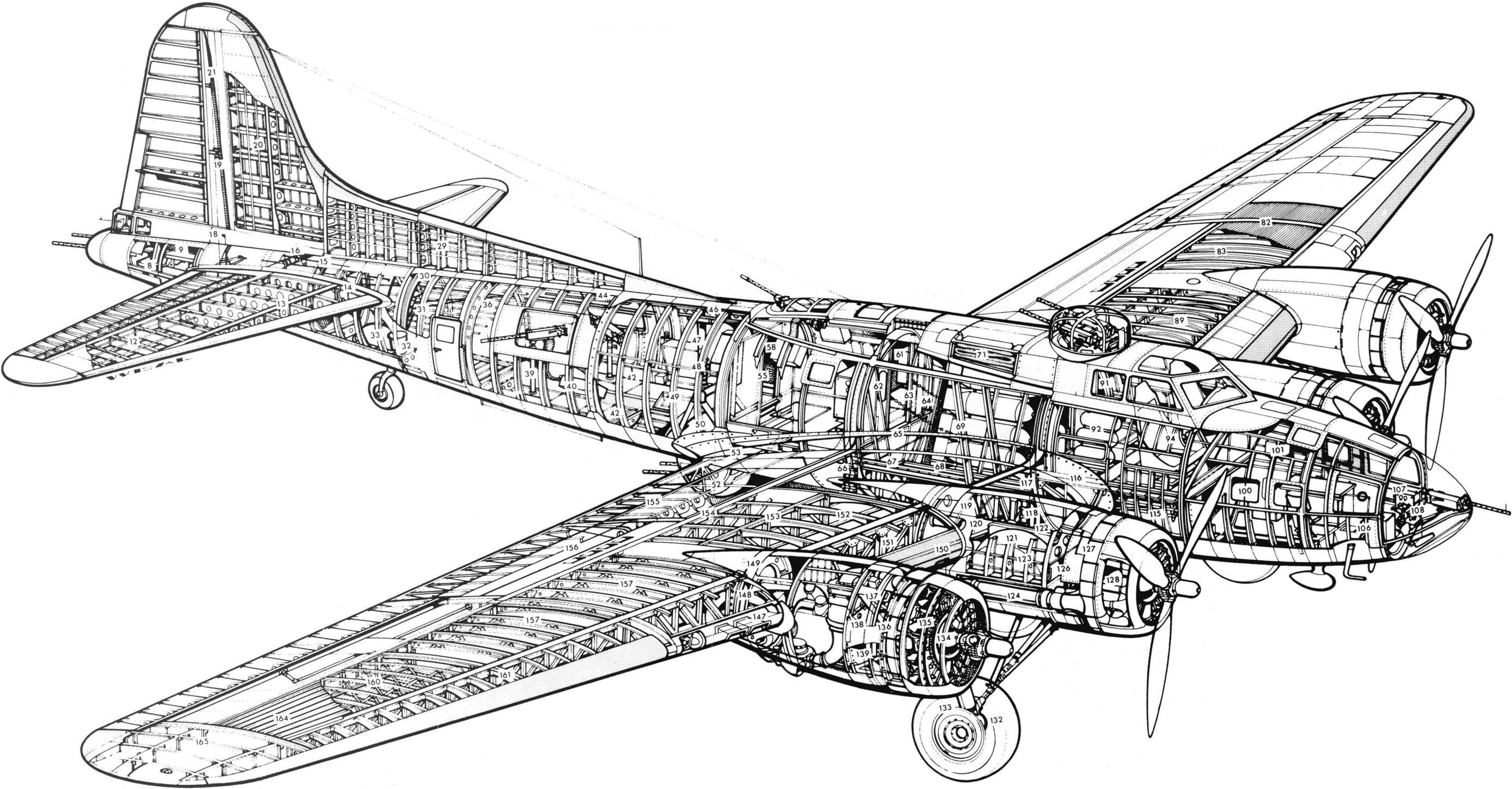
Cutaway drawing of the B-24D Liberator
Note the lack of a ball turret.
(Source)
The fact that there were only nine crewmembers aboard the Lady Be Good leads me to believe that the ship did not have a ball turret, as shown in the dramatization above, but rather had the Bendix Power Driven Turret as shown above. This was remotely operated by the radio operator. The following drawing shows this crewman as the "assistant radio operator." I've also seen references to the radio operator acting on occasion as one of the waist gunners.

Crew positions in the B-24D Liberator
(Source)
The Lady Be Good Stained Glass Window from the
Wheelus Air Force Base Chapel is now on display at the
National Museum of the United States Air Force.


Suggested Reading and Sources:
  • National Museum of the Air Force Link
  • Wikipedia, Lady Be Good Link
  • Wikipedia, the B-24 Liberator Link
  • Lost and Found the Story of the Lady Be Good Link
  • The Remains of Lady Be Good Link
  • Lady Be Good Link
  • Ghost Liberator Link
  • Lady Be Good Crashed 1943 Link
  • Lady Be Good Website Link
  • B-24 Manufacturing Photos Link


Hat tip to Don McCollor for giving me the idea for this post.

Friday, April 3, 2020

The Friday Flyby - Die Deutsche Luftwaffe im Jahr 1940

Dornier Do 17s of Kampfgruppe (KG) 2
(Source)
A glance at a map of Europe in 1938 reveals something interesting, well, at least to me it does -

Europe in 1938, before the Anschluss1
In fairly short order, from March of 1938 to June of 1940, Nazi Germany absorbed Austria and most of Czechoslovakia. They had invaded and defeated Poland, Denmark, Norway, Luxembourg, the Netherlands, Belgium, and France. If you look at the map, with the exception of Norway (which I'll get to in a moment), none of those nations had a major water obstacle between them and Germany (and in the case of Poland, Lithuania, Latvia, and Estonia - between them and the Soviet Union).

When the French had surrendered in June of 1940, nothing stood between the victorious Wehrmacht2 and the United Kingdom but the English Channel, which at its narrowest point (Calais to Dover) is 21 miles wide. A significant obstacle to ground forces, especially when faced by one of the most powerful navies on the planet in 1940, the British Royal Navy.

Before proceeding I should note, although Norway is separated from Germany by the Skagerrak, a strait leading from the North Sea to the Baltic Sea which separates Norway from Denmark. It is 82 miles from Hirtshals on the coast of Denmark to Kristiansand on the coast of Norway, which is wider that the English Channel but the Royal Navy wouldn't be there, just the Norwegian Navy which wasn't really a match for the Luftwaffe and the Kriegsmarine. On the other hand it is 292 miles from Peterhead on the coast of Scotland to Egersund on the coast of Norway. So the invasion of Norway, for the Germans, was significantly less of a problem than trying to get across the English Channel against the Royal Navy and the Royal Air Force. Though the Kriegsmarine suffered substantial losses, Norway fell to the Nazis.

Now about that English Channel, there's a reason it's called the English Channel (according to the English anyway) and that has a lot to do with their fleet. The British consider the Channel to be their first line of defense from an attack from the continent, as long as the Royal Navy is present. Another reason why the British placed so much emphasis on their navy. After all, the United Kingdom is an island and depends on the sea for many things, not the least of which is trade. So a big, well-equipped, and well-trained navy is a major requirement.

So the Germans are on the Channel coast in the early summer of 1940, they are at war with Britain, so what's the next step? Well, they have to get the Royal Navy out of the Channel, to do that they have to establish air superiority over the Channel and the presumptive invasion beaches in southeastern England. (A problem the Allies had in 1944 going the other direction. Whilst the Kriegsmarine wasn't considered to be a big enough threat to stop the invasion, the Luftwaffe was considered to be a big threat. Hence the emphasis on destroying the German air force as the prime aim of the Allied air forces prior to D-Day.)

Whereas the Allies in 1944 were superbly equipped with long range bombers, able to carry a very decent bomb load, and the fighters which could escort those bombers deep into Germany, the Germans had nothing to compare in 1940. Although their Air Force was very good, and very professional, they were essentially a tactical air force, designed to support the German army in their wars of aggression.

So what did the Germans have in the way of aircraft in the summer of 1940? What was available to sweep the Tommies from the air and the Channel? (Note that later in 1940 the Italians sent an expeditionary force from their air force to support the Germans, limited in numbers and effectiveness so I won't discuss them herein.)
The Luftwaffe, according to the Quartermaster General 6th Battalion returns on 10 August 1940, deployed 3,358 aircraft against Britain, of which 2,550 were serviceable. The force was made up by 934 single-seat fighters, 289 two-seat fighters, 1,482 medium bombers, 327 dive-bombers, 195 reconnaissance and 93 coastal aircraft, including unserviceable aircraft. The number of serviceable aircraft amounted to 805 single-seat fighters, 224 two-seat fighters, 998 medium bombers, 261 dive-bombers, 151 reconnaissance and 80 coastal aircraft. (Source - page 318)
The 1,482 medium bombers were:
  • Dornier Do 17 (Shown in the opening photo)
  • Heinkel He 111
  • Junkers Ju 88
A Heinkel He 111H of KG 53
(Source)
A Ju 88A over France in 1942
(Source)
Before we look at the bomb loads these aircraft could carry, note that the B-17G could carry 8,000 pounds of bombs for a short mission and 4,500 pounds on a long range mission.

Internal bomb loads of the three main German level bombers:
  • Do 17   - 2,205 pounds
  • He 111 - 4,400 pounds
  • Ju 88  - 3,100 pounds
Although all three aircraft could carry even more bombs externally, this was at an extreme detriment to the aircraft's performance and would be atypical in June of 1940.

Note also the gun positions (or lack thereof) on these three aircraft. The crews of these aircraft sat very near the front of the aircraft (in the Do 17 and Ju 88 they all sat in the nose of the aircraft). These birds absolutely required fighter escort for daylight raids into Britain.

What fighter aircraft did the Germans have available in 1940? On paper there were two but one of them was a fighter in name only and was easy meat for the Spitfire and the Hurricane.

Messerschmitt Bf 109E of the II. Gruppe (Group) of Jagdgeschwader (JG) 51
(Source)
The Bf 109E4 was a superb fighter aircraft, nimble and well-armed with two 7.9 mm machine guns mounted in the nose above the engine and one 20 mm cannon in each wing. This provided a lot more punch than the six .303 caliber machine guns carried by the Spitfire and the Hurricane (as you'll see in the video, soon, patience). The problem with the Bf 109E was it's rather short range. As I recall the aircraft only had about 15 minutes of combat time in the vicinity of London. Notice those blue arcs on the next map? The Bf 109 was designed as a short range interceptor, it wasn't really built for escorting bombers.

Bf 110s in flight above Budapest. 1944
(Source)
The Messerschmitt Bf 110, often known unofficially as the Me 110, is a twin-engine Zerstörer (Destroyer, heavy fighter) and fighter-bomber (Jagdbomber or Jabo) developed in Nazi Germany in the 1930s and used by the Luftwaffe during World War II. Hermann Göring was a proponent of the Bf 110. It was armed with two MG FF 20 mm cannon, four 7.92 mm (.312 in) MG 17 machine guns, and one 7.92 mm (.312 in) MG 15 machine gun (later variants’ rear gunner station would be armed with the twin-barreled MG 81Z) for defense. (Source)
If Göring liked something that's one strike right there, the man was a complete disaster as head of the Luftwaffe.

RAF and Luftwaffe bases for the Battle of Britain3
One more aircraft featured prominently in the Battle of Britain in 1940 and that was the Junkers Ju 87, the famed Stuka, (which is the German acronym for dive bomber, Sturzkampfflugzeug).

Junkers Ju 87B Stukas over Poland, September/October 1939
(Source)
This aircraft was rather slow and cumbersome, it could carry one 550 pound bomb on the centerline station and four 110 pound bombs under the wings (two per wing). Though the aircraft had two forward firing 7.92 mm machine guns and a single 7.92 mm machine gun for the rear gunner, it was shot down in droves by the RAF Spitfires and Hurricanes. The aircraft was soon withdrawn from use over Britain. It did serve as a very effective ground attack aircraft for the entire war, as long as no enemy fighters were around!

So the Germans went into battle over the Channel and southeastern Britain with equipment ill-suited to the task. That we're not all speaking German indicates that they lost the Battle of Britain and Hitler turned his gaze to Russia, where the Nazis got their asses kicked, though it took quite a while to get there.


The genesis of this post can be traced to an email from one of you all, Tom to be precise, regarding an interesting video of old Nazi tanks in Bulgaria. So by now you're wondering what that has to do with the Battle of Britain. Other than both have to do with World War II, nothing at all. Oh, there was the fact that the video Tom sent me the link to was from Mark Felton Productions on YouTube, this guy.

I found it odd that I hadn't subscribed to that channel yet, so I did and found a very interesting video about a Dornier Do 17 that had crashed in Britain during the war. The video had some very good footage of the crew cabin of the Do 17, to include a very odd way (to me at least) of mounting the defensive machine guns, which you'll see in the video.

The crew of the Do 17 all sat together in the nose of the aircraft, good for morale, which was the German intent, but bad for defensive firepower, of which there wasn't much.

Dornier Do 17 Cutaway Drawing
(Source)
Seems a bit claustrophobic to me!


The Do 17 had a nickname, Der fliegende Bleistift, the Flying Pencil. With that long narrow tail, seems an apt nickname.

Happy Friday, hope you all are surviving, if not exactly thriving. This too shall pass.


1 The Anschluss was the "union" of Nazi Germany and Austria. Allegedly supported by a popular vote.
2 The Wehrmacht was the the armed forces of Nazi Germany, this included the Army (das Heer), the Navy (die Kriegsmarine), and the Air Force (die Luftwaffe).
3 Note on the map: Luftflotte = Air Fleet, see Luftwaffe organization in WW2.
4 You'll also see Me 109 and Me 110, the "Me" standing for Messerschmitt. The "Bf" designation stands for Bayerische Flugzeugwerke (BFW), the Bavarian Aircraft Works, Willy Messerschmitt was the chief designer at BFW. Not even the Luftwaffe could decide how to designate the Bf/Me 109. Official Luftwaffe documents and actual manufacturer's data plates on the aircraft themselves used both. Sometimes in the same document/on the same airframe! BFW became Messerschmitt AG (Aktiengesellschaft, Corporation) in 1938. The 110 was never called the Me 110 officially as it was designed prior to BFW becoming Messerschmitt AG.
Thursday, April 2, 2020

Eager Beavers

B-17E "My Gal Sal" at the National WWII Museum in New Orleans
(Source)
She was a B-17E, delivered to the United States Army Air Forces at Minneapolis on 7 March 1943, she was initially assigned to the 435th Bomb Squadron (BS), 19th Bomb Group (BG) in Hawaii on 14 May 1942, then transferred to the 65th BS, 43rd BG in Australia. (Source)

She was heavily modified as a photo reconnaissance aircraft, loaded with extra machine guns, on her most famous photo mission, over Bougainville on the 16th of June 1943, she went into the history books as "Old 666," with the most highly decorated crew for a single mission of World War II. Two Medals of Honor and seven Distinguished Service Crosses, at the time the U.S. Army's second highest award. From a crew known as the Eager Beavers.

How many machine guns did Old 666 take on that mission -
In the Pacific Theater, Tail number 41-2666 is a shot up B-17 bomber with a reputation for being cursed named "Hard Luck Hattie," but in need of a ride, Captain Jay Zeamer, Jr. (born in Carlisle, Pennsylvania, in 1918, the pilot is a graduate of the Culver Military Academy in Culver, Indiana, winning marksmanship awards each year he is there, and before the war begins, graduates from M.I.T. with a B.S. in civil engineering, it is also at M.IT. that he gets his aviation license, learning how to fly in the school's flying club) takes on the project of resurrecting the plane from the scrapheap for photographic reconnaissance missions ... engines are replaced, the plane is lightened of all unnecessary gear, and its defensive capabilities are augmented by the addition of dual .50 caliber M2 Browning machine guns in the radio compartment and at both waist positions, and a fixed .50 caliber machine gun is installed in the nose for the pilot to fire ... in all, the bomber will go from having ten guns, to having nineteen, and it becomes the most heavily armed plane in the entire Pacific ...  ... on 6/16/1943, it will need every one of them (by the time of his famous mission, 24-year-old Zeamer is his squadron's executive officer and has been awarded a Silver Star for a 1942 photo reconnaissance flight over Simpson Harbor on the island of Rabaul, as well as receiving an Oak Leaf Cluster for a 1943 flight over the same dangerous Japanese held island). (Source)
I have to thank RHT447 as the inspiration for this post, he sent me the following YouTube link in a comment to this post (which got Your Humble Scribe to digging deeper) -


For reference, here's where the crewmen sit on a B-17 Flying Fortress -

(Source)

The crew aboard Old 666 that day only numbered nine out of the usual ten for a B-17 crew, as shown above. A single crewman, apparently, manned the waist gunners' stations, though another source indicates that one crewman swapped between the ball turret and one of the waist stations, which I find hard to believe. You just don't climb in and out of that cramped ball turret position during combat. I tried to find more information on that, but most sources concentrate on the sheer number of Japanese fighter aircraft this lone bomber had to deal with.

Well sure, that, after all, was the real story. As for that ball turret gun -


The crew for that June day were:
  • Capt Jay Zeamer, Pilot
  • 2Lt John T. Britton, Co-Pilot
  • 2Lt Joseph Raymond Sarnoski, Bombardier
  • 1Lt Ruby Ernest Johnston, Navigator
  • Sgt Johnnie James Able, Flight Engineer/Top Turret Gunner
  • Sgt William Vaughan, Radio Operator
  • TSgt Forrest Earl Dillman, Ball Turret Gunner/Waist Gunner (?)
  • TSgt George Edward Kendrick, Waist Gunner
  • Sgt Herbert Woodrow Pugh, Tail Gunner
The pilot, Capt. Zeamer, and the bombardier, 2Lt Sarnoski, both were awarded the medal of honor, 2Lt Sarnoski's was posthumous. Here are the citations for those medals:

Captain Jay Zeamer
The President of the United States of America, in the name of Congress, takes pleasure in presenting the Medal of Honor to Major (Air Corps), [then Captain] Jay Zeamer, United States Army Air Forces, for conspicuous gallantry and intrepidity in action above and beyond the call of duty while serving with the 65th Bombardment Squadron, 43d Bombardment Group (H), 5th Air Force. On 16 June 1943, Major Zeamer volunteered as pilot of a bomber on an important photographic mapping mission covering the formidably defended area in the vicinity of Buka, Solomon Islands. While photographing the Buka airdrome. his crew observed about 20 enemy fighters on the field, many of them taking off. Despite the certainty of a dangerous attack by this strong force, Major Zeamer proceeded with his mapping run, even after the enemy attack began. In the ensuing engagement, Major Zeamer sustained gunshot wounds in both arms and legs, one leg being broken. Despite his injuries, he maneuvered the damaged plane so skillfully that his gunners were able to fight off the enemy during a running fight which lasted 40 minutes. The crew destroyed at least five hostile planes, of which Major Zeamer himself shot down one. Although weak from loss of blood, he refused medical aid until the enemy had broken combat. He then turned over the controls, but continued to exercise command despite lapses into unconsciousness, and directed the flight to a base 580 miles away. In this voluntary action, Major Zeamer, with superb skill, resolution, and courage, accomplished a mission of great value. (Source)
2Lt Joseph Sarnoski
The President of the United States of America, in the name of Congress, takes pride in presenting the Medal of Honor (Posthumously) to Second Lieutenant (Air Corps) Joseph Raymond Sarnoski (ASN: 0-888520), United States Army Air Forces, for conspicuous gallantry and intrepidity in action above and beyond the call of duty while serving with the 65th Bombardment Squadron, 43d Bombardment Group (H), Fifth Air Force. On 16 June 1943, Second Lieutenant Sarnoski volunteered as bombardier of a crew on an important photographic mapping mission covering the heavily defended Buka area, Solomon Islands. When the mission was nearly completed, about 20 enemy fighters intercepted. At the nose guns, Second Lieutenant Sarnoski fought off the first attackers, making it possible for the pilot to finish the plotted course. When a coordinated frontal attack by the enemy extensively damaged his bomber, and seriously injured five of the crew, Second Lieutenant Sarnoski, though wounded, continued firing and shot down two enemy planes. A 20-millimeter shell which burst in the nose of the bomber knocked him into the catwalk under the cockpit. With indomitable fighting spirit, he crawled back to his post and kept on firing until he collapsed on his guns. Second Lieutenant Sarnoski by resolute defense of his aircraft at the price of his life, made possible the completion of a vitally important mission. (Source)
The citations for the award of the Distinguished Service Cross to the other members of the crew are as follows:

2Lt John Britton
The President of the United States of America, authorized by Act of Congress July 9, 1918, takes pleasure in presenting the Distinguished Service Cross to Second Lieutenant (Air Corps) John T. Britton, United States Army Air Forces, for extraordinary heroism in connection with military operations against an armed enemy while serving as Co-Pilot of a B-17 Heavy Bomber in the 65th Bombardment Squadron, 43d Bombardment Group (H), FIFTH Air Force, in aerial action against enemy forces on 16 June 1943, during a Photo-Reconnaissance air mission over Bougainville Island. Second Lieutenant Britton was Co-Pilot of a volunteer bomber crew which undertook an important and dangerous photo mapping mission over the heavily defended enemy base at Buka. Just before the photographing was completed, about twenty enemy fighters attacked. The bomber was extensively damaged and five of the crew were seriously wounded. After a forty-five minute running fight, in which five enemy planes were destroyed and two damaged, the bomber was flown safely to its base five hundred and eighty miles away. Second Lieutenant Britton showed admirable skill and determined courage on this voluntary mission, which secured information of great value in subsequent operations. He aided the wounded pilot and administered first aid to other wounded crew members during the 600-mile return flight. The personal courage and zealous devotion to duty displayed by Second Lieutenant Britton on this occasion have upheld the highest traditions of the military service and reflect great credit upon himself, the 5th Air Force, and the United States Army Air Forces. (Source)
1Lt Ruby Johnston*
The President of the United States of America, authorized by Act of Congress July 9, 1918, takes pleasure in presenting the Distinguished Service Cross to First Lieutenant (Air Corps) Ruby Ernest Johnston, United States Army Air Forces, for extraordinary heroism in connection with military operations against an armed enemy while serving as Navigator of a B-17 Heavy Bomber in the 65th Bombardment Squadron, 43d Bombardment Group (H), FIFTH Air Force, in aerial action against enemy forces on 16 June 1943, during a Photo-Reconnaissance air mission over Bougainville Island. First Lieutenant Johnston was a member of a volunteer bomber crew which undertook an important and dangerous photo mapping mission over the heavily defended enemy base at Buka. Just before the photographing was completed, about twenty enemy fighters attacked. The bomber was extensively damaged and five of the crew were seriously wounded. First Lieutenant Johnston, with multiple wounds about the head so that bleeding interfered with his vision, continued to man his guns until the explosion of a twenty millimeter shell in the nose of the bomber threw him back into the catwalk. He saw that fire had broken out behind the pilot's seat, got to his feet, tore out the burning oxygen bottles, and extinguished the fire bare-handed. After a forty-five minute running fight, in which five enemy planes were destroyed and two damaged, the bomber was flown safely to its base five hundred and eighty miles away, First Lieutenant Johnston supervising the navigation despite his injuries. He showed admirable skill and determined courage on this voluntary mission, which secured information of great value in subsequent operations. His unquestionable valor in aerial combat is in keeping with the highest traditions of the military service and reflects great credit upon himself, the 5th Air Force, and the United States Army Air Forces. (Source)
Sgt Johnnie Able
The President of the United States of America, authorized by Act of Congress July 9, 1918, takes pleasure in presenting the Distinguished Service Cross to Sergeant Johnnie James Able, Jr., United States Army Air Forces, for extraordinary heroism in connection with military operations against an armed enemy while serving as Flight Engineer of a B-17 Heavy Bomber in the 65th Bombardment Squadron, 43d Bombardment Group (H), FIFTH Air Force, in aerial action against enemy forces on 16 June 1943, during a Photo-Reconnaissance air mission over Bougainville Island. Sergeant Able was a member of a volunteer bomber crew which undertook an important and dangerous photo mapping mission over the heavily defended enemy base at Buka. Just before the photographing was completed, about twenty enemy fighters attacked. The bomber was extensively damaged and five of the crew were seriously wounded. After a forty-five minute running fight, in which five enemy planes were destroyed and two damaged, the bomber was flown safely to its base five hundred and eighty miles away. Sergeant Able showed admirable skill and determined courage on this voluntary mission, which secured information of great value in subsequent operations. Although he was shot through both legs, he continued to man his guns and without mentioning his wounds, took over the bomber's controls during part of the homeward trip so the co-pilot could administer first aid. The courage and zealous devotion to duty displayed by Sergeant Able on this occasion have upheld the highest traditions of the military service and reflect great credit upon himself, the 5th Air Force, and the United States Army Air Forces. (Source)
Sgt William Vaughan
The President of the United States of America, authorized by Act of Congress July 9, 1918, takes pleasure in presenting the Distinguished Service Cross to Sergeant William Vaughan (ASN: 15071291), United States Army Air Forces, for extraordinary heroism in action while serving in a B-17 Bomber of the 65th Bombardment Squadron, 43d Bombardment Group (Heavy), FIFTH Air Force, in action over Bougainville Island on 16 June 1943. Sergeant Vaughan was Radio Operator of a volunteer bomber crew which undertook an important and dangerous photo-mapping mission over the heavily defended enemy Base at Buka. Just before the photographing was completed, about twenty enemy fighters attacked. The bomber was extensively damaged and five of the crew, including the Pilot, were seriously wounded. Nevertheless, by skillful evasive flying and by expert gunnery on the part of the crew, successive enemy attacks were fought off. In this furious forty-five minute engagement, five enemy planes were destroyed and two damaged. Sergeant Vaughan, with a bullet wound in his neck, continued to man his guns until the enemy had broken combat. He then estimated the medical aid required and reported to all Bases at which the plane might land. As the navigation instruments were disabled, he then remained at his post and received bearings for the return flight of five hundred and eighty miles. Sergeant Vaughan showed admirable skill and courage on this voluntary mission, which secured information of great value in subsequent operations.(Source)
~ No photo available ~ 
The President of the United States of America, authorized by Act of Congress July 9, 1918, takes pleasure in presenting the Distinguished Service Cross to Technical Sergeant Forrest Earl Dillman, United States Army Air Forces, for extraordinary heroism in connection with military operations against an armed enemy while serving as a Gunner of a B-17 Heavy Bomber in the 65th Bombardment Squadron, 43d Bombardment Group (H), FIFTH Air Force, in aerial action against enemy forces on 16 June 1943, during a Photo-Reconnaissance air mission over Bougainville Island. Technical Sergeant Dillman was a member of a volunteer bomber crew which undertook an important and dangerous photo mapping mission over the heavily defended enemy base at Buka. Just before the photographing was completed, about twenty enemy fighters attacked. The bomber was extensively damaged and five of the crew were seriously wounded. After a forty-five minute running fight, in which five enemy planes were destroyed and two damaged, the bomber was flown safely to its base five hundred and eighty miles away. Technical Sergeant Dillman showed admirable skill and determined courage on this voluntary mission, which secured information of great value in subsequent operations. He fired so expertly and aggressively during the battle that he repeatedly broke up enemy attacks and accounted for one Japanese plane shot down. His unquestionable valor in aerial combat is in keeping with the highest traditions of the military service and reflects great credit upon himself, the 5th Air Force, and the United States Army Air Forces. (Source)
TSgt George Kendrick
The President of the United States of America, authorized by Act of Congress July 9, 1918, takes pleasure in presenting the Distinguished Service Cross to Technical Sergeant George Edward Kendrick, United States Army Air Forces, for extraordinary heroism in connection with military operations against an armed enemy while serving as Photographer and Gunner of a B-17 Heavy Bomber in the 65th Bombardment Squadron, 43d Bombardment Group (H), FIFTH Air Force, in aerial action against enemy forces on 16 June 1943, during a Photo-Reconnaissance air mission over Bougainville Island. Technical Sergeant Kendrick was a member of a volunteer bomber crew which undertook an important and dangerous photo mapping mission over the heavily defended enemy base at Buka. Just before the photographing was completed, about twenty enemy fighters attacked. The bomber was extensively damaged and five of the crew were seriously wounded. After a forty-five minute running fight, in which five enemy planes were destroyed and two damaged, the bomber was flown safely to its base five hundred and eighty miles away. Technical Sergeant Kendrick showed admirable skill and determined courage on this voluntary mission, which secured information of great value in subsequent operations. His unquestionable valor in aerial combat is in keeping with the highest traditions of the military service and reflects great credit upon himself, the 5th Air Force, and the United States Army Air Forces. (Source)
Sgt Herbert Pugh
The President of the United States of America, authorized by Act of Congress July 9, 1918, takes pleasure in presenting the Distinguished Service Cross to Sergeant Herbert Woodrow Pugh, United States Army Air Forces, for extraordinary heroism in connection with military operations against an armed enemy while serving as Tail Gunner of a B-17 Heavy Bomber in the 65th Bombardment Squadron, 43d Bombardment Group (H), FIFTH Air Force, in aerial action against enemy forces on 16 June 1943, during a Photo-Reconnaissance air mission over Bougainville Island. Sergeant Pugh was a member of a volunteer bomber crew which undertook an important and dangerous photo mapping mission over the heavily defended enemy base at Buka. Just before the photographing was completed, about twenty enemy fighters attacked. The bomber was extensively damaged and five of the crew were seriously wounded. After a forty-five minute running fight, in which five enemy planes were destroyed and two damaged, the bomber was flown safely to its base five hundred and eighty miles away. During the return flight, Sergeant Pugh stayed in action throughout the battle, cared for the wounded, and observed landmarks for the navigator, who was half-blinded by head wounds. Sergeant Pugh showed admirable skill and determined courage on this voluntary mission, which secured information of great value in subsequent operations. His unquestionable valor in aerial combat is in keeping with the highest traditions of the military service and reflects great credit upon himself, the 5th Air Force, and the United States Army Air Forces. (Source)
B-17E Cutaway Drawing
(Source)

Brave men all, I cannot imagine flying in a single aircraft on a long mission like that, over the ocean, then being beset by multiple Japanese fighter aircraft over the target, then flying home with one man dead and a number wounded, including the pilot, Capt Zeamer, who is seriously wounded, when they landed, the ambulance guys thought he was dead!

They clanked when they walked, I'm sure...


Suggested Further Reading and Sources:
  • The Amazing Medal of Honor Mission Link
  • Zeamer's Eager Beavers Link
  • Zeamer and the "Eager Beavers" Link
  • OLD 666 Link
  • VETERANS STORY: The Eager Beavers Link
  • SUICIDE RUN: The Final Flight of Old 666 Link
  • 43rd AW Dedicates HQ Building to MOH Recipients Link


* This photo was at one of the sources for this post. It was not labeled but was the only officer who wasn't otherwise accounted for. It is my assumption that this picture is of 1Lt Johnston.

Wednesday, April 1, 2020

Things I Should Do and A Thing That I Did...

(Source)
  1. Learn to cook, I mean really learn.
  2. Get a haircut.
  3. Not get annoyed by 90% of the stuff on Facebook.
  4. Comment more on OPB.1
  5. Practice more on my drum kit.
  6. Get back to work on the book.
  7. Get my substantial derriere back on my exercise bike.
  8. Improve on every other "failing" I have. (Hhmm, why did I put that in quotes?)
  9. Spend more time with the grandkids.
  10. Finally decide to retire, then actually do it.
Actually did #9 yesterday, via Kid's Messenger, which is a very kid friendly thing that koobecaF does. Let me explain.

Late Monday night my phone's Messenger alarm went off, meaning that someone had bothered messaged me via koobecaF Messenger. Grumbling (seriously people, stop sending me videos about this virus thing, I'm so pissed about this mess... well, yes, but I digress), I picked up my phone and there was a message from the youngest granddaughter asking me to connect on Kid's Messenger. Looked legit (and it was) so I said "Yes."

So the thing wants me to download the app and in the way of most modern software, the download claimed that it failed. After "hour glassing" for a minute or two, indicating that it wasn't done yet. (What? Done failing?) Though at least it didn't indicate "100% Complete" for ten minutes. Seriously you bit-whacking weenies2 out there, didn't they teach you anything in school? 100% complete means precisely that, there is no need for an hourglass on the screen, in fact just bail and tell the user that the software is ready to use.

As it indicated that the download failed, and it was nearly midnight, I figured I'd deal with it on the morrow. Which was, if you sit down and calculate it, would be Tuesday, as in yesterday. Off to the Land of Nod3 I went, thinking no more of it. (All the bloody strange dreams I've been having lately wouldn't leave any room for rational thought anyways.)

Tuesday morn arrived (again yesterday as of the date of this post) and I "went to work." Which means I put on pants, wandered down to the Command Center, put in eye drop one of two, fired up the two computers, and once the work laptop was up and running (sadly no email saying I had a task) I headed below decks to make a cuppa joe. Caffeinated beverage in hand, I returned to the Command Center to start my day. (After doing eye drop two of two. It's a glaucoma thing. Sigh...)

Not too far into the "work" day I decided to let my old boss at work know that I was alive and well. So I sent him this...

(Source)

Yes, he thought it hysterical. But like a good boss, he suggested a minor correction...

"working"

You say toe-mah-toe, I say toe-may-toe. Or something.

Anyhoo, where was I? Oh yes, after exchanging pleasantries with the boss via Skype, I went back to "work." (Better Clayton?)

And my cell phone started making some funny ringing/clanging noise. As I sat there looking at my phone like this...

(Source)
I eventually decided that actually picking up the phone would go far in telling me what the noise was, I did just that. It was the youngest granddaughter contacting me on Kid's Messenger, which apparently is a video kind of thing, like real Skype (we have to turn the cameras off on our work laptops so it's just text), or FaceTime (which The Missus Herself uses from time to time to chat with the grands). Answering my phone, there was Littlest Big Time4 saying "Hi Grampa!"

Enchanted I was, and excited to be able to chat with my four-year-old granddaughter. Soon The Missus Herself joined in, she was greeted with a rather loud "GRANDMA!!!" Yes, Your Humble Scribe was relegated to second fiddle, but that's okay, grandmas are more fun than grandpas, they're just not as good at making weird faces. Well, I am pretty darned good at that. No doubt The Nuke and The WSO would attribute it to my being naturally funny looking. (No, not funny "ha ha," funny strange.)

But what an excellent way to spend an hour here in Sparkling Isolation, chatting with my two granddaughters out in California. Technology, ya gotta love it.

Oh, yes, today is April Fools Day, but this whole post was actually factual. I was going to do some, "I've had enough, I'm quitting this blogging thing of ours...," but I know you wouldn't believe me.

Don't look now but there's a guy limping up to you from behind...

APRIL FOOLS.

Yes, that was lame.


1 OPB = Other People's Blogs
2 Bit-whacking weenie, professional software engineer. I can call 'em that 'cause I are one.
3 The mythical Land of Nod, where we go to sleep, perchance to dream, er... What I mean to say is the sleepy land, not the Biblical one where Cain was exiled after he slew Abel. In other words, oh never mind, that probably deserves a blog post all it's own.
4 Her older sister will oft go by "Little Big Time." Yes, they've adopted their Daddy's call sign, they even have t-shirts with their callsigns on the back. Sweet.

Tuesday, March 31, 2020

Gray Days

View from the Command Center

Aside from the occasional history lesson, pictures of aircraft, tanks, and warships, I (Your Humble Scribe) will, from time to time, subject you, gentle readers, to my musings on things which, for one reason or another, got stuck in my head. You might well imagine what has been going through my brain over the past few weeks.

Quarantine, "corn teen" if you will, which I won't, has been all the rage over the past cuppla weeks. After being sent off home two weeks ago yesterday, it's been a rather humdrum existence. As I have no actual task to work on at the moment, I sit between two computers, work laptop to my right, home desktop to my front. You can just see the top of the laptop screen above. I monitor comms and answer the occasional email. It's pretty exciting (NOT), I can tell you!

The weather has been gray for the most part, with a passing few hours of sunshine here and there, but not that you'd really notice. The view out my window above, is pretty much what I look at, nine hours a day (give or take) during this here exile-in-place.

We are hunkered down, we are self-isolating, we are avoiding our fellow ape lizards like they had the plague. Some of them kinda do, not judging here, just stating a fact. It's nasty in parts of the world right now, come to think of it, it's always nasty in some parts of the world. Sometimes it's the environment (live through a couple of tornadoes and you'll understand), sometimes it's self-inflicted, like if the government sucks. Many of which do, even the better ones have a kind of suckiness to them. A necessary evil I suppose as we ape lizards can't seem to get along in large groups.

The governor of Little Rhody has apparently decided that if you have New York plates on your car, the State Police will say "you ain't getting into Little Rhody." Yup, Gina's gone all Gandalf on people from a state which apparently didn't take this virus stuff seriously. (Why was I tempted to type Staatspolizei rather than State Police? 'Tis the troublemaker in me no doubt.)


I have mixed feelings about that, limitations to individual freedom and all, what's next? Border control checkpoints and "let me see your papers"? I hope not. I am aware that this is a temporary expedient but it makes the freedom-lover in me cringe just a bit.

But hey, ya gotta keep the zombies out, amiright?

That being said, the youngest of the progeny, that would be The WSO, aka LUSH has decreed that Your Humble Scribe and The Missus Herself are to remain confined to quarters for the foreseeable future. As we are, apparently, old farts, the kids are concerned for our health and safety. She's even arranged to have groceries delivered to our front door (sic) so's to lessen the possibility of contamination by going to the store ourselves.

Well, whatever makes her happy. First delivery was today and honestly, I could get used to this pampered, though constrained, existence. I do feel rather like a zoo animal though. (And The Missus Herself has indeed requested that I stop pacing back and forth on the deck glaring at the passersby.)

Just to keep you informed, we're not really in quarantine as -
It’s only Quarantine if it’s in the Quarante province of France. Otherwise it's just Sparkling Isolation.
Heh.

Now for a nice aircraft video which I swiped from Joe over at Koobecaf -


Love those Grumman cats.

Speaking of cats, one of the feline staff demanded a check of the downstairs bathroom sink -

When's the last time you cleaned this, Hoo-man?

Apparently she found the sink "acceptable."

Another day in paradise...


April showers bring May flowers. Apparently we've had a jump start on both.

Adieu mars, we hardly knew ye.

Be well my friends.


Yes, I know I need a new shade in the Command Center. Low priority right now dontcha know?